
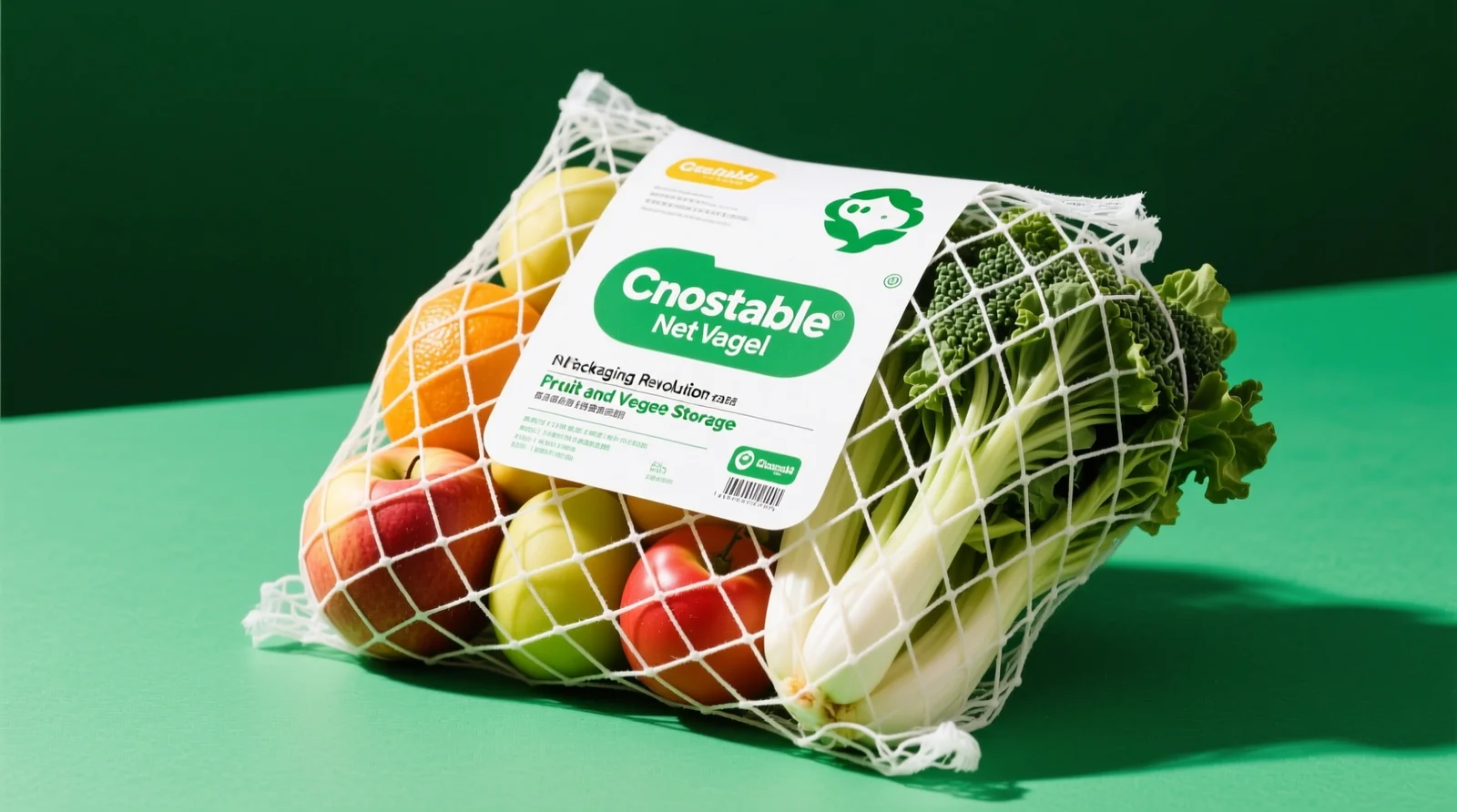
Introduction: Compostable Net Packaging for Fruit and Vegetables in an Evolving Market
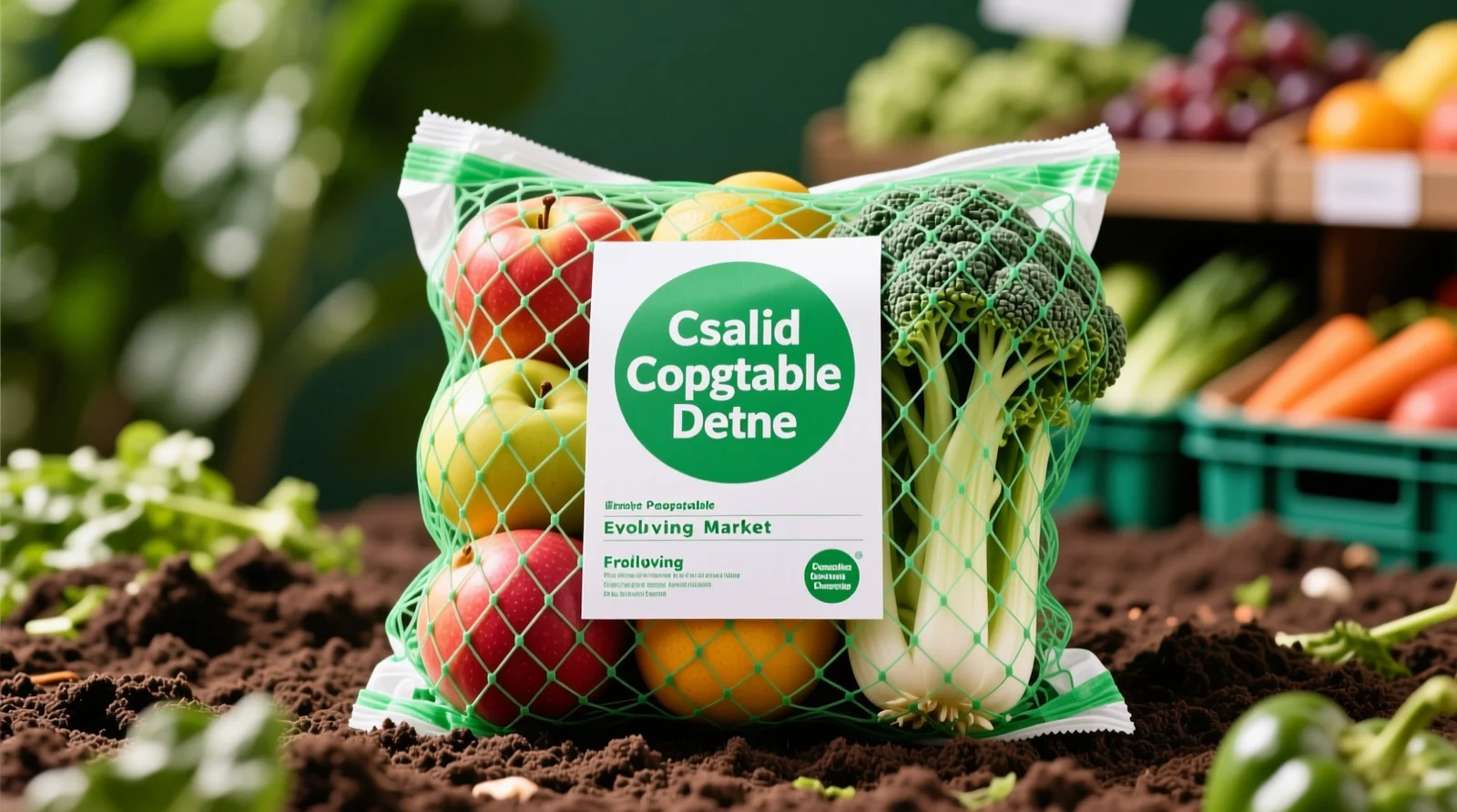
At Fruit Logistica 2026 in Berlin, Poly-clip System plans to showcase its net-pak® concept together with the Somi net clipping machine. The setup is positioned as compostable net packaging for fruit and vegetables (as well as pulses and other produce) and as a route toward sustainable produce packaging that can still run at industrial speeds on industrial net clipping machines.
More broadly, compostable packaging is gaining attention across fresh produce because retailers and brand owners face tighter expectations around packaging waste, material reduction, and end-of-life clarity. At the same time, the sector is learning that “compostable” is not automatically “circular”: outcomes depend heavily on access to suitable collection and industrial composting infrastructure, plus correct consumer disposal behavior.
TL;DR: net-pak® targets sustainable produce packaging using industrially compostable components, but real-world benefits depend on local composting infrastructure and correct disposal.
Industry Context: Why Compostable Packaging Is Being Reassessed
Fresh produce packaging is being reshaped by three parallel trends: (1) policy pressure to reduce packaging waste and improve recyclability/compostability outcomes; (2) retailer requirements for simpler materials and clearer labeling; and (3) operational realities—high throughput, seasonal peaks, and labor constraints in packing houses. Compostable solutions are often evaluated not only on “end-of-life” claims, but also on machinability, shelf-life performance, and total system cost.
In the EU, policy direction is strongly influencing packaging choices. For a practical overview of the EU packaging landscape and upcoming requirements, see the European Commission packaging waste page: https://environment.ec.europa.eu/topics/waste-and-recycling/packaging-waste_en.
TL;DR: Compostable packaging is driven by regulation, retailer demands, and pack-house realities—not just material innovation.
What net-pak® Includes (and What “Bio-based” Means)
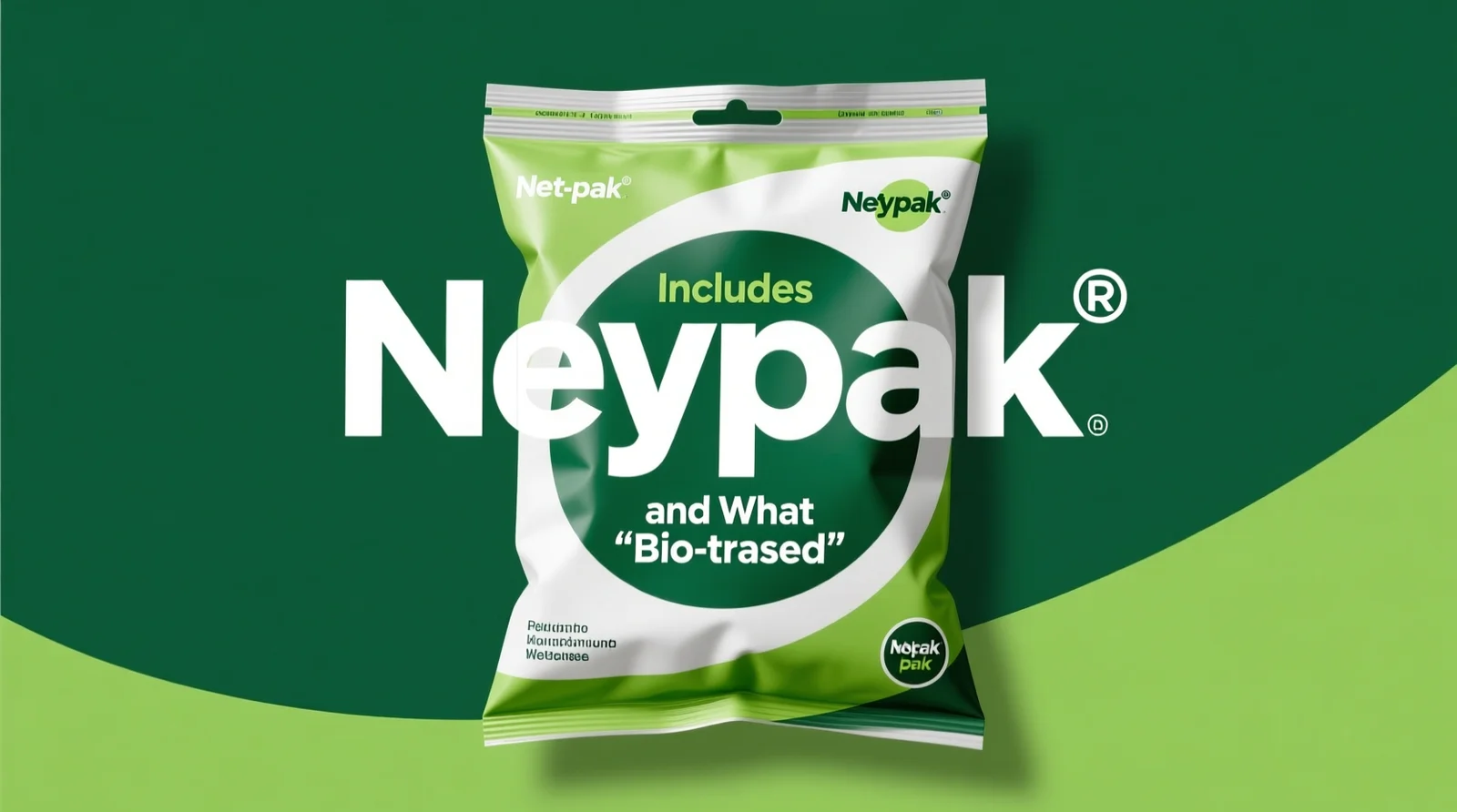
Poly-clip System describes net-pak® as a coordinated system of bio-based nets, bio-clips, and bio-labels, designed to run together on a compatible clipping machine. “Bio-based” means the material is derived partly or wholly from renewable biological resources (for example, plant-based feedstocks) rather than fossil sources. Importantly, bio-based does not automatically mean compostable, and compostable does not automatically mean bio-based. Compostability depends on the polymer chemistry and whether the item meets recognized compostability standards.
If you need a measurable definition of “bio-based content,” this is typically verified via standards such as ASTM D6866 (radiocarbon analysis used to estimate biobased carbon content). Reference: ASTM D6866. Poly-clip System has not specified a percentage bio-based content in the provided text; in procurement, packers often request a declared bio-based % and the applicable test method (e.g., ASTM D6866).
TL;DR: net-pak® combines net + clip + label; “bio-based” refers to renewable content (often verified via ASTM D6866) and is not the same as compostable.
Industrial Compostability Standards and What Logos/Certificates to Look For
Industrially compostable means the packaging is designed to biodegrade under controlled conditions typically found in industrial composting plants (managed temperature, humidity, oxygen, and residence time). Two widely referenced standards are:
- EN 13432 (EU): requirements for packaging recoverable through composting and biodegradation.
- ASTM D6400 (US): specification for compostable plastics designed to be aerobically composted in municipal or industrial facilities.
End users should look for third-party certification marks rather than relying on “compostable” text alone. Common certifiers and labels include:
- TÜV AUSTRIA “OK compost INDUSTRIAL” mark (industrial composting) — https://www.tuv-at.be/en/green-marks/ok-compost/
- DIN CERTCO (often used for EN 13432-based certifications in Europe) — https://www.dincertco.de/din-certco/en/main-navigation/certification/products/packaging/
- BPI (Biodegradable Products Institute, common in North America; aligned with ASTM D6400/D6868) — https://bpiworld.org/
Poly-clip System states that net-pak® components are “controlled and certified,” but buyers typically request the certificate number, scope (net/clip/label), and the exact standard (e.g., EN 13432) to confirm compliance for each SKU.
TL;DR: Verify “industrially compostable” via EN 13432/ASTM D6400 and recognized marks (e.g., OK compost INDUSTRIAL, DIN CERTCO, BPI) plus certificate numbers.
Balanced Comparison: Industrially Compostable Nets vs Recyclable Plastic Nets vs Paper-Based Options
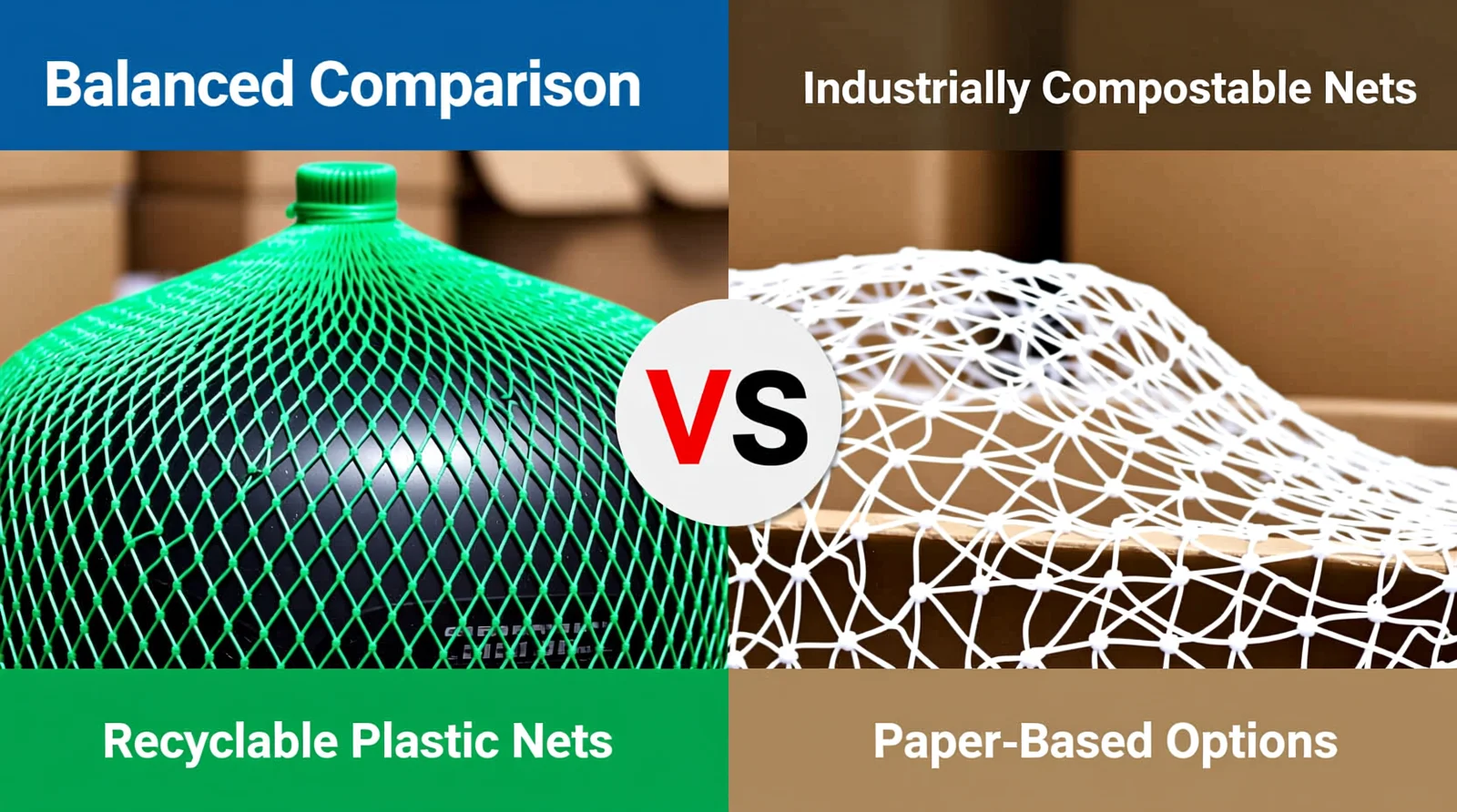
Packers choosing sustainable produce packaging usually compare three main routes:
- Industrially compostable net + clip + label (like net-pak®): Potentially strong end-of-life story where industrial composting exists; can reduce conventional plastic use. Limitation: if local collection/composting is unavailable, items may be treated as residual waste; contamination concerns can also restrict acceptance.
- Recyclable plastic nets (often polyethylene, PE): Can work well in existing packing lines, typically robust and moisture-resistant. Limitation: recycling depends on collection and sorting; small-format flexible packaging can be challenging in some systems, and “recyclable” does not guarantee it is recycled.
- Paper-based solutions (paper bags, paper bands, paper flow-wrap alternatives): Perceived as “plastic-free” and often widely collected with paper streams when designed correctly. Limitations: performance in wet/cold chains; risk of higher material weight; barrier needs may require coatings that complicate recycling.
In practice, the “best” option is site- and market-specific: what works for onions in one country may not work for citrus in another if composting or recycling routes differ.
TL;DR: Compostable nets can be attractive where composting exists; recyclable plastics depend on collection/sorting; paper can simplify messaging but may trade off performance and weight.
Material Performance and Process Reliability (What Matters on a Packing Line)
Poly-clip System positions net-pak® nets for stable machine processing with high tear resistance and secure closures. For packers, key performance questions typically include: net elasticity and knotting/tear behavior; clip closure integrity under vibration; label adhesion/print durability; and consistency across batches to avoid stoppages and weight non-conformance.
Operationally, produce packers often evaluate reliability using measurable indicators such as unplanned stoppage minutes per shift, clip/head jam frequency, pack rejection rate at checkweigher (an automated scale that verifies pack weight), and overall equipment effectiveness (OEE: a standard metric combining availability, performance, and quality).
TL;DR: Beyond “compostable,” packers need consistent net/clip performance to protect OEE, reduce rejects, and avoid stoppages.
Somi Net Clipper and the DC N3 600 Clip Head (with Maintenance Considerations)

The net-pak® concept is intended to run with the Somi net clipping machine, developed in cooperation with Spanish machinery manufacturer Damarc Agrobotic, and fitted with the DC N3 600 clip head. In the provided specifications, Somi targets packs in the 250–800 g range with output of up to 25 bags/min (capacity will vary with product, bag length, dosing stability, and operator workflow).
For food-contact environments, maintenance and hygiene tend to be as important as peak speed. While exact service intervals depend on operating hours and sanitation regime, packers typically plan preventive tasks around:
- Daily/shift cleaning: dry clean-down and/or approved wet cleaning where applicable; remove product debris and dust that can affect sensors and moving parts.
- Wear parts inventory: clip head wear components (e.g., cutting elements, forming parts), feed guides, springs, and seals (exact parts depend on clip head design). Keeping a critical spares kit reduces downtime risk.
- Planned inspection cadence: check alignment, fasteners, lubrication points (if present), and clip feed path to reduce misfeeds and jams.
Poly-clip System notes this as the first industrial application of the DC N3 600 clip head in an industrially compostable net system; buyers typically request recommended maintenance intervals (hours/cycles) and a standard spare parts list during FAT/SAT (Factory Acceptance Test/Site Acceptance Test).
TL;DR: Somi + DC N3 600 is positioned for retail pack sizes; practical performance hinges on cleaning routines, planned inspections, and readily available clip-head wear spares.
Integration into Existing Packing Lines (Interfaces, Layouts, and Equipment Compatibility)
Produce netting equipment is usually installed as a module within a line rather than in isolation. A typical configuration may include: infeed conveyor, dosing/portioning (manual or automatic), netting/clipping module, label application (if integrated), checkweigher, metal detector/X-ray (optional), and case packing/palletizing.
For integration planning, packers commonly confirm:
- Mechanical interfaces: infeed/outfeed conveyor heights, footprint, guarding, and access for tube changes and cleaning.
- Electrical & controls: power requirements; control cabinet location; communications with upstream/downstream equipment. Industrial lines often use common fieldbuses (e.g., Profinet/EtherNet/IP) and 24V I/O for basic interlocks (exact interface depends on site standards).
- Weighing/sorting compatibility: stable dosing upstream is critical to meet retailer weight compliance; downstream checkweighers need consistent pack presentation and spacing.
- Traceability: date/lot coding, label data, and potential connection to MES/ERP (Manufacturing Execution System/Enterprise Resource Planning) if required by customers.
Poly-clip System indicates the machine’s compact design helps with constrained floor space; in practice, the deciding factor is often not just footprint but service access (clip head, net path, sensors) and safe operator ergonomics.
TL;DR: Integration is about conveyors, controls, and downstream checkweigher/label/traceability needs—not just fitting the machine into the available footprint.
Operational Benefits and Downtime Reduction: Automatic Net Tube Change
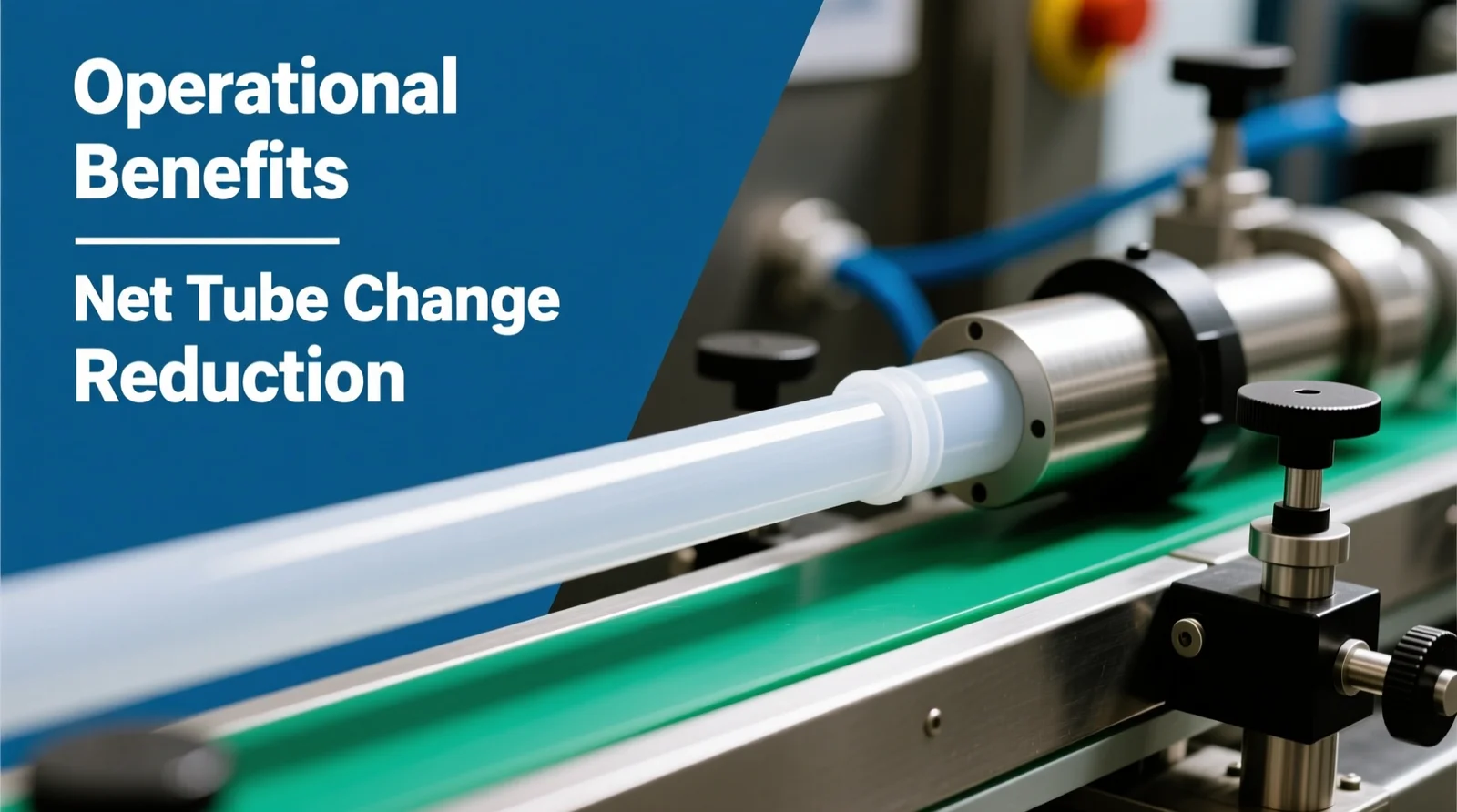
The Somi net clipper includes an automatic net tube change feature intended to reduce manual intervention and line stops associated with changing net tubes/spools. In high-volume produce operations, tube change events can become a significant contributor to micro-stops—especially when staffing is lean or when frequent SKU changes occur.
When evaluating downtime improvement, packers typically compare: changeover time per tube, number of tubes used per shift, and the effect on line balance (i.e., whether upstream dosing or downstream checkweighing becomes the limiting factor once tube changes are automated).
TL;DR: Automatic tube change can reduce micro-stops, but real gains depend on shift utilization, SKU mix, and whether other line stations become the new bottleneck.
Key Technical Specifications (Quick Reference)
- Target pack weight: 250–800 g (as stated for Somi)
- Throughput: up to 25 bags/min (application dependent)
- Closure system: DC N3 600 clip head; compatible with standard clip sizes (per Poly-clip System)
- Net concept: net-pak® coordinated system (net + clip + label) positioned as industrially compostable
- Automation feature: automatic net tube change
- Typical line add-ons (site dependent): dosing, conveyors, checkweigher, label printing/apply, metal detection
TL;DR: Somi is positioned for 250–800 g retail packs at up to 25 bags/min, with DC N3 600 clipping and automatic tube change.
CO2 and Material-Reduction Claims: How to Interpret “Up to 25%” Responsibly
Poly-clip System states that net packaging can use a small proportion of material (quoted at around 0.5% of total pack weight) and that clip-based netting can reduce CO2 emissions by up to 25% compared with common plastic film or tray solutions, depending on application and local energy mix.
To evaluate this type of claim, sustainability teams typically ask for: (1) the baseline (e.g., tray + lidding film vs film bag vs net); (2) the system boundary (cradle-to-gate vs cradle-to-grave); (3) assumptions such as electricity grid mix, transport distances, and waste treatment; and (4) whether the result comes from an internal life cycle assessment (LCA) model or a third-party reviewed study. For background on LCA methodology commonly used in packaging, see ISO’s overview of the ISO 14040 family: https://www.iso.org/standard/37456.html.
TL;DR: “Up to 25% CO2 reduction” is plausible but highly scenario-dependent; request baseline, LCA boundaries, energy mix assumptions, and whether a third party verified the study.
Industrial Compostability in Practice: Limitations and Disposal Guidance
Industrial compostability only delivers its intended end-of-life outcome when there is a dedicated collection route and an industrial composting facility that accepts certified compostable packaging. In regions without such infrastructure, compostable items may be sent to incineration or landfill, which reduces (or can negate) the intended circularity benefit.
From a practical disposal standpoint, the advantage of a “full pack” concept is that net, clip, and label follow the same route (where accepted). However, packers and brand owners should confirm:
- whether local composters accept compostable packaging alongside food/organic waste,
- whether the pack should be disposed of with bio-waste/organic waste or another stream, and
- what on-pack markings are required (e.g., OK compost INDUSTRIAL mark, certificate ID, disposal instructions).
Clear labeling helps consumers and waste operators, but acceptance rules are local—so disposal instructions should be aligned with the target market’s collection system.
TL;DR: Industrial compostability works only where collection and composting acceptance exist; disposal guidance and recognized compostability marks are critical for real-world outcomes.
Compliance with EU Packaging Regulations (What Packers Should Watch)
EU packaging compliance is evolving toward stricter requirements on recyclability, waste prevention, and environmental claims substantiation. For packers selling into the EU, this means sustainable produce packaging choices increasingly need documented evidence (certificates, test reports, and claim substantiation) and packaging formats that align with local collection realities.
For an official starting point on EU packaging waste policy direction and updates, reference the European Commission resource: https://environment.ec.europa.eu/topics/waste-and-recycling/packaging-waste_en.
TL;DR: In the EU, compliance is moving toward stricter documentation and real-world end-of-life performance—plan for certificates, claim substantiation, and market-specific disposal rules.
Use Case Scenario: Citrus Packing Operation (Example Workflow and KPIs)
Scenario: A citrus packer producing mixed SKUs (e.g., 500 g and 750 g) wants to shift from a plastic film bag to a net format while maintaining throughput during peak season.
- Implementation changes: add/position the Somi net clipping module after portioning; confirm conveyor height and pack spacing into the checkweigher; align label information with retailer requirements; train operators on tube-change workflow and sanitation checks.
- Operational KPI targets (typical evaluation metrics): maintain output near the rated capacity (e.g., up to 25 bags/min where feasible), reduce micro-stops linked to tube changes, and stabilize reject rates at the checkweigher via consistent dosing.
- Material KPI targets: reduce packaging mass versus heavier formats (often a driver for netting); verify whether compostability certification can be claimed on-pack in the destination market.
Actual results depend on fruit size variability, dosing method, and downstream controls; many packers run a short pilot to quantify stoppage minutes, reject rates, and operator workload before scaling.
TL;DR: In citrus, implementation is mainly about line placement, dosing/checkweigher stability, labeling, and operator routines—pilot runs help confirm throughput and reject-rate impacts.
Is net-pak® Suitable for Your Operation? A Practical Evaluation Checklist
- Throughput needs: If you require higher speeds than ~25 bags/min per lane, consider multi-lane configurations or alternative machines; if you run lower volumes, focus on changeover time and labor efficiency.
- Product mix: Best fit is often consistent-size produce and standard retail weights (e.g., 250–800 g stated range). Highly variable items may increase weight rejects unless dosing is upgraded.
- Existing equipment: Check compatibility with your portioning system, conveyors, and checkweigher. Confirm controls interfacing and safety guarding requirements.
- End-of-life infrastructure: Verify whether your target markets have industrial composting acceptance for certified compostable packaging and whether “organic waste” collection is available.
- Customer requirements: Retailers may require specific certification marks (OK compost INDUSTRIAL, DIN CERTCO, BPI) and documented certificate numbers.
TL;DR: Evaluate net-pak® against throughput, product variability, line compatibility, and—most importantly—whether your markets can actually collect and compost certified materials.
Total Cost of Ownership (TCO): What to Consider Beyond Unit Material Price
Total cost of ownership (TCO) for net systems typically includes material costs (net + clip + label), machine depreciation/financing, labor, downtime, maintenance spares, and waste/rejects. Even when compostable materials carry a premium versus conventional plastics in some markets, packers may justify investment through:
- Labor efficiency: automation (such as tube change) can reduce operator intervention and stabilize shifts.
- Downtime reduction: fewer stoppages can improve OEE and reduce overtime during peak demand.
- Retail/customer value: meeting packaging specs or sustainability requirements that protect shelf access.
Payback periods vary widely by volume and labor cost structure; high-utilization lines often see faster payback than seasonal/low-utilization installations. For decision-making, many sites model “best / expected / worst” scenarios using their actual stoppage logs and labor rates.
TL;DR: TCO isn’t just material price—automation, downtime, maintenance spares, and retailer requirements often determine whether the investment pays back.
Fruit Logistica 2026: Where the System Will Be Shown
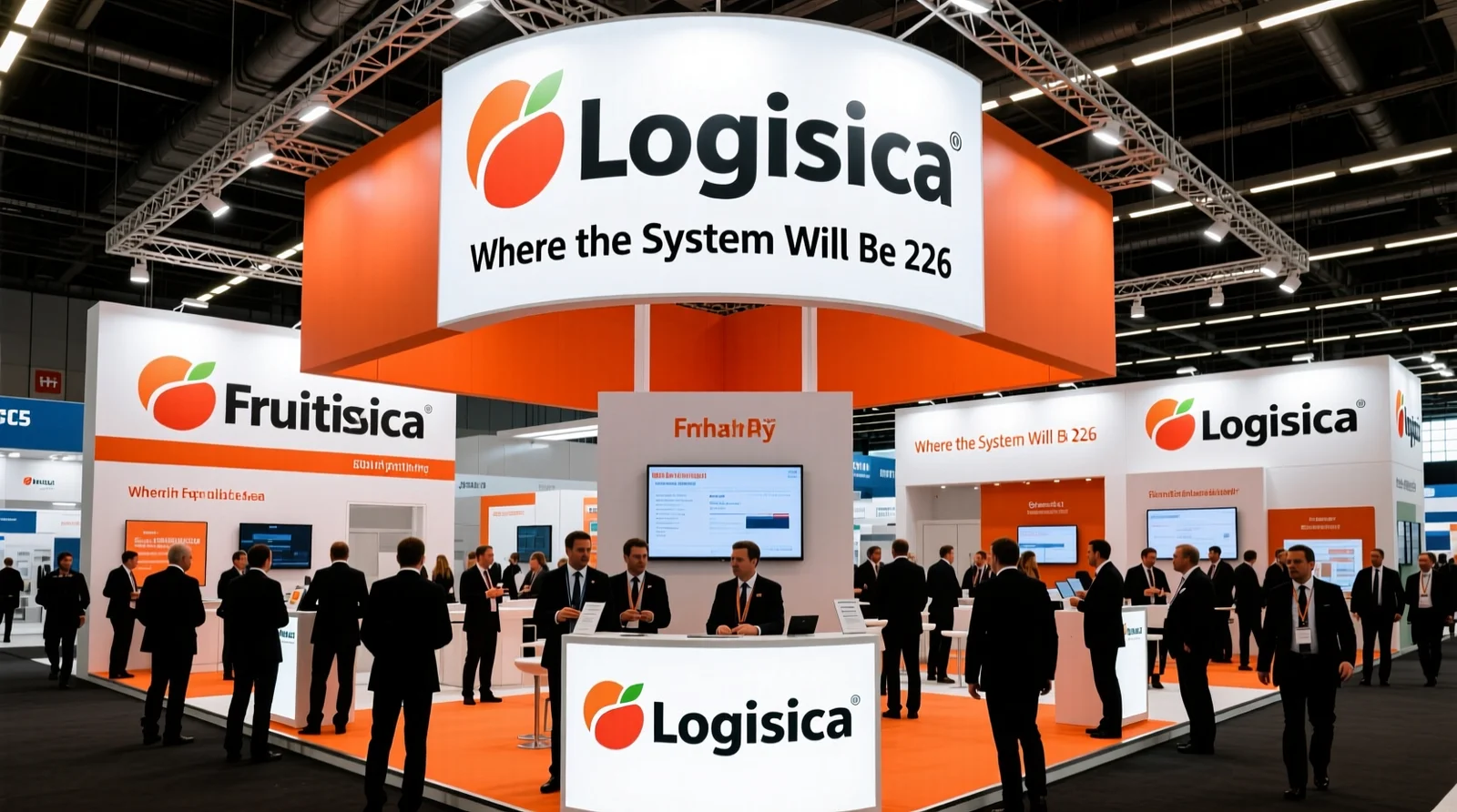
Poly-clip System will present net-pak® and the Somi net clipper at Fruit Logistica 2026 in Berlin, including demonstrations and application discussions for produce such as citrus, onions, potatoes, and garlic.
Exhibition details:
Fruit Logistica 2026
Hall 2.1, Stand D-20
Berlin, Germany
TL;DR: net-pak® and the Somi clipper will be demonstrated live at Fruit Logistica 2026 (Hall 2.1, Stand D-20).
Contact and Further Information
Contact:
Linda Halter
Poly-clip System GmbH & Co. KG
Tel: +49 6190 8886 277
Email: [email protected]
Website: https://www.polyclip.com/
TL;DR: For specifications, certificates, and integration guidance, contact Poly-clip System directly via polyclip.com.
Conclusion

net-pak® combines an industrially compostable packaging concept (net, clip, label) with an industrial net clipping machine configuration (Somi with DC N3 600) aimed at common retail produce pack sizes. Its value proposition is strongest where packers can verify recognized compostability certifications (e.g., EN 13432/ASTM D6400 via trusted marks) and where end-of-life routes exist to actually compost the packaging.
For packers, the decision typically comes down to a balanced assessment of: line integration effort, downtime and maintenance planning, certification/documentation readiness, local composting acceptance, and TCO under real operating conditions.
TL;DR: net-pak® can fit high-throughput produce packing—if certification, line integration, and local industrial composting infrastructure align with your markets and KPIs.
FAQ
Q: What certifications should I ask for when sourcing compostable net packaging for fruit and vegetables?
A: Ask for the exact standard (commonly EN 13432 in Europe or ASTM D6400 in North America), the certificate number, and the certifier/mark (e.g., TÜV AUSTRIA OK compost INDUSTRIAL, DIN CERTCO, or BPI). Also confirm the certificate scope covers the net, clip, and label—not just one component.
Q: Does “bio-based” netting automatically mean it will compost in industrial composting?
A: No. “Bio-based” refers to renewable feedstock content and can be measured (often via ASTM D6866), but compostability depends on meeting compostability standards (e.g., EN 13432/ASTM D6400). A material can be bio-based without being compostable, and vice versa.
Q: How do I integrate an industrial net clipping machine into an existing produce packing line?
A: Confirm mechanical fit (conveyor heights, footprint, guarding), controls interfaces (I/O or network communications), and downstream equipment compatibility (checkweigher spacing/presentation, label printing/apply, traceability). Plan for sanitation access and a critical spares kit for the clip head to reduce downtime.
Q: What happens to industrially compostable net packaging in regions without industrial composting infrastructure?
A: If there is no accepted collection route to an industrial composter, the packaging is typically treated as residual waste (incineration/landfill depending on the region). That’s why it’s important to match compostable packaging rollouts to markets with verified acceptance and to provide clear disposal labeling.
Q: How can I assess whether net-pak® is cost-effective compared with recyclable plastic nets or paper packaging?
A: Compare total cost of ownership: packaging material cost (net/clip/label), labor, downtime (tube changes, jams), maintenance and spare parts, reject rates, and any retailer compliance value. High-utilization lines and labor-constrained operations often benefit more from automation features than low-volume seasonal lines.