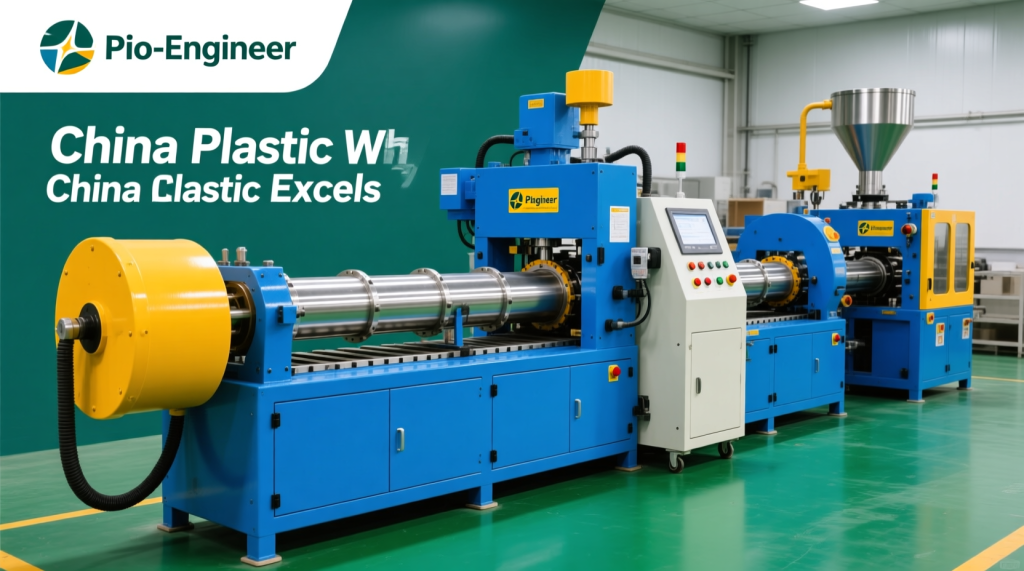
The global beverage and liquid packaging sector is moving toward automation and “smart factory” production. If you’re evaluating a China intelligent plastic blowing machine manufacturer, your short list will likely include suppliers of automatic bottle blowing machines and companies that can deliver a turnkey PET bottling line (blowing + filling + labeling + packing). This guide focuses on practical selection criteria, typical configurations, and proof-oriented benchmarks—using Pio-Engineer as one example among several sourcing paths.
TL;DR: Treat supplier selection as a systems-engineering decision (quality + utilities + service + line integration), not just a machine price comparison.
The Evolution of Plastic Blowing Machines in Modern Industry

Today’s bottle production is driven by higher efficiency, lower material usage, and consistent quality across climates and utilities. A modern bottle blowing system is commonly used for:
- Packaged drinking water and mineral water
- Carbonated soft drinks (CSD, carbonated soft drinks) and energy drinks
- Edible oils and condiments
- Dairy beverages (process-dependent)
- Household chemicals and detergents
In more regulated markets (North America, Europe, Australia), buyers often prioritize:
- High-speed, continuous production with stable scrap rates
- Food-contact design considerations and hygiene engineering
- Machine safety design aligned with EU requirements (e.g., Machinery Directive) and electrical safety norms
In fast-growing or infrastructure-variable markets (parts of Africa, Southeast Asia, Latin America), buyers often emphasize:
- Ruggedness and tolerance to power fluctuation and ambient heat
- Simplified maintenance, accessible spares, and operator-friendly controls
- Utilities design that matches local compressor/chiller capabilities
Many buyers target material reduction through lightweighting. Saving 0.5–1.0 g of PET (polyethylene terephthalate) per bottle can be meaningful at scale. Simple example: at 20,000 bottles per hour (bph), running 16 hours/day and 300 days/year, output is about 96 million bottles/year. A 0.5 g reduction saves ~48,000 kg (48 tons) of PET/year; a 1.0 g reduction saves ~96 tons/year (before considering yield and scrap).
For background on PET packaging and recyclability context, see the American Chemistry Council’s overview of plastics and packaging: https://www.americanchemistry.com/chemistry-in-america/news-trends/plastics.
TL;DR: Modern bottle blowing is a scale game—small gram and kWh improvements become large annual savings, but only if the line is stable and matched to local utilities.
Blow Molding Technologies Explained (So You Can Compare Suppliers Fairly)
“Plastic blowing machine” can refer to different processes. Clarifying the process helps you compare like-for-like proposals:
- SBM (stretch blow molding): The dominant method for PET beverage bottles (water, CSD, juice) using PET preforms that are reheated and stretched before blowing. SBM is typically chosen for high-output beverage packaging.
- IBM (injection blow molding): Often used for smaller containers that demand high neck precision and cosmetics/pharma-style consistency (application-dependent). IBM integrates injection and blow steps and is frequently used for smaller bottle formats and specialty packaging.
Most beverage PET bottles (e.g., 200 mL to 2 L, and often up to 5 L depending on design) are produced via SBM. IBM is more common in certain small container applications where dimensional precision is prioritized over the lowest per-bottle cost at very high beverage volumes.
For a standards reference point on blow molding terminology and plastics processing, you can consult ASTM’s standards catalog (standards are paywalled, but the catalog is authoritative): https://www.astm.org/.
TL;DR: PET beverage lines usually mean SBM; IBM is typically for smaller/specialty bottles—confirm the process before comparing speed, energy, and bottle specs.
Why Technical Integration Often Matters More Than Factory Size

In capital equipment, “bigger manufacturer” does not automatically mean “best fit.” Your main sourcing options typically include:
- European/Japanese premium brands: Often strong on long-term reliability, documentation, and global service networks—typically higher CAPEX (capital expenditure) and sometimes longer lead times.
- Large Chinese groups: Often competitive on price and standardized platforms; customization may be more limited depending on organization structure.
- Specialized Chinese integrators: Often faster on engineering changes and turnkey projects; results depend heavily on engineering maturity, quality system, and service model.
- In-house line builds / multi-vendor assembly: Potentially flexible and brand-agnostic but increases interface risk (controls, timing, responsibility split) and typically requires stronger internal engineering resources.
Pio-Engineer positions itself in the “specialized integrator” category—aiming to combine blowing equipment with filling/packing integration and project delivery. As with any integrator, the practical buyer question is: can they balance speed, quality, and after-sales support in your target region?
TL;DR: The best choice depends on your constraint—budget, lead time, service coverage, and your ability to manage multi-vendor interfaces.
Selection Checklist: Criteria You Can Apply to Any Manufacturer
Use the checklist below to compare suppliers objectively (Chinese, European/Japanese, or mixed-vendor builds). “TCO” below means Total Cost of Ownership (purchase price + utilities + maintenance + downtime + spares + labor impact).
| Selection Criterion | What to Ask / Verify | Why It Matters |
|---|---|---|
| Energy & air consumption | kWh per 1,000 bottles; high-pressure air (bar, Nm³/h); any air recovery | Compressed air and heating are major OPEX (operating expense) drivers |
| Material efficiency | Typical bottle weight targets; stability of wall thickness; scrap rate assumptions | 0.5–1 g PET savings can become tens of tons/year at scale |
| Certifications & safety design | CE (where needed), ISO 9001; safety components; documentation set | Reduces commissioning risk and improves audit readiness |
| Capacity & future expansion | bph range; cavities; mold changeover time; upgrade path | Avoids bottlenecks and costly re-platforming |
| Line integration capability | Synchronization with filler/packer; single control system; OEE tooling | Interface problems are a top cause of downtime in multi-vendor lines |
| Service model | Remote support SLA; local partners; spare parts strategy; training | Fast recovery from faults often matters more than small CAPEX differences |
| FAT/SAT discipline | FAT (Factory Acceptance Test) protocol; SAT (Site Acceptance Test) plan | Defines success criteria and protects your schedule |
TL;DR: Compare suppliers on energy/air, certifications, integration, and service—not just nameplate speed or machine price.
Pio-Engineer’s Quality and Compliance Foundation (With Clear Boundaries)

For any supplier, request evidence of a repeatable quality system and export compliance documentation. Pio-Engineer states it operates under:
- ISO 9001:2015 quality management system for design/production of beverage line equipment (scope as specified by the supplier)
- CE compliance declarations for certain line models, aligned with the EU Machinery Directive 2006/42/EC (note: CE is a self-declaration regime backed by technical documentation)
You can reference the EU’s official Machinery Directive summary here: https://eur-lex.europa.eu/legal-content/EN/TXT/?uri=CELEX:32006L0042. For ISO 9001 basics, see ISO’s official overview: https://www.iso.org/iso-9001-quality-management.html.
Important clarification: Equipment design may help customers produce in a way that supports food-contact or hygiene programs, but the equipment itself does not “grant” FDA/EU compliance for your final packaged product. Your process, materials, validation, and local regulatory pathway determine compliance.
TL;DR: Certifications and documentation reduce project risk, but your final product compliance depends on your own materials, process validation, and regulatory requirements.
Agile Customization and Delivery: Where Mid-Sized Integrators Can Win
When space is limited or bottle designs are non-standard, customization speed becomes a commercial advantage. Compared with highly standardized platforms, some specialized Chinese PET bottle blowing equipment suppliers can deliver faster layout adaptations, mold iterations, and integration changes—provided the engineering discipline is strong.
Typical customization requests that matter in real projects:
- Bottle & preform alignment: matching neck finish, preform length/weight, and target bottle performance
- Compact footprint design: fitting blowing + filling + packing into constrained buildings
- Utilities matching: configuring compressors, dryers, and chillers to match local availability and ambient conditions
TL;DR: Fast customization is valuable, but only if it comes with disciplined testing, documentation, and commissioning support.
Whole-Line Integration: From Preform to Pallet (Turnkey PET Bottling Line)

One of the most common failure modes in new plants is equipment mismatch: the blower, filler, labeler, and packer come from different suppliers and the line never stabilizes due to timing, transfer, or controls issues. A turnkey PET bottling line approach can reduce these interface risks—if the integrator truly owns performance and acceptance criteria.
Line Balancing and Synchronization
Line balancing means each module’s effective throughput (not just nameplate bph) is matched so the line doesn’t starve or block. Synchronization includes conveyor sizing, buffer logic, accumulation tables, and changeover strategy. This is critical for long-tail queries like “bottle blowing and filling line synchronization” because many downtimes come from transfer points, not the core machines.
Unified Control and Diagnostics
A unified HMI (Human–Machine Interface) and alarms strategy helps operators troubleshoot faster. Some suppliers also provide remote diagnostics (VPN-based access, alarm logs, and trend charts) to reduce time-to-recovery—particularly important where experienced technicians are scarce.
As a reference point for hygienic design thinking in food machinery, EN 1672-2 is widely cited in industry; you can view the standard’s listing here: https://standards.iteh.ai/catalog/standards/cen/ff5c3d63-6c4a-4d3d-8b3c-9b48a1c5659a/en-1672-2-2020.
TL;DR: Turnkey integration can reduce interface downtime—ask specifically how the supplier handles line balancing, controls integration, and acceptance tests.
Technical Precision Inside an Automatic Bottle Blowing Machine (Benchmarks Engineers Ask For)
A high-performance automatic bottle blowing machine is defined by heating control, mechanical repeatability, air management, and control logic. Common technical building blocks include:
- IR heating (infrared heating): multi-zone temperature control to shape the preform’s heat profile for uniform wall thickness
- Servo motion: servo-driven mold open/close and transfer for repeatable timing and reduced mechanical shock
- Closed-loop sensing: temperature/pressure/flow sensors for stability across ambient variation
- Hygienic layout: cleanable surfaces and protected bottle path (especially when integrated with filling)
Typical capacity benchmarks (indicative ranges): depending on bottle size and design, SBM machines commonly run from a few thousand bph (small, fewer cavities) up to tens of thousands bph (multi-cavity high-speed). Engineers often evaluate output as bph per cavity and total bph per machine, then confirm performance on their specific bottle during FAT.
Typical bottle volume ranges: PET beverage blowing commonly spans 200 mL–2 L for water/CSD, with additional configurations for larger containers (e.g., 3–5 L) and separate systems for 5-gallon-style large containers (often different handling and utilities considerations).
High-pressure air management (critical for OPEX): Blow molding uses high-pressure compressed air; serious proposals should specify required pressure, flow (Nm³/h), and whether the system supports air recovery (reusing exhaust air for low-pressure functions) to reduce compressor load. Buyers should also confirm the scope for air dryer (dew point requirement), filtration, and chiller capacity for stable mold/oven cooling.
TL;DR: Ask for bph (and bph/cavity), bottle volume range, compressor/dryer/chiller requirements, and whether air recovery is included—these items drive real-world stability and OPEX.
Typical Configuration Examples (Scope & Investment Level)

Exact pricing depends on specifications, brand level, and automation scope, but these examples help frame what’s typically included.
- Example A: 8,000 bph water line (mid-speed)
Typical scope: SBM blower + water rinser/filler/capper (RFC monoblock) + labeling + film wrap/carton packing + basic palletizing option. Investment level: medium (often chosen by regional water brands scaling from semi-auto). - Example B: 24,000 bph CSD line (higher speed & higher performance)
Typical scope: higher-output SBM blower + CSD-capable filling system (pressure filling / isobaric design depending on product) + warmer/cooler considerations + higher-spec air and CO2 system interface + robust accumulation and conveyor controls. Investment level: medium-to-high due to process complexity and utilities. - Example C: 5-gallon line (large container)
Typical scope: large-container blowing + washing/filling/capping + inspection + handling automation. Investment level: medium, often driven by container handling automation and sanitation requirements.
TL;DR: “Same bph” lines can have very different scopes—define product/process needs (water vs CSD vs large container) before comparing quotes.
Step-by-Step Process to Select a China Intelligent Plastic Blowing Machine Supplier
- Define requirements (URS): Create a URS (User Requirement Specification) covering product type, bottle sizes, bph, resin/preform, utilities, and target scrap rate/OEE (Overall Equipment Effectiveness).
- Review bottle design & preform compatibility: Share bottle drawings, neck finish, top-load needs, and lightweight targets; ask for feasibility feedback and risk areas.
- Shortlist 3–5 suppliers (mixed benchmarks): Include at least one alternative category (e.g., a large Chinese group, a specialized integrator like Pio-Engineer, and a premium brand or local integrator) to benchmark TCO and service models.
- Factory audit (on-site or remote): Verify machining/assembly capability, QC records, electrical standards practice, and reference installations; request a documentation sample set.
- Confirm utilities & layout engineering: Ask for compressor/dryer/chiller sizing, power load list, and line layout drawing; validate building constraints and future expansion provisions.
- Run FAT and define acceptance criteria: FAT (Factory Acceptance Test) should include output stability, bottle measurements, leak tests, energy/air data (as feasible), and changeover checks on your bottle.
- Plan SAT, training, and service agreement: SAT (Site Acceptance Test) should include ramp-up plan, operator/maintenance training, spare parts list, and remote support/response time commitments.
TL;DR: Use a structured URS → audit → FAT → SAT process; it’s the fastest way to reduce surprises and compare suppliers objectively.
Key Factors When Choosing a Manufacturer: Energy, Stability, Service, and TCO

Energy Consumption and Material Efficiency
Look for measured—not just claimed—reductions in heating and air usage. Simple energy example: if a line reduces average electrical load by 10 kW and runs 16 hours/day for 300 days/year, that’s ~48,000 kWh/year saved (multiply by your local electricity rate to estimate annual cost impact). For compressed air, verify compressor power and whether air recovery is included, since air is often one of the largest OPEX items in blow molding.
Stability, Maintenance, and Support Model
Service model often decides your real TCO. Clarify:
- Remote troubleshooting capability (and what data is accessible)
- Spare parts lead times and recommended critical spares list
- Preventive maintenance intervals (e.g., weekly checks, monthly lubrication, planned wear-part replacement based on hours/cycles)
Certifications and Export Readiness
Verify how the supplier supports your target region’s safety and documentation requirements (electrical schematics, CE technical file where applicable, manuals in your language). For Europe, consult the EU guidance ecosystem (Machinery Directive link above). For North America, many plants also expect controls and electrical design aligned to local practices (even if not legally mandated in every case).
TL;DR: TCO depends on energy + air + uptime; insist on measurable utilities data, a clear service model, and disciplined documentation.
Mini Case Summaries (Anonymized) to Make Results More Concrete
Case 1 (East Africa, packaged water, ~8,000 bph):
Challenge: limited floor space and power instability causing frequent stops on an older semi-automatic setup.
Approach: compact line layout, utilities matching (compressor/dryer sizing and voltage adaptation), operator training, and commissioning support.
Reported result: faster stabilization after installation, improved consistency, and reduced operator intervention versus the prior setup (performance depends on local utilities and maintenance discipline).
Case 2 (Southeast Asia, CSD, ~24,000 bph):
Challenge: bottle burst/leak risk and inconsistent wall thickness during lightweighting trials.
Approach: heating zone tuning, mold/venting review, and process window definition during FAT and ramp-up.
Reported result: improved wall thickness consistency and reduced quality holds after process tuning; lightweight targets validated within agreed acceptance criteria.
TL;DR: Ask suppliers for comparable references by product type (water vs CSD), capacity, and local conditions—those factors drive whether a solution will work in your plant.
Where Pio-Engineer Fits (Product Line Clarity and Credibility Signals)

Pio-Engineer (Suzhou Pio-Engineer Machinery Co., Ltd.) is presented as a China-based supplier covering blowing equipment and turnkey beverage lines. In its lineup, models are referenced such as:
- PIO600 / PIO2L: commonly positioned around PET bottle blowing applications (confirm exact capacity, cavities, and bottle range per model)
- PIO-IBM40: positioned for IBM (injection blow molding) applications (confirm target bottle sizes and resins)
For credibility evaluation beyond brochures, buyers should also ask about:
- Years of operation and installation base by region/product (request reference contacts where possible)
- Industry exhibitions participation (e.g., Chinaplas, Drinktec) and what products were shown (useful as a maturity signal, not proof alone). You can verify event relevance at official sites like CHINAPLAS: https://www.chinaplasonline.com/ and drinktec: https://www.drinktec.com/.
- After-sales structure: remote monitoring option, regional partners (if any), and recommended maintenance plans
TL;DR: Pio-Engineer is one potential integrator option; validate fit through references, documented acceptance tests, and a clearly defined service model.
Conclusion: Make the Supplier Earn “Long-Term Partner” Status
Choosing a Chinese PET bottle blowing equipment supplier (or any manufacturer) is a long-term decision that affects uptime, utilities cost, bottle quality, and your ability to scale. A strong buyer approach is to compare categories (premium brands, big Chinese groups, specialized integrators, or multi-vendor builds) using the same checklist: energy/air, certifications, line integration, FAT/SAT discipline, and service readiness.
If you’re considering Pio-Engineer as one candidate, treat the evaluation like an engineering project: validate bottle feasibility, utilities sizing, and acceptance criteria early—then confirm performance during FAT and ramp-up at SAT.
TL;DR: The “best” manufacturer is the one that can prove performance on your bottle, in your utilities conditions, with a service model you can actually rely on.
Contact Pio-Engineer for Technical Consultation

If you want a more accurate preliminary proposal, prepare and send:
- Your bottle drawing (or sample), neck finish, and target bottle weight
- Capacity target (bph), working hours/day, and product type (water/CSD/juice/oil/chemicals)
- Your plant layout (available area), power standard, and available utilities (air/chilled water)
Suzhou Pio-Engineer Machinery Co., Ltd.
No. 161, Lexingnan Road, Zhangjiagang City, Suzhou, Jiangsu, China
Email: plast01@pio-engineer.com
Tel/WhatsApp: +86-18915674285
Website: https://pio-machinery.com/
TL;DR: Send bottle drawings + capacity + layout for a faster, more accurate line concept and utilities recommendation.
FAQ
Q: How do I compare a China intelligent plastic blowing machine manufacturer against European or Japanese brands?
A: Compare on measurable TCO: kWh/1,000 bottles, compressed air requirements, expected scrap rate, documentation quality (FAT/SAT protocols), and service response model. Premium brands may offer stronger global service networks, while many Chinese suppliers compete on CAPEX and lead time; the best choice depends on your uptime risk and local support needs.
Q: What is a realistic way to estimate PET savings from lightweighting (0.5–1 g per bottle)?
A: Multiply annual bottle output by the gram reduction. Example: 20,000 bph × 16 hours/day × 300 days/year ≈ 96 million bottles/year. Saving 0.5 g each equals ~48,000 kg (48 tons) PET/year; saving 1.0 g equals ~96 tons/year (before scrap/yield adjustments).
Q: What utilities should I plan for when buying an automatic bottle blowing machine?
A: Plan for high-pressure compressed air (pressure and Nm³/h), an air dryer (dew point requirement), filtration, stable electrical supply, and chilled water/chiller capacity for molds and ovens. Ask whether air recovery is included, because it can reduce compressor load and operating cost.
Q: Is a turnkey PET bottling line always better than buying separate machines?
A: Not always. Turnkey integration can reduce interface problems and simplify responsibility (one party for line performance), but multi-vendor sourcing can work if you have strong in-house engineering and a clear controls/synchronization plan. The key is defining acceptance criteria and accountability for line throughput and downtime causes.
Q: Which blow molding process should I choose—stretch blow molding (SBM) or injection blow molding (IBM)?
A: For PET beverage bottles (water/CSD) at high volumes, SBM is typically the standard approach. IBM is commonly used for smaller or specialty bottles where neck precision and cosmetic consistency are priorities. Your bottle design, resin, volume range, and target output will determine the best fit.