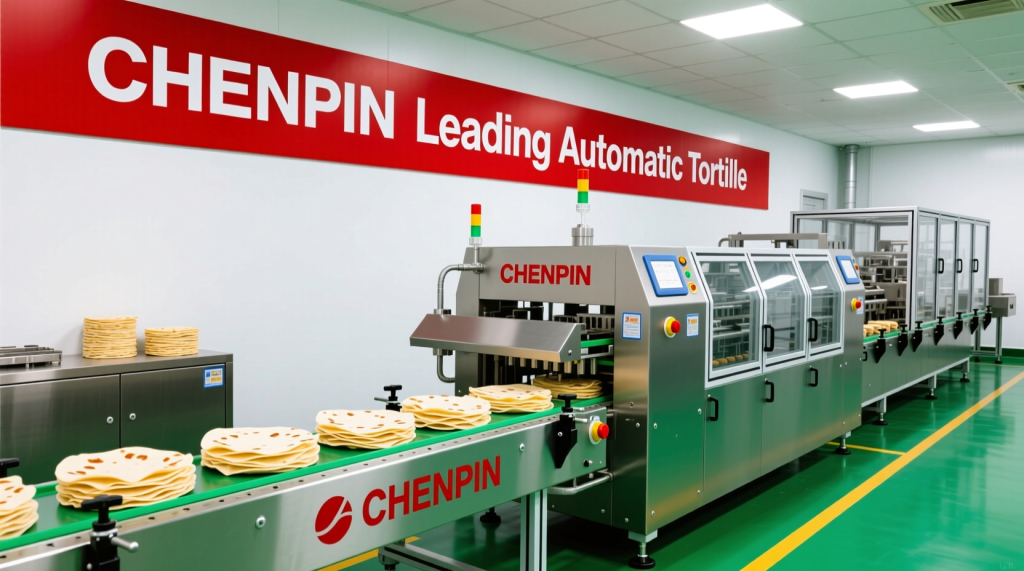
CHENPIN’s automatic tortilla production line is an industrial tortilla machine platform designed for continuous, high-volume output with repeatable thickness, bake color, and moisture control. As a piece of tortilla manufacturing equipment, it integrates dough feeding, synchronized hot pressing, multi-zone baking, and controlled cooling/stacking to reduce manual handling and stabilize quality at industrial speeds.
TL;DR: This article explains how CHENPIN’s automatic tortilla production line is built (feeding → pressing → multi-zone baking → cooling/stacking), what technical ranges to expect, how it integrates into a factory, and what KPIs producers typically improve after automation.
Global Market Trends Driving Automatic Tortilla Production
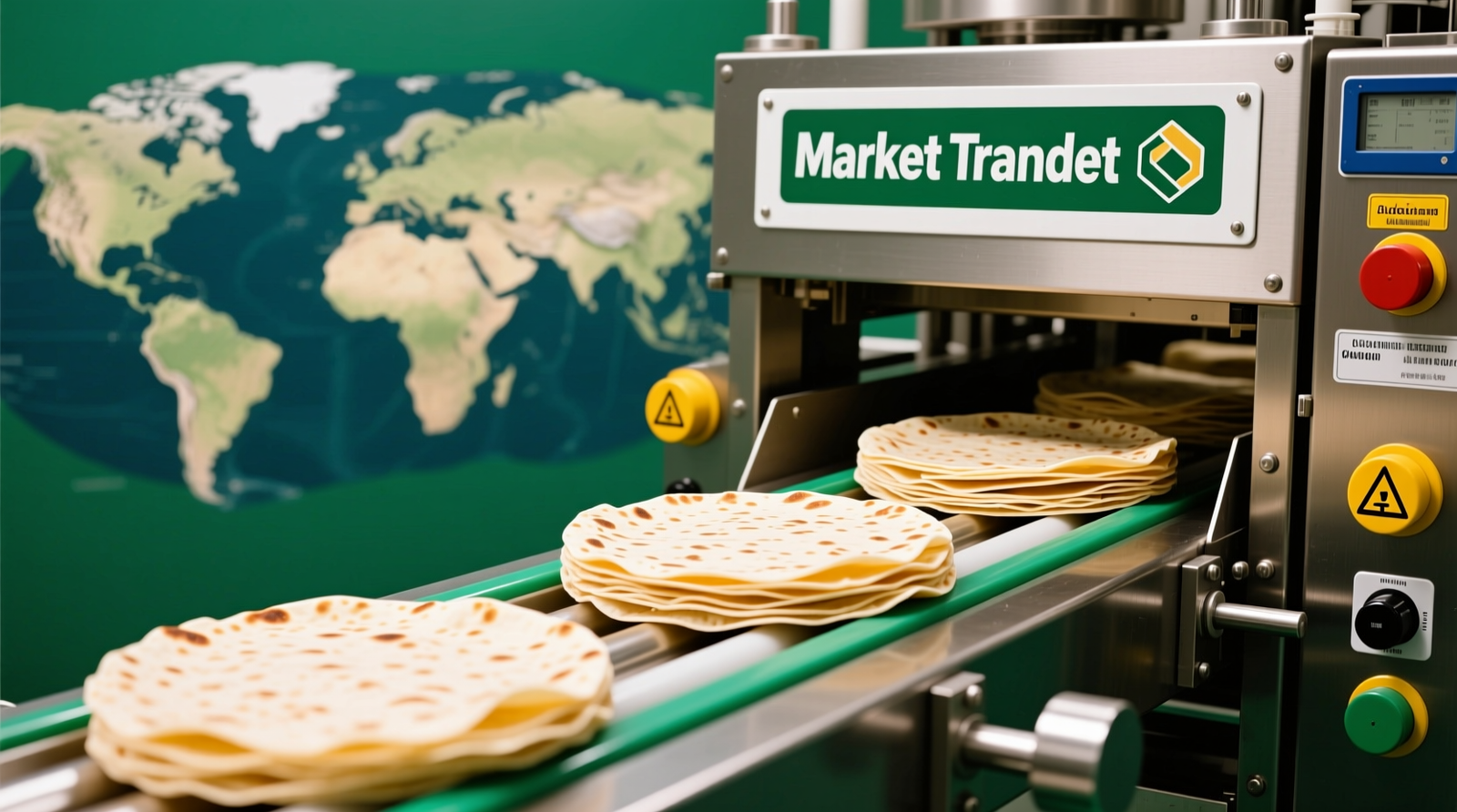
Demand for tortillas, wraps, and flatbreads continues to rise in retail, foodservice, and frozen channels. For many plants, the bottleneck is no longer recipe development—it’s running consistent product at scale while meeting tighter hygiene and traceability expectations.
- Labor: Higher wage pressure and fewer skilled operators push producers toward automation.
- Food safety: More documented controls, fewer hand-touch points, and faster allergen cleaning are required.
- Distribution: Frozen and long-distance shipments increase the need for stable moisture and flexibility (less cracking).
- Standardization: QSR (quick-service restaurant) and co-manufacturing programs demand tighter dimensional tolerances for automated filling/packing.
For context on global food safety management expectations (hazard analysis, preventive controls, documentation), see the U.S. FDA Food Safety Modernization Act (FSMA) overview.
TL;DR: Automation is increasingly driven by labor scarcity, stricter food safety requirements, and the need for consistent tortillas that survive freezing and long distribution chains.
CHENPIN: Engineering Background, Patents, and Real-World Adoption
CHENPIN FOOD MACHINE CO., LTD (established in 2010 in Shanghai; built on decades of dough-processing know-how from its founding team) develops integrated flatbread lines rather than assembling unrelated modules. Controls, mechanics, and thermal systems are engineered to work as one process.
Patents and IP: CHENPIN reports patents covering key functions such as dough forming, synchronized pressing, and modular/multi-zone thermal control. (For formal verification in your country, search the relevant public patent database—e.g., Google Patents.)
Where this is used: Typical application segments include industrial bakeries, frozen flatbread producers, and large-scale foodservice supply chains (often multi-plant operations requiring standardized operation and spare parts strategies).
TL;DR: CHENPIN positions its tortilla line as a tightly integrated system (mechanical + controls + thermal), backed by patentable features and used in industrial and frozen-flatbread production contexts.
Process Overview: How the Automatic Tortilla Production Line Works
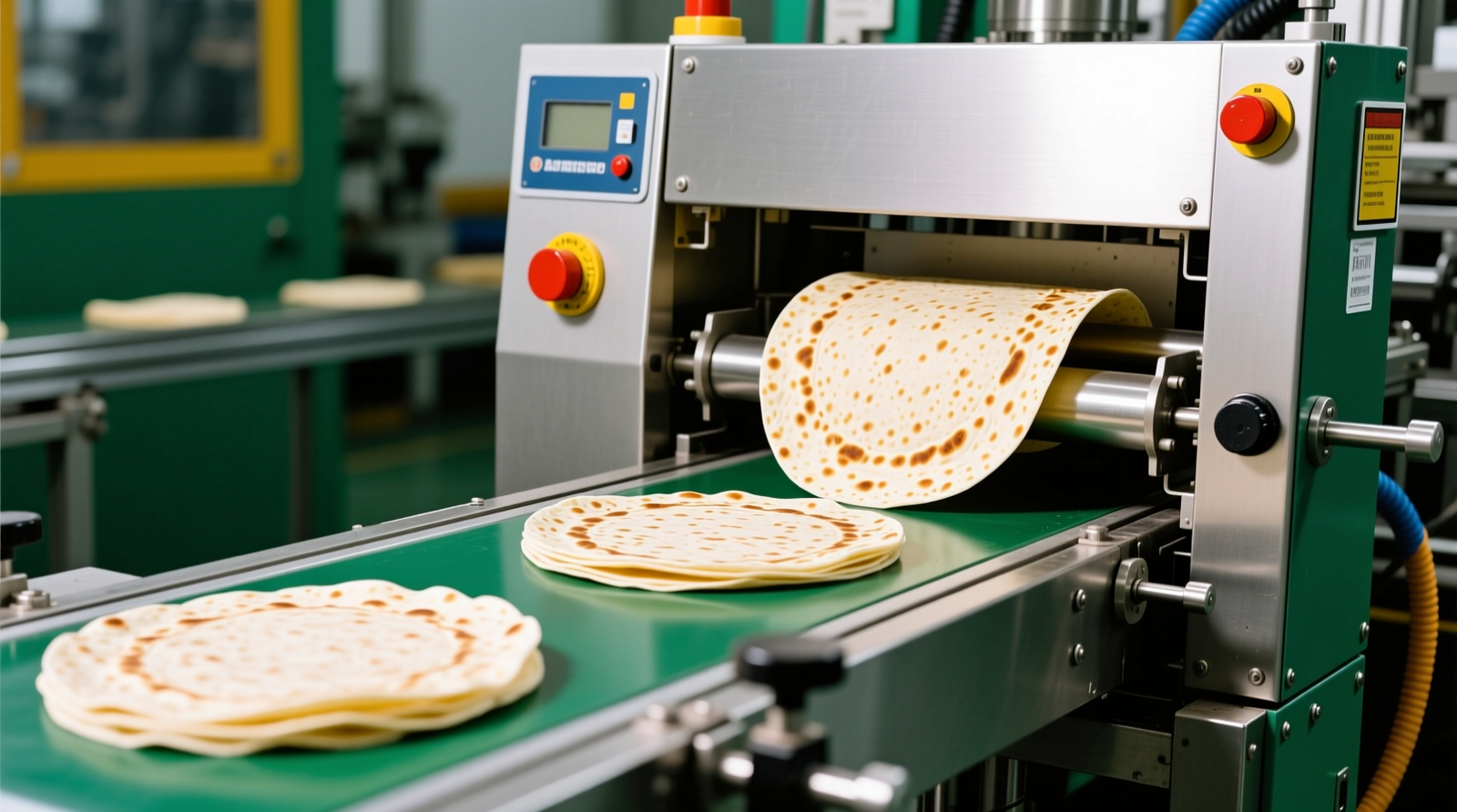
A fully automatic tortilla production line typically runs as a continuous process:
- Dough feeding & portioning: Consistent dough piece weight and spacing.
- Hot pressing: Controlled compression to target diameter and thickness.
- Multi-zone baking: Managed heat input for color, blistering, and moisture exit targets.
- Cooling & stacking: Controlled cooling to prevent condensation and deformation prior to packing or freezing.
Abbreviations defined: PLC = programmable logic controller; HMI = human-machine interface; MAP = modified atmosphere packaging; QSR = quick-service restaurant.
TL;DR: The line is built around a stable end-to-end process (feed → press → bake → cool/stack) with PLC/HMI control so quality is repeatable at high throughput.
Dough Feeding, Portion Control, and Typical Product Ranges
Portioning stability is a major driver of yield and pack quality. When dough weights drift, plants often see diameter variation, uneven bake, and downstream packaging rejects.
Typical operating ranges (application-dependent):
- Dough ball / portion weight: commonly ~20–120 g depending on diameter and thickness (e.g., smaller tacos vs. large wraps).
- Diameter range: often 6–12 inch formats, with other diameters possible by configuration.
- Line output: high-capacity configurations can exceed 14,000 pieces/hour (as referenced for certain CHENPIN configurations; exact output depends on size, thickness, and bake profile).
Servo-controlled feeding and synchronized conveyance help keep spacing uniform into the press, which reduces “operator corrections” and makes automated stacking/packing more reliable.
TL;DR: Stable weight and spacing upstream protect yield and reduce packaging rejects; common tortilla portion weights are roughly 20–120 g depending on SKU.
Synchronized Hot Pressing: Thickness, Diameter, and Changeover Practicalities
Pressing largely determines thickness uniformity (edge-to-center), roundness, and final pliability. CHENPIN describes a synchronized dual-surface pressing approach that keeps pressing plates parallel through the compression cycle, helping reduce center-thick/edge-thin defects.
What engineers usually care about:
- Thickness control: digital setpoints via HMI (rather than trial-and-error mechanical adjustment).
- Format changes: switching between SKUs (e.g., 6″, 8″, 10″, 12″) should be primarily recipe/setpoint driven, with minimal tooling disruption depending on configuration.
- Scrap drivers: off-round pieces, thickness drift, and sticking—all affected by press alignment, surface condition, and dough temperature consistency.
TL;DR: Parallel, synchronized pressing plus digital thickness setpoints is aimed at reducing thickness defects and speeding up SKU changes without extensive mechanical rework.
Multi-Zone Baking: Temperature, Dwell Time, and Moisture Targets
Oven control determines color, blistering, and the moisture profile needed for flexibility (fresh) or freeze/thaw performance (frozen). CHENPIN uses a three-tier oven concept with independent zone control per tier.
Typical industrial tortilla baking guidance (varies by recipe and oven design):
- Baking temperature range: commonly 180–260°C (356–500°F), tuned by zone.
- Dwell time: often 20–60 seconds total residence time, depending on thickness and target color.
- Exit moisture target (rule-of-thumb): many producers aim for a controlled moisture window to prevent cracking (too dry) or condensation/mold risk (too wet). A typical target may land in the 28–35% range for soft tortillas, but should be validated by shelf-life and packaging method.
For an external reference on hygienic and validated processing expectations in food plants, the EHEDG (European Hygienic Engineering & Design Group) provides widely used hygienic design guidance (helpful when evaluating oven access, cleanability, and zoning).
TL;DR: Multi-zone baking lets plants tune temperature and dwell time (often 180–260°C, 20–60 s) to hit consistent color and a moisture window that supports flexibility and shelf-life.
Cooling, Condensation Control, and MAP/Frozen Readiness
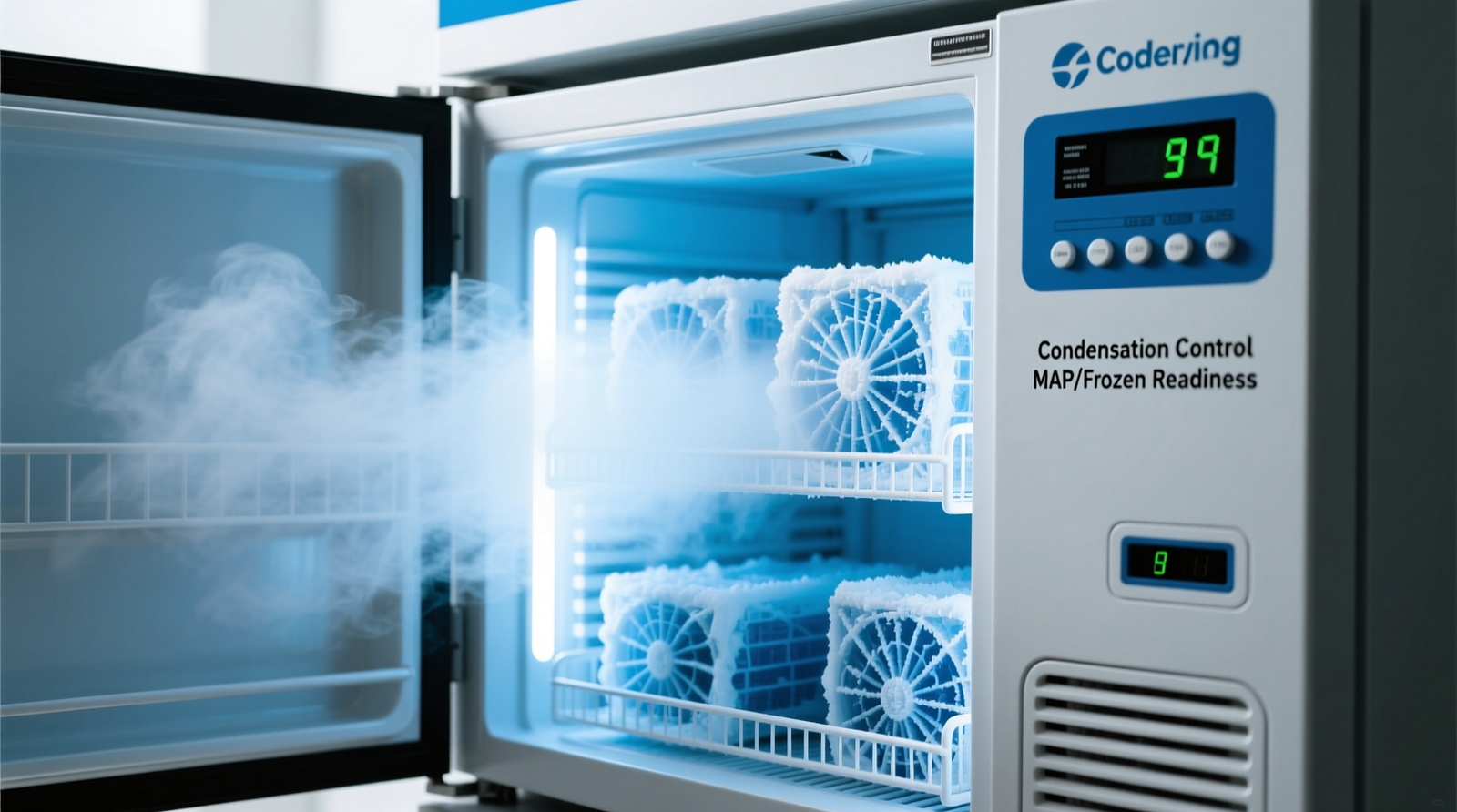
Cooling is not just “bringing temperature down”—it is about preventing condensation in packaging and stabilizing the tortilla’s moisture gradient so stacks don’t stick or deform.
Common targets and practices:
- Controlled cooling time: matched to line speed and tortilla thickness to avoid a warm core entering a cold pack area.
- Stacking consistency: uniform spacing and gentle handling reduce edge curling and compression marks.
- MAP (modified atmosphere packaging) and frozen lines: require extra attention to condensation risk; stable exit conditions reduce bag fogging and seal contamination.
TL;DR: Proper cooling reduces sticking, curling, and condensation—critical for MAP and frozen tortillas.
Technical Specifications Overview (Typical Ranges)
- Product types: tortillas, wraps, tacos, lavash, pita-style flatbreads (recipe-dependent)
- Diameter range: commonly 6–12 inch
- Portion weight range: commonly 20–120 g
- Throughput (capacity): mid- to high-capacity configurations; high-capacity setups reported at >14,000 pcs/hour
- Baking temperature: often 180–260°C, multi-zone
- Dwell time: often 20–60 s total (oven/recipe dependent)
Note: Final performance depends on dough formula (flour type, hydration, fat content, fiber level), thickness, and packaging requirements. Always validate with plant trials/FAT settings.
TL;DR: Expect 6–12″ tortillas, ~20–120 g portions, multi-zone baking around 180–260°C, and capacity scaling up to >14k pcs/hour depending on model and SKU.
Scalable Tortilla Line Architecture: Which Model Fits Which Plant Profile?
CHENPIN’s CPE model groups are positioned by throughput and footprint. Exact numbers vary by SKU, but the practical selection logic is usually tied to staffing, shift pattern, and packaging speed.
- CPE-450 / CPE-650: commonly selected by regional producers moving from semi-automatic to fully automatic production, or plants with frequent SKU changes and moderate daily volume. Typical goal: stabilize quality and reduce labor per shift without committing to the largest oven footprint.
- CPE-800 / CPE-950 / CPE-1100: aimed at multi-shift industrial operations supplying national foodservice programs or large frozen/retail distribution. Typical goal: maximize pieces/hour while keeping thickness and bake color within tight tolerances for automated downstream packaging.
TL;DR: CPE-450/650 generally suit mid-volume plants upgrading from semi-auto; CPE-800/950/1100 target continuous, multi-shift industrial output and tighter packaging tolerances.
Plant Integration: Upstream/Downstream Equipment and Communication Protocols
Automation projects succeed when the tortilla line is engineered as part of the whole factory flow, not as an island.
Common upstream integrations: mixers, vacuum mixers, ingredient dosing, dough resting systems, dough dividers/portioners.
Common downstream integrations: cooling tunnels (if extended cooling is needed), metal detectors/checkweighers, baggers, flow wrappers, MAP systems, cartoners, case packers, spiral freezers or IQF (individually quick frozen) freezing systems.
Typical industrial communications options (project-dependent): EtherNet/IP (Industrial Protocol), PROFINET (Process Field Net), and OPC UA (Open Platform Communications Unified Architecture) for data exchange to SCADA/MES. Define these early to avoid late-stage rework.
TL;DR: Plan integration from mixer to freezer/cartoner; confirm comms early (EtherNet/IP, PROFINET, OPC UA) to ensure the line exchanges data cleanly with plant SCADA/MES.
Sanitation, Hygienic Design, and Regulatory Considerations
Hygienic design is increasingly a buying criterion for tortilla manufacturing equipment—especially for plants producing for major retailers, export markets, or allergen-controlled SKUs.
What to look for (typical best practices):
- Stainless steel: product contact and washdown areas often use AISI 304 stainless steel; AISI 316 may be specified in more corrosive environments (e.g., aggressive cleaners/salt exposure).
- Hygienic details: sloped surfaces, minimized horizontal ledges, sealed or hygienic fasteners where appropriate, and accessible guarding for inspection/cleaning.
- Cleaning approach: a mix of wet cleaning and dry cleaning depending on zone; some subsystems can be designed for fast disassembly. Where CIP (clean-in-place) is used, it should be validated for coverage and drainage.
- Compliance context: for machinery, CE marking aligns with EU requirements (see the European Commission CE marking overview). For hygienic engineering guidance, EHEDG documents are a common benchmark (EHEDG).
TL;DR: Prioritize stainless steel selection (304/316), cleanable geometry, validated cleaning methods (including CIP where applicable), and documented compliance expectations (e.g., CE for machinery, EHEDG guidance for hygienic design).
Safety Features and Machinery Risk Reduction
Industrial tortilla machines combine heat, pinch points, and moving conveyors—so safety engineering must be designed in, not added later.
Typical safety package elements:
- Guarding and interlocks: access doors with safety interlock switches to stop hazardous motion when opened.
- E-stops: emergency stop circuits positioned around operator access points.
- Safe control architecture: safety PLC (programmable logic controller) or safety relays designed to appropriate performance levels/category based on risk assessment.
- Thermal safety: shielding/insulation around hot zones, temperature monitoring, and lockout/tagout (LOTO) procedures for maintenance.
For a credible baseline on machine safety concepts (risk reduction, guarding principles), see OSHA machine guarding guidance.
TL;DR: Look for interlocked guards, accessible E-stops, safety-rated control architecture, and well-defined LOTO practices—especially around presses and ovens.
Case Snapshots: Baseline vs. Post-Installation KPIs
The exact KPI gains depend on recipe discipline and plant practices, but two anonymized snapshots illustrate what producers typically track.
Snapshot 1: Mid-size plant upgrading from semi-automatic
- Before: ~6 operators/shift; frequent thickness drift; packaging rejects due to off-size pieces.
- After (fully automatic line): reduced to 3–4 operators/shift; packaging rejects reduced by ~30–50% after dialing in press setpoints and oven zoning; planned changeovers standardized through HMI recipes.
Snapshot 2: High-volume frozen tortilla program
- Before: condensation events causing seal contamination and freezer clumping; unplanned stoppages during peak weeks.
- After (process tuning + controlled cooling/stacking): condensation-related rejects reduced by ~40%; unplanned downtime reduced by ~15–25% with standardized wear-part replacement intervals and faster cleaning access.
TL;DR: Typical measurable wins are fewer operators per shift, fewer packaging rejects, and lower unplanned downtime—especially when pressing, oven zoning, and cooling are tuned as one system.
Beyond Tortillas: How Cross-Technology Transfer Improves Tortilla Lines
CHENPIN also builds lines for laminated pastries and other flatbreads. That matters because several engineering “lessons” transfer directly into tortilla production:
- Soft-dough handling: gentle conveyance and tension control (common in lamination lines) can reduce stretching/ovalization before pressing.
- Thermal profiling: multi-zone concepts used for other baked goods support better control of color development and par-bake style outcomes.
- Changeover discipline: recipe-driven setpoints and repeatable mechanical references reduce variability when plants run many SKUs.
TL;DR: Know-how from lamination and other flatbreads can translate into gentler dough handling and better temperature profiling for tortillas—helpful for soft, thin, or par-baked products.
When to Move from Semi-Automatic to Fully Automatic Tortilla Manufacturing Equipment
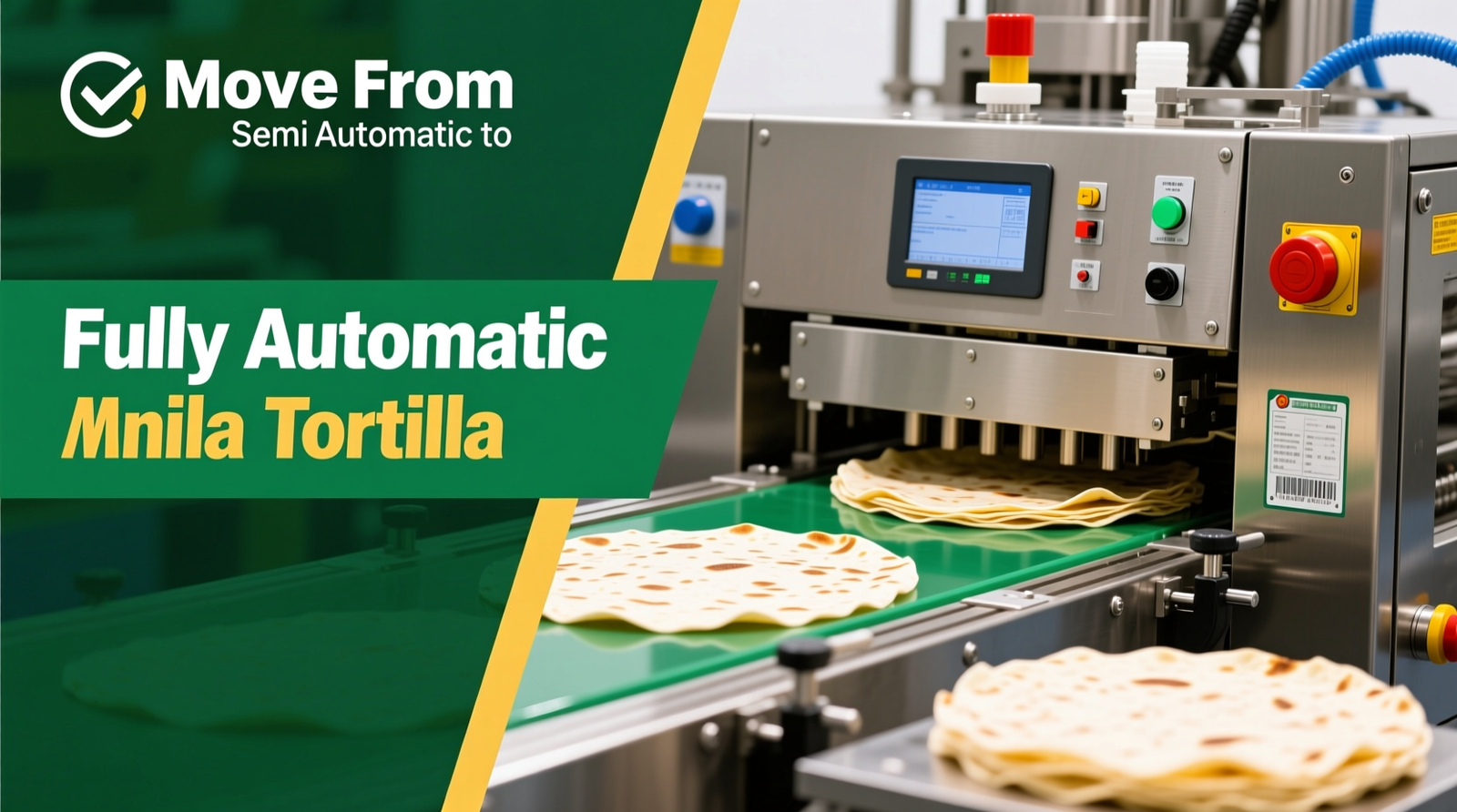
Producers typically consider a fully automatic tortilla production line when one or more of these triggers appear:
- Throughput threshold: you routinely exceed what semi-automatic pressing/handling can support without quality drift (often when daily demand pushes multi-shift operation).
- Labor cost and availability: staffing becomes a constraint (overtime, turnover, training time) and labor per 1,000 pieces is no longer competitive.
- SKU complexity: more diameters, “better-for-you” variants (high-fiber), or gluten-free runs increase the cost of inconsistency and cleaning time.
- Downstream automation: you add high-speed bagging/cartoning and need tighter tolerances to avoid constant stoppages.
TL;DR: Move to fully automatic when semi-auto can’t meet volume without quality drift, labor becomes a bottleneck, SKU complexity increases, or downstream packaging speed demands tighter tolerances.
Project Steps and Typical Timeline (Concept to Ramp-Up)
Automation investments go smoother when the project is managed as a staged engineering program:
- Concept & scope (2–6 weeks): define SKU list, target output, footprint, utilities, hygiene level, and data integration.
- Design & build (8–20+ weeks): mechanical/electrical design, procurement, fabrication, software development.
- FAT (Factory Acceptance Test): run agreed test dough/SKUs at target rates; document quality and safety checks.
- Installation & SAT (Site Acceptance Test) (1–3 weeks typical): install, connect utilities, verify safety, prove performance in plant conditions.
- Ramp-up (2–8+ weeks): operator training, maintenance routines, recipe locking, OEE (overall equipment effectiveness) stabilization.
TL;DR: Plan in phases—concept, design/build, FAT, installation/SAT, and ramp-up—so performance and hygiene targets are proven before full-volume production.
Common Production Challenges (High-Fiber, Gluten-Free, Changeovers, Cleaning) and Mitigations
- High-fiber dough: can tear or resist pressing; mitigation usually involves tighter control of hydration, rest time, and press profile.
- Gluten-free dough: often has lower elasticity and different sticking behavior; mitigation may include surface management, temperature control, and gentler handling.
- Changeover impact: frequent diameter/thickness swaps can create startup scrap; mitigation is recipe-based setpoints, standardized startup checks, and documented “golden run” parameters.
- Cleaning downtime: can dominate the schedule in allergen environments; mitigation is hygienic layout, improved access, and validated cleaning procedures.
TL;DR: Difficult doughs and frequent changeovers are manageable when handling is gentle, press/oven setpoints are repeatable, and cleaning access is designed in from the start.
Service, Commissioning, and Lifecycle Support
For industrial tortilla production, uptime and repeatability often come down to commissioning quality and preventive maintenance routines—not just nameplate capacity.
- Commissioning: parameter setup (press profile, zone temperatures, conveyor speeds), training, and baseline quality targets.
- Preventive maintenance: standardized inspection and wear-part replacement intervals to reduce unplanned stoppages.
- Data-based optimization: trending rejects, downtime causes, and energy use to tune operating windows.
TL;DR: Strong commissioning and preventive maintenance discipline are key to keeping a tortilla line stable, not just fast.
About CHENPIN FOOD MACHINE CO., LTD
CHENPIN FOOD MACHINE CO., LTD is headquartered in Shanghai, China, serving customers across Asia, Europe, and the Americas with automated dough-processing solutions for tortillas, flatbreads, pastries, and bakery products.
Company details:
CHENPIN FOOD MACHINE CO., LTD
No. 61 Lane, Dongshe Road 129, Songjiang District, Shanghai, China
Email: sales@chenpinsh.com
Tel: +86 021-57674551
TL;DR: CHENPIN supplies automated dough-processing and tortilla manufacturing equipment globally, with engineering and service support for industrial applications.
FAQ
Q: What is the difference between an automatic tortilla production line and a semi-automatic setup?
A: A semi-automatic setup typically requires more manual dough handling, transfer, and stacking, which increases variability and labor per shift. An automatic tortilla production line integrates feeding, synchronized pressing, multi-zone baking, and controlled cooling/stacking under PLC control, improving repeatability and enabling higher packaging speeds with fewer stoppages.
Q: What installation time and commissioning duration should I plan for?
A: Many projects plan 1–3 weeks for installation and site acceptance testing (SAT) once the equipment arrives, followed by 2–8+ weeks of ramp-up to lock recipes, train teams, and stabilize OEE (overall equipment effectiveness). Actual timing depends on utilities readiness, civil work, and the number of SKUs to validate.
Q: What utilities are typically required for industrial tortilla machines?
A: Utility needs vary by oven and plant standards, but commonly include electrical power (for drives, controls, and auxiliaries), fuel or heat source for the oven (often gas, depending on configuration), compressed air for pneumatics, and adequate exhaust/ventilation for oven heat and moisture. Confirm local codes and line-specific ratings during the engineering phase.
Q: How often do automatic tortilla production lines need maintenance, and what skills are required?
A: Plants typically run daily operator checks (cleaning, visual inspection), weekly inspections (belt tracking, lubrication where applicable), and scheduled wear-part replacement based on hours and product conditions. A basic maintenance team with mechanical and electrical troubleshooting skills plus PLC/HMI familiarity is usually sufficient; deeper controls support may be needed for advanced data integration.
Q: Can one tortilla manufacturing equipment line run high-fiber or gluten-free tortillas?
A: Often yes, but these doughs may require tighter control of hydration, rest time, surface management, and baking profile. Expect additional trial work to reduce sticking, tearing, and thickness drift, and plan cleaning procedures carefully to manage allergen or gluten-free segregation requirements.