
Meta overview: Caterpillar earnings show AI data centers lifting industrial equipment demand

In its latest reported quarter (Q1 2023, ended March 31, 2023), Caterpillar earnings exceeded analyst expectations on an adjusted (non-GAAP) basis and management raised its full-year revenue outlook, pointing to strong industrial equipment demand across North American construction and electricity-related projects. A key incremental driver has been AI-driven data center expansion, which is boosting orders for mission-critical backup and prime power systems within Caterpillar’s Energy & Transportation segment (as Caterpillar defines it in its financial reporting). Results also benefited from dealer inventory replenishment and pricing actions that helped offset inflation and tariff-related costs.
For primary sources, see Caterpillar’s Investor Relations materials and filings, including quarterly press releases and presentations: Caterpillar Investor Relations and SEC filings via SEC EDGAR (CAT).
TL;DR: Caterpillar’s Q1 2023 beat and raised outlook were underpinned by pricing and North America strength, with AI data centers increasingly supporting Energy & Transportation demand for power systems.
Caterpillar as an economic bellwether (and why cyclicality still matters)
Caterpillar (CAT) is often treated as a bellwether because its end markets—construction, mining, oil & gas, and power generation—tend to move early in capital expenditure (capex) cycles. Historically, Caterpillar’s results have been highly cyclical: dealer inventory swings, commodity-driven mining upturns, and construction slowdowns can amplify earnings volatility even when long-term infrastructure needs remain intact.
What looks different in the current cycle is the mix of demand signals: alongside traditional infrastructure and non-residential construction, compute-intensive cloud facilities (AI data centers) are adding a power reliability and grid-constraint dimension. This can create pockets of “must-have” spending (backup power, switchgear integration, fast-deploy generation) even when other industrial categories cool.
TL;DR: Caterpillar remains cyclical, but AI data center buildouts can add a more reliability-driven, less discretionary layer of demand in power-related products.
AI data center infrastructure drives Caterpillar Energy & Transportation growth

Caterpillar reports data center-linked power demand primarily in Energy & Transportation (E&T) (segment name per Caterpillar). Within E&T, the most directly exposed product families are generator sets (“gensets,” i.e., packaged engine + alternator power units) and integrated power solutions used for standby, peak shaving, and in some cases prime power.
Which Caterpillar product lines are most tied to AI data centers?
- Diesel standby gensets for emergency backup and fast-start reliability (commonly specified in hyperscale and colocation projects where uptime is contractual). Caterpillar markets a wide range of diesel gensets under the Cat brand (often integrated by engineering, procurement, and construction firms and power-system integrators). Product overview: Cat Electric Power.
- Natural-gas generator sets (lower criteria pollutants than diesel and often easier long-duration operation where pipeline gas is available). Gas gensets can be used for prime/continuous power or microgrid applications, depending on permitting and interconnection constraints.
- Microgrids (a “microgrid” is a localized power system that can operate connected to, or islanded from, the grid). In data centers, microgrids can combine gensets with controls, switchgear, and sometimes renewables and battery energy storage to improve resilience and manage demand charges. Caterpillar’s microgrid offering: Cat Microgrids.
Operational reality: lead times, backlogs, and what management commentary typically implies
Caterpillar does not always publish a single “data center backlog” number, but earnings commentary and segment performance can still be interpreted operationally. When large customers accelerate AI data center deployments, it tends to show up as: (1) stronger order rates for E&T power generation packages, (2) elevated quoted lead times for high-output configurations, and (3) a richer mix of engineered systems and aftermarket service contracts (maintenance, parts, remote monitoring).
In periods of strong demand, power-system integrators often report longer lead times for engine-driven gensets and associated gear (switchgear, controls, emissions aftertreatment). When you see Caterpillar emphasize improved price realization and favorable mix in E&T, that is frequently consistent with tighter capacity and higher-value system content—conditions commonly associated with data center-related purchasing cycles.
How Caterpillar’s positioning compares with peers
- Cummins is a close peer in generator sets and engines for standby power; it also has meaningful exposure to data center backup demand through its power generation business. Peer reference: Cummins Investor Relations.
- Wärtsilä is a major competitor in flexible power generation and energy systems (notably gas engines and hybrid plants) that can be used in grid support and certain behind-the-meter applications. Peer reference: Wärtsilä Investors.
- Deere and Komatsu skew more toward construction and mining equipment than dedicated power generation for data centers, making Caterpillar’s E&T power exposure a differentiator versus those primarily equipment-focused peers. Peer references: Deere Investor Relations, Komatsu IR.
TL;DR: AI data centers most directly boost Caterpillar’s Energy & Transportation segment via diesel and gas gensets and microgrid controls; relative to Deere/Komatsu, Caterpillar has more direct power-generation leverage, competing most closely with Cummins and Wärtsilä in this demand pocket.
Construction Industries strength: dealer inventory rebuild and project mix
On the equipment side, Caterpillar’s Construction Industries segment (official segment name) benefited from a sharp rebound in dealer ordering. “Dealer inventory rebuild” means independent dealers increase purchases from Caterpillar to restock machines on their lots after running lean—this can lift manufacturer sales even before end-user demand fully normalizes.
In the reported quarter, Construction Industries revenue rose 38% year over year, driven largely by North America. For operational readers, that magnitude of change is typically consistent with multiple factors happening at once: higher shipment volumes, improved product availability, and elevated dealer restocking after supply constraints.
Peer comparison (construction equipment)
- Komatsu and Deere are key comps in earthmoving and construction cycles. When Caterpillar outperforms, it often reflects stronger North American channel dynamics (dealer inventory, rental fleet rotation) or better price realization/mix rather than purely end-market share gains.
- Relative positioning matters for investors: if Caterpillar is seeing a pronounced dealer rebuild while peers report a flatter channel, it can signal CAT is earlier in a normalization phase (or simply had more depleted inventories).
TL;DR: Construction Industries benefited from a classic channel restock cycle in North America; compared with Deere/Komatsu, CAT’s results can look stronger when dealer replenishment and pricing are both supportive.
Quarterly results (Q1 2023): revenue and adjusted EPS beat (non-GAAP)
For Q1 2023 (January–March), Caterpillar reported the following key metrics (adjusted EPS is non-GAAP; revenue is GAAP):
- Adjusted profit per share (non-GAAP): $5.54 (vs. $4.25 a year earlier)
- Analyst expectation: $4.62 per share (per LSEG consensus, as cited in market coverage)
- Total revenue (GAAP): $17.42 billion, up 22% year over year
- Revenue consensus: $16.61 billion
By segment (year-over-year revenue growth as stated):
- Construction Industries: +38%
- Energy & Transportation: +22%
Investors often focus on “quality of beat,” meaning whether performance was driven by sustainable factors (aftermarket, mix, disciplined pricing) versus temporary levers (channel fill). Caterpillar’s narrative in strong quarters has frequently included a combination: pricing gains and higher volumes, with costs (manufacturing, logistics, materials) acting as offsets.
TL;DR: Q1 2023 showed a clear revenue and adjusted EPS beat, with standout growth in Construction Industries and strong E&T momentum tied partly to power demand from AI data centers.
Margins and pricing power: what is doing the work?
Revenue growth matters, but margins determine how much operating leverage Caterpillar captures. Caterpillar typically discusses profitability through segment profit and operating profit measures in earnings materials; “margin” refers to profit as a percentage of sales.
What tends to support margins in this environment
- Price realization (net pricing) via list price increases, targeted surcharges, and value-based pricing—especially in mission-critical applications like data centers where downtime costs can dwarf equipment costs.
- Mix shift toward higher-value power systems, controls, and aftermarket (aftermarket = parts and service sold after initial equipment purchase), which often carries structurally better margins than new equipment sales alone.
- Capacity and lead-time dynamics that allow disciplined quoting and fewer discounts when supply is tight.
Is there customer pushback? In cyclical markets, price resistance typically increases when equipment availability improves or end-user utilization softens. However, data center buyers and their EPC partners often prioritize delivery certainty, validated configurations, and serviceability—factors that can make pricing more resilient than in purely commodity equipment categories.
TL;DR: Caterpillar’s margin durability is most supported by net pricing and mix (aftermarket and higher-value power systems), with data center reliability requirements often reducing price elasticity versus standard equipment buys.
Raised full-year revenue outlook: what it signals operationally
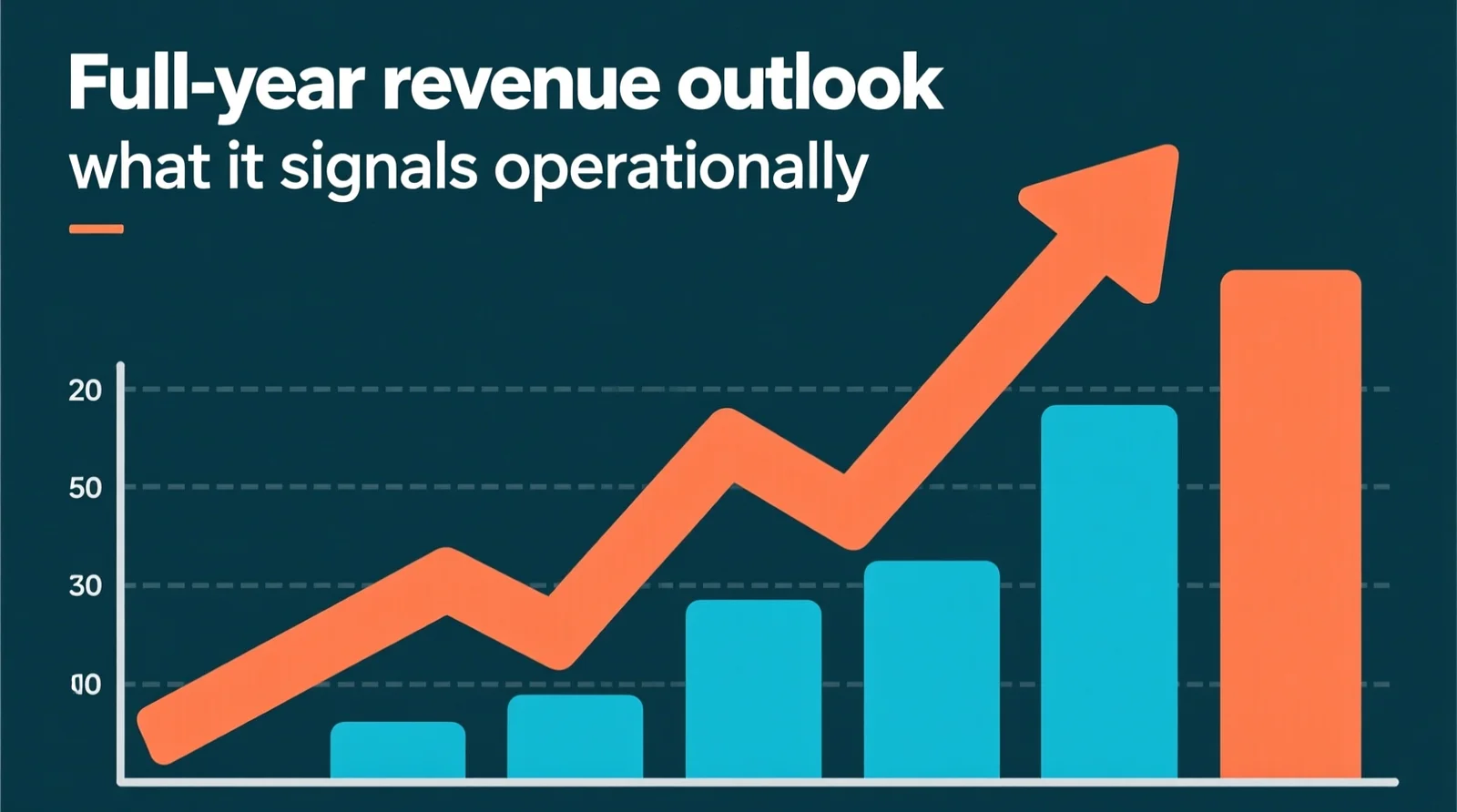
Caterpillar raised its full-year revenue forecast and pointed to sustained demand. A raised outlook can reflect: (1) stronger-than-expected order intake, (2) improved production throughput, (3) better supply chain continuity, and (4) confidence that pricing will continue to offset inflationary inputs.
For readers tracking industrial signals, a meaningful question is whether the company’s book-to-bill ratio (orders divided by sales; a value above 1.0 typically indicates backlog build) is rising. Caterpillar does not always present a single consolidated book-to-bill figure each quarter, but directional commentary on backlog, dealer inventories, and lead times can serve as practical proxies.
TL;DR: The raised revenue outlook implies management sees enough demand and execution capacity to sustain shipments, with order/backlog signals likely supportive even if not summarized as a single book-to-bill number.
Tariffs and manufacturing costs: what the $2.2–$2.4B impact means (and where it comes from)
Caterpillar cited $710 million in unfavorable manufacturing costs in the quarter, with tariffs as a major contributor. For the full year, Caterpillar narrowed its estimated tariff impact to $2.2 billion to $2.4 billion (down from $2.6 billion previously). This type of figure is generally discussed as an incremental cost headwind versus a prior baseline (i.e., the additional cost burden attributable to tariffs), rather than total spend.
Which trade measures are most relevant? In U.S. industrial supply chains, two commonly cited tariff frameworks are:
- Section 232 tariffs (national security-related measures that have included steel and aluminum). Background: U.S. Department of Commerce – Section 232.
- Section 301 tariffs (often associated with actions on imports from China under the Trade Act of 1974). Background: Office of the U.S. Trade Representative – Section 301 tariff actions.
Pass-through vs. absorption: Tariff impacts typically get managed through a mix of supplier negotiation, sourcing changes, engineering substitutions, and pricing (including surcharges). The competitive issue is whether global competitors with different manufacturing footprints can price more aggressively in certain regions. In practice, Caterpillar’s ability to pass through costs tends to be stronger where it has differentiated product support, parts availability, and high uptime requirements (e.g., certain power and mining applications).
TL;DR: The tariff headwind is an incremental cost burden (not total spend) tied to U.S. trade measures like Sections 232 and 301; Caterpillar offsets it through pricing, sourcing actions, and productivity, with pass-through easier in uptime-critical markets.
Sustainability and regulatory context: diesel vs. gas, emissions, and hybrid pathways

Data center power strategies are increasingly shaped by emissions rules, permitting, and corporate sustainability targets. Diesel gensets remain common for standby because of fast response and high power density, but natural gas options and hybrid controls are gaining attention where longer run-times are expected or local regulations tighten.
Key practical considerations
- Criteria pollutants and permitting: Local air permitting can influence whether diesel, gas, or hybridized solutions are favored, especially for frequent testing or extended operations.
- Fuel availability and resilience: Pipeline gas can be attractive, but some operators evaluate dual-fuel strategies and on-site fuel storage for resiliency planning.
- Hybrid and microgrid controls: Controls that optimize dispatch across gensets, batteries, and renewables can reduce run-hours and emissions while maintaining redundancy.
For broader regulatory background on U.S. stationary engines and related air rules, readers can reference the U.S. Environmental Protection Agency (EPA): EPA – Stationary Sources of Air Pollution.
TL;DR: Data center buyers still rely heavily on diesel for standby reliability, but gas and microgrid/hybrid configurations are becoming more relevant as permitting and sustainability constraints tighten.
Key metrics snapshot (Q1 2023) for fast scanning
| Metric | Reported value | Notes |
|---|---|---|
| Total revenue (GAAP) | $17.42B (+22% YoY) | Company-reported; compared vs. consensus $16.61B |
| Adjusted EPS (non-GAAP) | $5.54 | Compared vs. consensus $4.62 (LSEG-cited) |
| Construction Industries revenue growth | +38% YoY | Driven largely by North America; dealer restocking dynamic |
| Energy & Transportation revenue growth | +22% YoY | Supported by power generation demand, including data centers |
| Unfavorable manufacturing costs | $710M | Partly tied to tariffs and inflationary inputs |
| Full-year tariff impact estimate | $2.2B–$2.4B | Incremental cost headwind estimate; previously $2.6B |
TL;DR: The quarter combined strong top-line growth with an adjusted EPS beat, while tariffs and manufacturing costs remained material headwinds.
Outlook and key risks (for investors and industrial buyers)

What could keep demand strong: AI data center expansion, grid constraints driving behind-the-meter power solutions, and continued public infrastructure activity can support a higher floor for certain categories of industrial equipment demand.
Key risks to monitor:
- Rates and construction sensitivity: Higher interest rates can slow non-residential construction and equipment financing, pressuring the Construction Industries cycle.
- Channel normalization: Dealer inventory rebuilds can reverse if end-market demand softens, causing orders to slow even if retail sales remain stable.
- Tariff/policy shifts: Changes to Section 232/301 regimes, retaliatory measures, or new trade barriers can move cost baselines and alter regional competitiveness.
- Capacity planning: If AI-related power demand spikes, suppliers can overextend; prudent capacity additions and flexible manufacturing matter to avoid a boom-bust pattern.
- Emissions and permitting: Local rules could limit diesel run-hours or impose additional controls, changing the preferred technology mix (diesel vs. gas vs. hybrid).
Capital allocation priorities: In industrial cycles, investors typically watch how management balances capacity investments, supply chain resilience, research and development (R&D; investment in new products), dividends, and share repurchases. These choices influence how well Caterpillar can meet lead times in hot markets like data centers without sacrificing returns when conditions normalize.
TL;DR: The setup is favorable for E&T power demand, but construction cyclicality, channel swings, tariff policy, and capacity discipline are the main swing factors for the next phase.
Conclusion: Caterpillar’s quarter highlights AI-linked power demand within a broader industrial cycle
Caterpillar’s Q1 2023 performance—highlighted by an adjusted EPS beat and raised revenue outlook—shows how AI data centers are becoming a meaningful incremental driver for Energy & Transportation through gensets and microgrid solutions, while Construction Industries benefits from North American demand and dealer inventory normalization. Tariffs and manufacturing costs remain a measurable headwind, but pricing and mix have helped protect profitability. Longer term, Caterpillar’s relevance extends beyond a single quarter as industrial automation, electrification, and digitalization reshape how customers buy equipment, power systems, and lifecycle services.
TL;DR: CAT is executing well in a cyclical environment, with AI data centers adding a structurally important power-demand tailwind alongside traditional infrastructure and construction.
FAQ

Q: Which Caterpillar products benefit most from AI data center growth?
A: The biggest beneficiaries are in Caterpillar’s Energy & Transportation segment—especially diesel standby generator sets (gensets), natural-gas gensets for longer-duration or prime-power use cases, and microgrid control systems that integrate generation, switching, and sometimes batteries/renewables for resilience and cost optimization.
Q: Is AI-related data center demand cyclical or structural for Caterpillar?
A: It can be both. Deployment timing can be cyclical (tied to hyperscaler capex budgets and utility interconnection timelines), but the underlying drivers—AI compute growth, redundancy requirements, and grid capacity constraints—look more structural. Management teams typically plan capacity cautiously by using flexible manufacturing, supplier dual-sourcing, and higher aftermarket/service content so they can meet surges without overbuilding fixed costs.
Q: How are U.S. infrastructure and CHIPS-related investments influencing Caterpillar’s order pipeline?
A: Public infrastructure programs can support roads, bridges, utilities, and related site work that pulls through earthmoving equipment and engines. In parallel, CHIPS and broader domestic manufacturing investment can increase demand for site prep, material handling, and power reliability solutions around new fabs and industrial campuses. For policy reference, see the White House briefing page on the Bipartisan Infrastructure Law and the U.S. Department of Commerce overview of the CHIPS for America program.
Q: How do tariffs affect Caterpillar, and is the company passing those costs to customers?
A: Tariffs raise the incremental cost of certain imported materials and components (commonly linked to U.S. Section 232 steel/aluminum measures and Section 301 China-related tariffs). Caterpillar typically offsets these costs through a mix of pricing actions (including surcharges or negotiated price), sourcing changes, and productivity. Pass-through tends to be more achievable in differentiated, uptime-critical applications (like data center power) than in highly price-competitive equipment categories, and it can affect competitiveness versus non-U.S. manufacturers depending on their production footprint.
Q: What should investors watch next in Caterpillar earnings for AI data center exposure?
A: Watch Energy & Transportation order commentary, any notes on lead times for power systems, pricing realization, and margin/mix signals (aftermarket attachment and engineered systems). Also monitor whether management indicates backlog build (a book-to-bill-like dynamic) and how capacity and supplier constraints are being managed to meet data center delivery schedules.