For OEMs, investors, distributors, and mining service providers evaluating Indonesia’s mining machinery segment, this outlook explains what is driving demand through 2031, which equipment categories are likely to grow fastest, and where policy, infrastructure, and technology risks could reshape project timelines and returns.
Indonesia’s mining equipment demand is entering a sustained growth phase, supported by downstream processing policy, rising battery-metal requirements, and a structural shift toward safer, more automated operations. Alongside coal, the country is positioning itself as a key hub in the global electric-vehicle (EV) and battery supply chain—reshaping equipment mix, financing models, and supplier strategies.
Independent research from Mordor Intelligence suggests attractive long-term opportunities for companies that combine local presence with global technical expertise—especially in processing plants, automation, and lifecycle services.
Indonesia Mining Equipment Market Overview

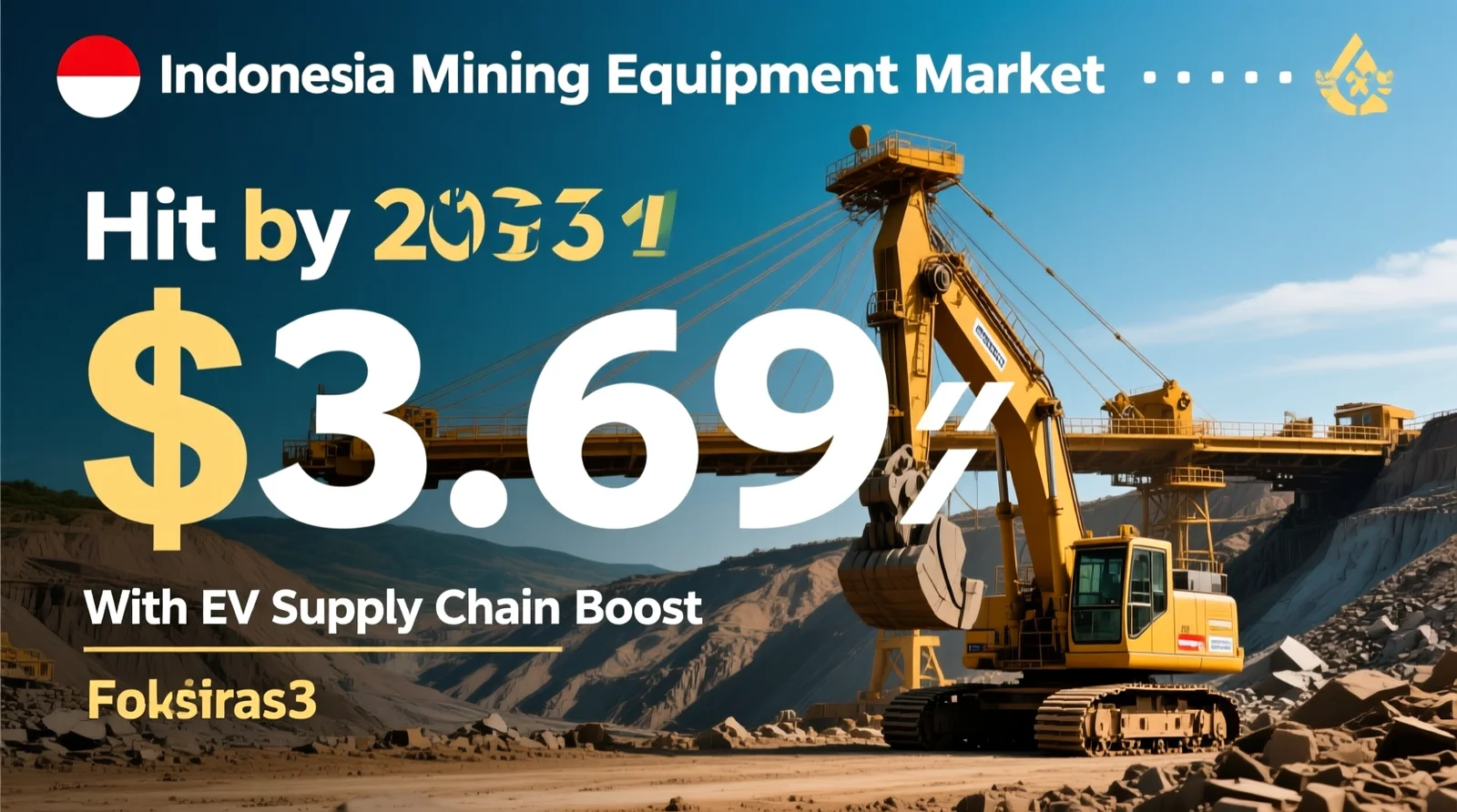
Indonesia’s mining equipment market is projected to be valued at around USD 2.7 billion in 2026 and forecast to reach approximately USD 3.69 billion by 2031, at a compound annual growth rate (CAGR) of about 6.43% over 2026–2031. Growth is closely linked to Indonesia’s ongoing shift from raw ore exports toward integrated processing, refining, and battery-material manufacturing.
Operationally, deeper ore bodies and higher productivity expectations are pushing miners toward more energy-efficient equipment and connected fleets (telematics plus analytics). Capital spending is also shifting “downstream,” where plants require specialized mineral-processing equipment rather than only conventional digging-and-hauling fleets.
Mining output context: Indonesia remains one of the world’s major coal exporters while simultaneously scaling up metals—especially nickel and copper. In practice, this means two demand centers run in parallel: (1) large surface fleets serving coal and laterites, and (2) fast-growing processing capacity tied to nickel and copper value chains.
Government sources and industry announcements indicate numerous nickel smelters, high-pressure acid leach projects, and copper smelter expansions in the pipeline. For reference on policy direction and sector governance, see Indonesia’s Ministry of Energy and Mineral Resources (MEMR/ESDM): https://www.esdm.go.id/.
TL;DR: Growth to 2031 is driven less by “more mines” alone and more by more processing capacity, connected equipment, and higher-spec plants for nickel and copper.
Methodology and Data Sources
Market sizing and forecasts referenced in this article are based on Mordor Intelligence research, cross-checked against publicly available government releases and reputable international datasets where applicable. Examples include mineral production and reserve estimates published by the U.S. Geological Survey (USGS) (latest available annual summaries): https://www.usgs.gov/centers/national-minerals-information-center, and Indonesian regulatory and policy updates from MEMR/ESDM: https://www.esdm.go.id/.
Where the article describes technology adoption (automation, battery-electric fleets), it uses a mix of OEM announcements, site-level project disclosures, and observed procurement patterns in comparable operations across Southeast Asia.
TL;DR: Forecasts combine Mordor Intelligence modeling with the latest accessible government and international reference data (e.g., USGS, MEMR/ESDM).
Key Drivers Shaping Demand in Indonesia’s Mining Equipment Industry

Downstream-Processing Mandate Expands Plant-Level Equipment Demand
Indonesia’s domestic value-add policy is a primary catalyst for equipment spending. Export restrictions on unprocessed nickel ore and certain copper concentrates have encouraged investment in local smelting and refining—shifting procurement toward plant construction and sustaining long-term aftermarket service needs.
This policy has accelerated multiple HPAL developments. HPAL (high-pressure acid leach) is a complex hydrometallurgical process used to extract nickel (and cobalt) from laterite ores using high pressure, high temperature, and sulfuric acid—driving demand for corrosion-resistant and high-integrity equipment.
Typical HPAL and downstream nickel circuits can require:
- Autoclaves and pressure vessels (critical for high-pressure leaching)
- Acid plants and off-gas treatment (to supply sulfuric acid and meet emissions controls)
- MHP circuits for mixed hydroxide precipitate (MHP), an intermediate product used for battery materials
- Pumps, valves, and distributed control systems—often specified in high-alloy materials due to acid and chloride exposure
Mini-case (anonymized, Sulawesi): one laterite-to-MHP project that moved from construction into early ramp-up prioritized redundant slurry pumping and upgraded valve packages after early commissioning issues (erosion/corrosion). The result was a procurement “second wave” focused on reliability upgrades—benefiting suppliers with local overhaul capability.
Compared with conventional open-pit fleet purchases, downstream facilities often favor suppliers who can deliver: (1) engineered packages, (2) controls integration, and (3) local-content compliance under TKDN (Tingkat Komponen Dalam Negeri, Indonesia’s local content requirement).
TL;DR: Downstream policy is pushing spending toward HPAL/smelter plants—creating high-value demand for engineered processing equipment and long-run aftermarket services.
Nickel and Copper Expansion (EV Supply Chain) Shifts Specs Toward “Battery-Grade” Processing

Indonesia holds some of the world’s largest nickel reserves and has become a top global producer (USGS, latest annual reporting). This positions the country as strategic for EV and battery manufacturers seeking secure supply of battery inputs. See USGS minerals data and annual summaries here: https://www.usgs.gov/centers/national-minerals-information-center.
As global automakers and cell producers lock in materials, investments increasingly target integrated “mine-to-chemicals” chains. That shifts equipment selection toward higher-throughput, quality-controlled systems rather than commodity-grade processing.
On the copper side, large-scale smelter projects and expansions tied to flagship mines are adding capacity. These developments typically require:
- Materials-handling systems (conveyors, stackers, reclaimers) to reduce unit logistics cost
- Comminution (crushing and grinding) and flotation systems sized for higher throughput
- Smelting/refining equipment plus anode/cathode handling for consistent output quality
- Captive power or reliability upgrades where grids are constrained
For battery-grade nickel chemicals, unit operations such as crystallizers matter because they help control purity and crystal size distribution in products like nickel sulfate—key for cathode precursor consistency.
Unique insight (competition dynamics): procurement and financing structures increasingly differ between Chinese-backed industrial parks and Western/Japanese/Korean-backed projects. The former often optimize for speed-to-capacity and integrated EPC (engineering, procurement, construction) packages; the latter tend to emphasize traceability, ESG screens, and vendor qualification—creating parallel “routes to market” for equipment suppliers.
TL;DR: Nickel/copper growth is not just volume-driven—battery-grade specs raise demand for precision processing equipment and tighter digital quality control.
Digitization, Automation, and Remote Operations Raise the Baseline for Productivity and Safety
As ore grades decline and operations expand into more complex geologies, miners are adopting automation and data tools to protect productivity and reduce safety exposure. Regulators and lenders are also placing more weight on risk management and ESG (environmental, social, and governance) performance, strengthening the business case for connected fleets.
Common deployment pathways in Indonesia include:
- Telematics and fleet management (fuel burn, idle time, payload, and maintenance triggers)
- Collision avoidance and proximity detection to reduce incident rates in high-traffic pits and ROM (run-of-mine) areas
- Remote operations support where skill shortages or site remoteness make on-site troubleshooting slow and expensive
Mini-case (anonymized, Kalimantan coal): a mid-sized coal contractor piloted collision-awareness kits and dispatch optimization across a mixed fleet (multiple OEMs). The immediate benefit was fewer near-misses and better truck utilization during peak hauling hours—leading to a broader retrofit program focused on the highest-risk intersections and loading zones.
Note on dates: any references to OEM facility expansions or product rollouts (e.g., local assembly initiatives) should be interpreted as public, forward-looking examples and may shift based on capex cycles and permitting.
TL;DR: Automation in Indonesia is often “stepwise” (telematics → safety systems → partial autonomy), with strong demand for local support and integration across mixed fleets.
Battery-Electric Vehicles (BEVs) Move from Pilots Toward Early Adoption—First Underground, Then Select Surface Use

Smaller contractors and mid-tier miners are increasingly influential buyers, especially in remote areas with high diesel logistics costs. This is accelerating interest in BEVs (battery-electric vehicles) and hybrid equipment.
Near-term adoption tends to be strongest in underground mines, where BEVs can reduce diesel particulate exposure and ventilation power costs. Typical requirements include:
- Battery-electric loaders and trucks sized for short-haul duty cycles
- Charging solutions (fixed fast chargers or battery-swap approaches) designed for weak-grid/off-grid sites
- Service agreements that cover battery health, thermal management, and operator training
Indicative timeline: BEVs are likely to remain largely in pilot-to-early adoption through the mid-to-late 2020s, with broader uptake dependent on site power upgrades, proven battery lifecycle performance in tropical conditions, and financing models that reduce upfront cost barriers.
TL;DR: BEVs are gaining traction first where they solve a clear operational constraint (ventilation and diesel logistics), with broader rollout tied to power infrastructure and financing.
Indonesia Mining Equipment Market Segmentation
The market can be segmented by equipment type, automation level, powertrain, power output, application, and region. For suppliers and investors, segmentation is most useful when linked to “where the money moves”—processing plants, automation layers, and services—not only unit counts of machines.
Segmentation by Equipment Type

- Surface mining equipment: excavators, shovels, draglines, surface drill rigs, plus loading/hauling systems used widely in coal and laterite operations.
- Underground mining equipment: LHDs (load–haul–dump machines), underground trucks, roof bolters, and ventilation systems.
- Mineral-processing equipment: crushers, mills, screens, flotation cells, thickeners, and hydrometallurgical systems (including HPAL) for nickel and copper value chains.
- Drills and breakers: blast-hole drills, rock drills, hydraulic breakers, and consumables.
- Crushing, pulverizing, and screening: ore sizing and preparation equipment that strongly correlates with throughput upgrades.
- Loaders and haul trucks: wheel loaders, articulated trucks, rigid dump trucks—often the core of surface production fleets.
TL;DR: The fastest-expanding spend is increasingly in mineral processing (HPAL/smelters) and high-utilization fleet categories with strong aftermarket pull-through.
Segmentation by Automation Level
- Manual: conventional machines without advanced autonomy—still common among smaller operators.
- Semi-autonomous: operator-assist, remote control, collision avoidance, and advanced telematics.
- Fully autonomous: driverless trucks and autonomous drills under centralized control—mostly limited to large, long-life assets where utilization is high enough to justify the system cost.
TL;DR: Semi-autonomous retrofits and telemetry are typically the largest “near-term” volume, while full autonomy is concentrated in big sites with strong connectivity and disciplined maintenance.
Segmentation by Powertrain Type

- ICE (internal-combustion engine): diesel remains dominant, especially for large surface fleets and weak-grid regions.
- BEV (battery-electric vehicle): most traction in underground and compact equipment classes.
- Hybrid: a transition option where charging is constrained but efficiency targets are rising.
TL;DR: Diesel leads in surface mining, but BEVs/hybrids are growing where they cut ventilation, fuel logistics, and emissions exposure.
Segmentation by Power Output
- <500 HP: compact loaders, utilities, support equipment, and smaller drills—common for contractors and quarrying.
- 500–1,000 HP: mid-sized haul trucks, excavators, and processing units.
- >1,000 HP: large shovels, ultra-class trucks, high-capacity crushers, and critical plant equipment.
TL;DR: Higher-horsepower equipment is tied to major mines and large plants, while <500 HP categories are where localization and fast parts access can win share.
Segmentation by Application

- Metal mining: nickel, copper, gold—key growth area due to energy-transition demand.
- Industrial minerals: bauxite, tin, and others linked to manufacturing and construction.
- Coal mining: continues to sustain significant surface fleet demand despite price cycles.
TL;DR: Metals (nickel/copper) are the growth engine for processing and automation, while coal remains a large base market for fleets and rebuilds.
Segmentation by Region
- Sumatra: established coal and minerals in certain basins.
- Java: administration, services, distribution, workshops, and OEM/dealer hubs.
- Kalimantan: major coal region; consistent demand for surface equipment and haulage logistics solutions.
- Sulawesi: nickel laterite and HPAL hub; strong pull for both mining and processing equipment.
- Papua: home to large copper and gold deposits; high-spec equipment and infrastructure requirements.
TL;DR: Sulawesi (nickel processing build-out) and Papua (large copper/gold complexes) typically drive the highest-spec demand; Kalimantan anchors volume fleet needs.
Key Players in the Indonesia Mining Equipment Industry

Competition includes global OEMs, Chinese suppliers tied to industrial park buildouts, regional specialists, and Indonesian rebuilders/service firms. In many tenders, service response time, parts availability, and rebuild capability can be as decisive as upfront equipment price.
- Caterpillar Inc. – broad surface/underground portfolio, engines, and digital tools supported by dealer networks.
- Komatsu Ltd. – strong presence in mining trucks, excavators, and dozers across coal and minerals.
- Hitachi Construction Machinery – large hydraulic excavators and surface solutions.
- Epiroc AB – drilling, rock excavation, underground equipment, plus automation and digital services.
- Sandvik AB – underground loaders/trucks, rock tools, automation offerings, and aftermarket support.
Partnerships between global OEMs and Indonesian firms are increasingly common to address TKDN and to reduce downtime risk through local workshops and inventory. In parallel, more price-competitive entrants (often aligned to specific project sponsors) are pressuring incumbents—raising the importance of measurable performance guarantees and lifecycle cost proof.
TL;DR: The winning play is often “equipment + uptime”: local service density and rebuild capability increasingly differentiate suppliers, not just machine specs.
Market Challenges and Opportunities
The outlook is strong, but procurement and investment decisions are shaped by a handful of recurring constraints—many of which can be turned into commercial opportunities for the right suppliers.
Key Challenges

- Coal-price volatility: price swings can delay capex and shift focus to rebuilds and life-extension.
- Infrastructure gaps: limited roads, ports, and reliable power increase logistics cost and complicate commissioning schedules.
- Regulatory complexity: evolving rules on exports, permitting, and environmental compliance can move timelines.
- Skill shortages: limited availability of automation technicians and experienced maintainers can slow adoption.
TL;DR: Volatility, infrastructure, regulation, and skills are the core friction points that influence timing, vendor choice, and contracting models.
Growth Opportunities (Linked to the Challenges)
- Local assembly and parts localization (TKDN-driven): mitigates infrastructure/logistics constraints and shortens lead times, while improving compliance with local-content requirements.
- Digital and remote support: helps address skill shortages through remote diagnostics, guided troubleshooting, and condition-based maintenance—particularly valuable in remote Sulawesi/Kalimantan operations.
- Energy-efficient and low-emission equipment: offsets diesel logistics and supports ESG expectations from global buyers and lenders; BEVs/hybrids are most attractive where ventilation or fuel delivery is costly.
- Lifecycle services and financing: reduces capex sensitivity in volatile commodity cycles via rebuild programs, availability-based contracts, and training bundles.
TL;DR: The best opportunities are “solutions to constraints”: local hubs, remote support, efficiency upgrades, and service-led commercial models.
Strategic Considerations for OEMs and Investors
- Prioritize service hubs near demand clusters: Sulawesi for nickel processing corridors; Kalimantan for coal fleet density; Java for distribution and technical centers.
- Align product roadmap to the processing wave: corrosion-resistant pumping/valving, thickening/filtration, controls integration, and spares for HPAL and smelter operations.
- Build a clear TKDN plan: start with assembly/parts localization where volumes justify it, then expand to certified local suppliers and training programs.
- Offer automation as a phased package: telematics + safety retrofits first, then semi-autonomous functions; reduce adoption friction with training and remote ops support.
- Stress-test project assumptions: power availability, water/acid logistics, and permitting are often the real schedule drivers for processing plants.
TL;DR: Win share by investing in local service density, processing-aligned portfolios, TKDN execution, and phased automation that matches site readiness.
Conclusion: Outlook for Indonesia’s Mining Equipment Market Through 2031
Indonesia’s mining machinery demand is being reshaped by downstream industrial policy, EV supply chain investment, and a steady shift toward digitized, safer, and more efficient operations. Nickel and copper projects—especially those tied to HPAL and expanded smelting—are increasing demand for high-spec mineral-processing equipment and plant services, while coal continues to underpin fleet volumes and rebuild activity.
Policy insight post-2024: after the 2024 election cycle, the direction of travel is still expected to favor downstreaming and industrial parks, but implementation pace may vary by permitting capacity, grid buildout, and how environmental standards are enforced. For suppliers, flexibility in delivery schedules and strong local stakeholder management can matter as much as product fit.
Forecast risk disclaimer: all market forecasts are subject to uncertainty. Key swing factors include commodity prices (coal/nickel), regulatory adjustments, project financing conditions, and execution risks in large processing plants (power, water, acid supply, and ramp-up performance).
TL;DR: The clearest growth pockets are processing plants, automation layers, and services—while the biggest risks are commodity cycles, infrastructure readiness, and project execution.
Related Industry Insights
Many readers benchmark Indonesia within a broader regional portfolio. If this article sits within a larger site, consider linking to relevant pages such as Indonesia construction equipment market report and Asia Pacific mining equipment outlook to strengthen topical authority and help users navigate adjacent forecasts.
TL;DR: Indonesia is best assessed as part of a regional equipment strategy, especially for suppliers serving multi-country mining customers.
About Mordor Intelligence
Mordor Intelligence provides market intelligence and advisory services used by equipment manufacturers, investors, and policymakers to assess market potential, competitive dynamics, and technology trends.
With a team of domain experts and on-ground specialists, Mordor Intelligence delivers syndicated and custom research across industrial sectors including automation, energy and power, chemicals and materials, logistics, and heavy equipment.
TL;DR: Mordor Intelligence supports data-driven planning with syndicated and custom research across major industrial markets.
FAQ
Q: What is the projected size of the Indonesia mining equipment market by 2031?
A: The market is projected to reach about USD 3.69 billion by 2031, up from an estimated USD 2.7 billion in 2026, implying a CAGR of roughly 6.43% over 2026–2031.
Q: Which equipment categories are expected to grow fastest in Indonesia through 2031?
A: The fastest growth is typically expected in mineral-processing equipment tied to nickel HPAL and smelter buildouts, plus automation/telematics and lifecycle services (rebuilds, condition monitoring, training). Conventional coal fleets remain large, but growth is often steadier and more cycle-dependent.
Q: What is HPAL, and why does it matter for mining equipment suppliers in Indonesia?
A: HPAL (high-pressure acid leach) is a hydrometallurgical process used to extract nickel (and cobalt) from laterite ores using high-pressure, high-temperature sulfuric acid. It matters because HPAL plants require specialized, corrosion-resistant equipment (autoclaves, pumps, valves, off-gas systems) and high uptime—creating large initial capex and ongoing aftermarket demand.
Q: How is TKDN measured for mining equipment, and how can suppliers improve compliance?
A: TKDN (Tingkat Komponen Dalam Negeri) is Indonesia’s local content requirement, generally assessed through a scored calculation of domestic components, local labor/services, and sometimes local assembly/manufacturing contribution, depending on the product category and applicable rules. Suppliers typically improve compliance by establishing local assembly, qualifying domestic component vendors, building Indonesian service capability, and documenting cost structure and sourcing clearly for audits/tender submissions.
Q: What is a typical payback period for mining automation in Indonesian operating conditions?
A: Payback varies by site, fleet utilization, connectivity, and baseline maintenance discipline. In practice, many mines first target “quick wins” (telematics, dispatch optimization, collision avoidance) that can justify investment through reduced downtime, fuel savings, and fewer incidents, while more advanced autonomy tends to require larger fleets and higher utilization to reach attractive payback. A credible payback case usually depends on measured baseline KPIs (hours, delays, fuel, tire life) and a realistic local support plan.