
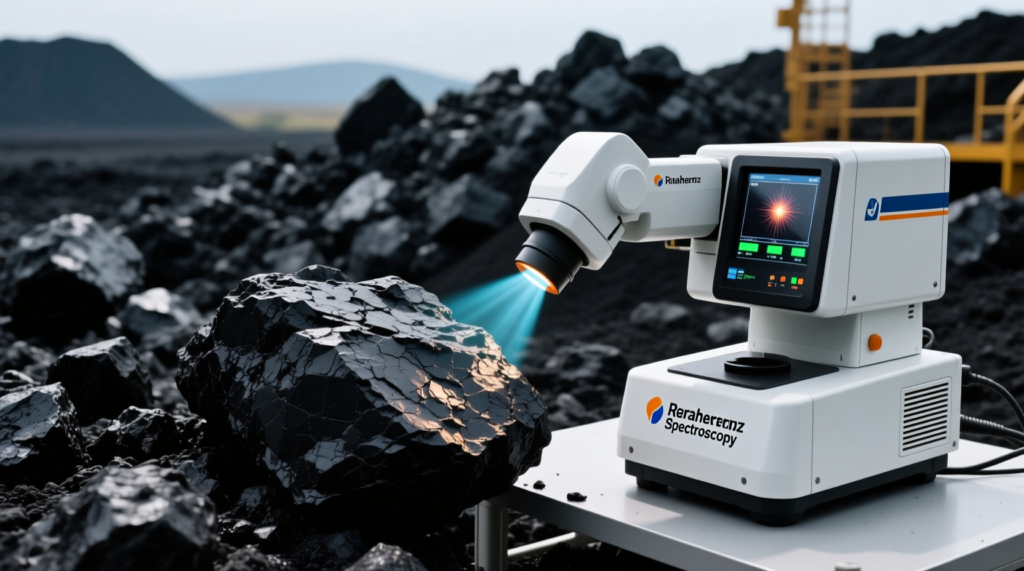
Terahertz-based coal interface sensing is emerging as a promising, non-contact, non-ionizing approach for identifying coal–rock boundaries and monitoring coal quality in modern mines. This article explains how Terahertz Time-Domain Spectroscopy (THz‑TDS) combined with machine learning (ML) reached 96% accuracy under controlled lab conditions, what that number does (and does not) mean for underground deployment, and how mines, equipment OEMs, and automation providers can pilot and scale the technology.
Introduction

Accurate coal–rock identification is a prerequisite for intelligent and automated mining. Misjudging the coal–rock interface can increase cutter wear, lower coal recovery (more dilution with gangue), and introduce safety risks at the face.
A peer-reviewed paper in Photonics reports that combining Terahertz Time‑Domain Spectroscopy (THz‑TDS)—a technique that measures the time-resolved amplitude and phase of terahertz pulses—with machine learning (ML) achieved up to 96% classification accuracy for coal–rock mixtures in a laboratory test using pelletized samples. While the lab result is encouraging, real mine performance typically depends on moisture, dust, vibration, surface roughness, sensor standoff stability, and maintenance discipline.
TL;DR: THz‑TDS + ML can classify coal–rock mixtures very well in the lab (96% reported), but underground accuracy and uptime will hinge on ruggedization, calibration control, and integration with mining automation workflows.
Why Coal–Rock Identification Matters in Intelligent Mining
Coal remains a major energy source in many regions. In China, coal’s share of energy consumption has been reported around the mid‑50% range in recent years depending on the accounting basis and year; for broader context and comparable international statistics, see the International Energy Agency (IEA) and national statistics agencies such as China’s National Bureau of Statistics.
As longwall and continuous mining operations move toward higher automation, operators increasingly need sensing that supports:
- Real-time coal–rock interface detection to guide cutting height and reduce dilution
- Coal quality monitoring (e.g., ash-related dilution proxies) at the face or on conveyors
- Geotechnical awareness near roof/floor transitions to reduce instability risks
Common sensing modalities include:
- Acoustic emission (AE): elastic waves generated by cracking/fracture; useful for change detection but often sensitive to mechanical noise and machine state.
- Gamma-ray / radiometric methods: can infer ash/density changes; involve ionizing radiation and regulatory controls (see general radiation protection principles from the IAEA).
- Machine vision: camera-based classification; can degrade under dust, poor lighting, water spray, and lens fouling.
In practice, harsh underground environments (coal dust, water spray, humidity, vibration, impacts, variable lighting, electromagnetic interference) frequently drive the total cost of ownership (TCO) more than the sensor purchase price.
TL;DR: Coal–rock identification directly affects dilution, wear, and safety; legacy methods work but often degrade underground due to dust/water/vibration and (for gamma) regulatory constraints.
Terahertz Sensing as a New Tool for Coal–Rock Interface Detection

Terahertz (THz) radiation typically refers to electromagnetic frequencies from about 0.1 to 10 THz, between microwaves and infrared. THz‑TDS (Terahertz Time‑Domain Spectroscopy) measures a short THz pulse after it passes through (transmission) or reflects from (reflection) a sample, capturing both amplitude and phase information.
Why THz is interesting for coal–rock problems:
- Spectral contrast: organic coal and inorganic minerals often show different THz refractive index/absorption behavior.
- Short-range, non-contact sensing: attractive near cutting drums, conveyors, or chutes where physical probes wear quickly.
- Non-ionizing: unlike gamma systems, THz does not rely on ionizing radiation, which can simplify regulatory and safety management.
However, THz also has known limitations that matter in mines:
- Water sensitivity: liquid water strongly absorbs THz, so wet coal, water spray, and high humidity can reduce signal and shift spectra.
- Dust and window fouling: dust layers on protective windows can introduce drift and attenuation; this is a major deployment risk versus lab conditions.
- Surface roughness/scattering: broken coal and rock surfaces scatter THz differently than pressed pellets, complicating reflection-mode classification.
- Mechanical ruggedization: keeping a stable standoff distance and alignment under vibration and impacts is non-trivial.
TL;DR: THz sensing offers strong coal–rock contrast and non-contact operation, but underground performance is often constrained by moisture absorption, dust fouling, rough surfaces, and mechanical stability.
Terahertz coal–rock identification system design (what engineers should plan for)
Industrial readers typically need to translate “lab demonstrator” into “deployable subsystem.” A practical THz spectral coal–rock classification stack usually includes:
- Emitter/receiver head (transmission or reflection geometry) with a controlled standoff distance (often on the order of centimeters to tens of centimeters depending on optics and target size).
- Protective window (e.g., THz-transparent polymer) plus air purge, wiper, or vibration cleaning to manage dust/water film.
- Time synchronization with machine PLC/SCADA (programmable logic controller / supervisory control and data acquisition) for tagging spectra to position and operating state.
- Edge compute for inference: a compact industrial PC or embedded GPU/CPU that runs the trained model with low latency.
Key design tradeoffs versus other modalities:
- Versus vision: THz is less dependent on visible lighting but can be more sensitive to water and window fouling.
- Versus gamma: THz avoids ionizing radiation controls, but gamma can be relatively robust to dust and can “see through” some obscurants differently.
- Versus acoustics: THz can provide more direct material-property signatures; acoustic methods can be cheaper and rugged but are often machine-state dependent and noisy.
TL;DR: A deployable THz coal–rock system is as much about mechanical packaging, window cleaning, and automation integration as it is about the spectrometer and model.
Experimental Framework: THz‑TDS Combined With Machine Learning

The reported results come from a controlled laboratory study (pelletized samples, uniform thickness, controlled geometry). This matters: the 96% figure should be interpreted as a best-case baseline for the chosen dataset and setup—not a guaranteed underground KPI.
THz detection system and measurement setup
The study used a commercial THz‑TDS instrument (TAS7500SP, ADVANTEST) in transmission mode. The paper reports a sub‑10 ms response time and high signal-to-noise ratio (SNR), which indicates feasibility for near-real-time acquisition in principle—provided industrial packaging and cleaning keep the optical path stable.
The team measured amplitude attenuation and phase shift across frequency, then derived:
- Refractive index: how strongly the material bends/slows THz waves
- Absorption coefficient: how much THz energy the material absorbs per unit distance
Coal–rock sample preparation (and why it matters)
They prepared 55 pellet samples across 11 mixing ratios (0–100% coal content) using coal powder and quartz sand (as a mineral proxy), with polyethylene as a binder, pressed at high pressure into uniform pellets.
This approach improves repeatability, but it also creates a gap to underground conditions:
- Pellets have uniform density and low surface roughness versus fractured, layered, moisture-variable material at the face.
- The binder and pressing process can reduce porosity variability that otherwise affects THz scattering and absorption.
Feature extraction using PCA
Principal Component Analysis (PCA) is a statistical method that compresses high-dimensional spectra into a smaller set of components while preserving most variance. The study reports that the first two principal components captured nearly all variance for refractive index features, enabling efficient model training and faster inference.
Machine learning models evaluated
The study compared:
- SVM (Support Vector Machine)
- LS‑SVM (Least Squares Support Vector Machine)
- ANN (Artificial Neural Network)
- RF (Random Forest)
Clarifying “classification” and “accuracy”: In this context, “classification” typically means assigning a sample to a discrete coal-content class (e.g., one of 11 mixture ratios) rather than estimating a continuous coal fraction. The reported “accuracy” is best read as overall correct classification rate on the study’s evaluation split (often cross-validation or held-out test data; details should be confirmed in the paper’s methods section).
- Compact experimental design summary (for engineers):
- 55 pelletized samples, 11 coal–rock mixture ratios (0–100% coal)
- Transmission-mode THz‑TDS; spectra converted to refractive index & absorption coefficient
- PCA applied to reduce spectral dimensionality (first two PCs capture ~all variance reported)
- Four ML classifiers trained; RF achieved the highest reported lab accuracy
TL;DR: The 96% figure comes from a controlled pellet-based, transmission-mode THz‑TDS experiment using discrete mixture classes and ML classifiers—useful as a benchmark, not a direct underground guarantee.
Key Findings: Spectral Sensitivity and What the 96% Accuracy Really Means
Optimal frequency band and the transmission-mode limit
The study reports highest sensitivity in roughly the 0.7–1.3 THz band. It also observes that as coal fraction increases beyond ~30%, attenuation rises sharply, making transmission-mode sensing less effective because insufficient THz energy passes through the sample.
Industrial implication: transmission-mode THz may be best for thin zones, mixed interfaces, or rock-dominant conditions. For thick coal or opaque mixtures, reflection mode is usually the more realistic deployment geometry.
Model performance (with controlled-condition caution)
Reported lab results (pellets, controlled geometry) were approximately:
- Random Forest (RF): up to 96% overall accuracy
- ANN: ~94.8%
- LS‑SVM: slightly below ANN (see paper for exact value)
- SVM: ~64%
Important scope clarification: The 96% accuracy was achieved under controlled laboratory conditions using pelletized samples. Real-world accuracy may be lower due to moisture variability, dust layers, changing standoff distance, vibration-induced jitter, and mixed lithologies beyond quartz-rich rock (e.g., clays, carbonates, pyrite-bearing bands).
Benchmarking versus other sensing modalities (typical ranges, highly application-dependent)
Published performance varies widely by site conditions, training data quality, and what exactly is being detected (interface position vs. ash proxy vs. “coal vs. rock”). As a practical benchmark:
- Vision-based classifiers can be strong in clean/controlled lighting but often degrade sharply with dust/water; reported accuracies in academic studies can exceed 90% in controlled imagery, but underground robustness is frequently the limiting factor.
- Radiometric (gamma) ash/density sensing is widely used for coal quality monitoring in some contexts; it can be stable but requires radiation safety management and may provide indirect proxies rather than direct interface mapping.
- Acoustic/vibration methods are rugged and low-cost, but accuracy can be machine-state dependent and may require frequent re-tuning as picks wear and geology changes.
Because methods, datasets, and definitions differ across studies, treat cross-technology comparisons as directional unless evaluated side-by-side at the same mine.
TL;DR: The 0.7–1.3 THz band appears most informative in the lab; 96% is a controlled-condition classification metric on pellets, and underground benchmarks must account for moisture, dust, and operational variability.
THz‑TDS for real-time coal quality monitoring: data pipeline and deployment considerations

To move from lab success to real-time operations, practitioners should plan the full data pipeline:
- Sampling rate: The instrument response time reported (single‑digit milliseconds) suggests potential for tens to >100 spectra/sec in ideal conditions, but practical rates will be lower once you add averaging, vibration filtering, and compute latency.
- Training data volume: For ML models like RF/ANN, mines should expect to collect hundreds to thousands of labeled spectra per condition (per seam, moisture band, and sensor mounting geometry) to avoid brittle models.
- Inference location:
- On-device/edge inference reduces latency and dependence on network uptime—usually preferred for shearer control interlocks.
- Cloud inference can help fleet learning and model updates but must handle intermittent connectivity and cybersecurity constraints.
- Model monitoring: Add drift dashboards (confidence scores, feature distribution shift) to flag when recalibration or retraining is required.
TL;DR: Real-time THz coal–rock classification is as much a data engineering problem as a sensing problem—plan spectra rates, labeling scale, edge inference, and drift monitoring from day one.
Applications in Modern Smart Mining (near-term vs longer-term)
Near-term: implementable use cases (6–18 months with a focused pilot)
1) Conveyor coal-quality / dilution monitoring: Mount a reflection-mode THz head above a belt or chute to classify coal vs. rock-rich stream segments and trigger alarms, blending actions, or diversion to rework. This is often the fastest path because conveyors offer more stable geometry than the cutting face.
2) Transfer-point sorting assist: Use THz spectral coal–rock classification as an additional signal to support mechanical diverters, air jets, or downstream washing setpoints. Even if THz does not perform all decisions alone, it can strengthen a fusion model with vision/NIR (near-infrared) data.
3) Shearer advisory (not closed-loop control at first): Start with a “traffic-light” interface estimate displayed to operators and logged to historian systems, then move toward semi-automatic adjustments once reliability is proven.
Longer-term: higher-integration or speculative use cases
1) Closed-loop adaptive cutting: Use THz interface estimation to automatically adjust cutting height/angle. This requires high availability, deterministic latency, strong functional safety design, and robust handling of dust/water transients.
2) Digital twin integration: Feed THz-derived interface/quality signals into a digital twin (a continuously updated virtual representation of the mine process) for reconciliation of geology models, dilution accounting, and optimization across cutting–conveying–processing.
3) Multi-sensor “all-weather” perception: Fuse THz with radar/LiDAR, acoustics, NIR/hyperspectral, and machine telemetry for higher robustness than any single sensor.
TL;DR: Start with conveyors and advisory systems (stable geometry, quick ROI), then progress to closed-loop cutting and digital twins after proving uptime, cleaning, and calibration stability.
Reality Check: Limitations Underground vs. the Lab

Bridging the lab-to-mine gap is the central challenge for terahertz-based coal interface sensing.
- Dust interference and window fouling: Unlike a lab path, an underground optical window can accumulate dust films within hours. Even thin layers can bias absorption estimates and cause “false rock” readings unless purged/cleaned.
- Water content and humidity: Water is a strong THz absorber. Changes in moisture can look like changes in material composition unless the model is trained across moisture bands or compensated with an auxiliary moisture sensor.
- Ruggedization and alignment: THz heads must survive vibration, impacts, and misalignment. Standoff distance changes can mimic spectral changes, particularly in reflection mode.
- Calibration drift: Temperature cycles, component aging, and window replacement can shift baselines. Without a calibration routine, accuracy can decay silently over weeks.
- Integration with mine automation: Turning “predictions” into actions requires integration with PLC logic, safety rules, event logging, and operator interfaces—often the hidden schedule driver.
Maintenance & calibration strategies that tend to work:
- Periodic reference checks using a stable reference target (and/or standard pellets) to verify baseline response.
- Built-in self-checks (internal reference path or shutter) to detect drift and window fouling.
- Condition-based cleaning triggered by signal attenuation thresholds, not just a time schedule.
TL;DR: Underground success depends on managing dust, water, vibration, and calibration drift—and on tight PLC/SCADA integration, not just a strong lab classifier.
How to Pilot and Scale THz Deployment: Practical mini-scenarios
Scenario A (mine operator): conveyor pilot to reduce dilution
- Phase 1 (4–8 weeks): Install a protected THz head above a belt after the crusher. Collect spectra + belt samples for lab assay (ash, moisture) to label datasets.
- Phase 2 (8–12 weeks): Train an RF baseline model and validate against weekly independent sample sets. Deploy “shadow mode” (no control actions) and track false alarms.
- Phase 3 (3–6 months): Add operator alerts and integrate with diversion gates or blending logic. Quantify ROI via reduced out-of-spec shipments, reduced wash plant load, or fewer customer penalties.
Scenario B (OEM): shearer-mounted advisory system
- Phase 1: Mechanical integration study: standoff distance stability, protective window design, purge air routing, and vibration isolation.
- Phase 2: Face trial in advisory-only mode. Log spectra, machine telemetry, and geology model alignment. Focus on uptime and maintenance intervals.
- Phase 3: Expand to semi-autonomous control only after meeting reliability thresholds (e.g., minimum availability, bounded latency, and defined fail-safe behavior).
TL;DR: Successful pilots start in stable geometries (conveyors), run shadow-mode validation, and only then move toward shearer integration and closed-loop control with proven uptime and maintenance routines.
Scientific and Industry References (with broader context)

The primary study summarized here:
Ye, D., et al. (2026). Research on Coal and Rock Identification by Integrating Terahertz Time‑Domain Spectroscopy and Multiple Machine Learning Algorithms. Photonics, 13, 409. DOI: 10.3390/photonics13050409 (open access via MDPI: mdpi.com/2304-6732/13/5/409).
Independent context sources used for scope, safety, and industry framing:
- International Energy Agency (IEA) (energy statistics and outlook context)
- IAEA Radiation Protection (principles relevant when comparing to gamma/radiometric methods)
Note on publication year: If you are publishing this article “now,” verify whether the Photonics paper is already published/accessible (the DOI link above should resolve). If your site requires current-year framing, cite the paper by its DOI and journal issue details as shown on the publisher page.
TL;DR: The Photonics paper is the core technical source; external references add context on energy statistics and radiation safety when benchmarking against radiometric systems.
Conclusion
THz‑TDS combined with ML demonstrates strong lab performance for coal–rock mixture classification, with the best reported result reaching 96% accuracy under controlled conditions using pelletized samples. The work supports the case for THz as a non-contact, non-ionizing sensing option for short-range coal–rock discrimination—especially when paired with robust classifiers like Random Forest.
The critical path to real mine value is not “another percent of lab accuracy,” but engineering for dust/water tolerance, calibration stability, rugged packaging, and automation integration. For many sites, the most practical first deployment is conveyor or transfer-point monitoring, followed by staged expansion toward shearer advisory and eventually closed-loop control.
Key Takeaways for Mine Operators and OEMs
- Treat 96% as a lab benchmark: expect lower underground accuracy unless moisture/dust/vibration are explicitly engineered and trained for.
- Start where geometry is stable: conveyor pilots typically deliver faster ROI and cleaner datasets than face-mounted closed-loop control.
- Budget for window cleaning & calibration: maintenance design (purge/wiper/self-check) is a first-order requirement, not an afterthought.
- Edge inference is usually preferred: low latency and independence from network uptime matter for operational decisions.
- Plan integration early: PLC/SCADA hooks, event logs, and fail-safe behavior determine whether a good model becomes a usable product.
TL;DR: THz coal–rock sensing is promising, but ROI depends on staged deployment, ruggedization, calibration discipline, and edge-integrated automation—not just lab accuracy.
Author / Reviewer Note (E‑E‑A‑T)
This article was prepared and technically reviewed by a contributor with experience in industrial sensing systems and mining/automation use cases (sensor deployment, edge analytics, and reliability engineering). Site owners can place a full bio and disclosure policy on an “About” or editorial standards page.
TL;DR: The content is written for practitioners and reviewed with an industrial sensing and mining automation lens.
FAQ
Q: Does terahertz coal–rock identification really achieve 96% accuracy underground?
A: No. The 96% accuracy reported in the referenced study is achieved under controlled laboratory conditions with pelletized samples and stable measurement geometry. Underground accuracy can be lower due to moisture, dust films on protective windows, vibration, and changing standoff distance. A pilot trial is the right way to quantify site-specific performance.
Q: What does “classification” mean in THz spectral coal–rock classification?
A: In this context, “classification” generally means assigning a measurement to a discrete class (for example, one of several coal-content mixture ratios), rather than continuously estimating an exact coal percentage. The reported “accuracy” is typically the overall percent of correct labels on a defined evaluation split (e.g., cross-validation or a held-out test set), as described in the paper’s methods.
Q: Where should a THz sensor be placed first for a practical pilot—shearer or conveyor?
A: Most operations start with conveyors or transfer points because the geometry is more stable and it’s easier to collect labeled samples for model training. Shearer mounting is feasible but requires more ruggedization, better window cleaning, and tighter integration with machine control and safety logic.
Q: How do dust and water spray affect THz-based coal interface sensing compared with cameras?
A: Cameras can fail quickly with dust and poor lighting, while THz sensing is not dependent on visible light. However, THz can be highly sensitive to water and to dust films on the protective window, which can cause signal attenuation and drift. In both cases, protective housings, cleaning mechanisms, and drift monitoring are essential.
Q: What maintenance and calibration strategy is realistic for THz sensors in mining?
A: A practical approach includes routine window cleaning (air purge and/or wiper), periodic reference checks using a stable target (or standard pellets), and built-in self-checks that detect baseline drift or window fouling. Mines should also track model confidence and data drift to trigger recalibration or retraining before performance degrades.