Direct printing on PET fruit containers: how to scale sustainable blueberry clamshell packaging without slowing the line

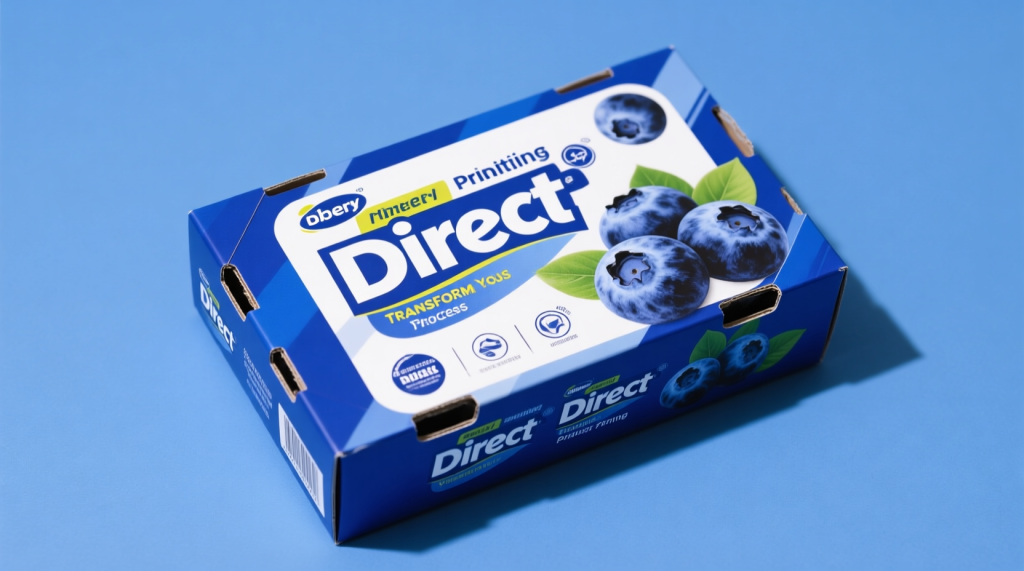
Blueberry packers face a common conflict: retailers want sustainable blueberry clamshell packaging (mono-material, recyclable, fewer components), but peak-season operations also demand high throughput, clear traceability, and consistent on-shelf appearance. One route gaining adoption is direct printing on PET fruit containers—printing graphics onto the lid or tub rather than applying a pressure-sensitive label.
Key Benefits at a Glance
- Material reduction: removes label film + adhesive (often ~0.2–1.0 g per pack depending on label size), cutting label-related plastics by ~1–5% of total pack weight in many common clamshell formats.
- Recyclability: supports mono-material berry packaging (e.g., PET code 1) and reduces adhesive contamination in wash/reclaim systems.
- Operational simplification: fewer SKUs for labels, fewer label-application stoppages, and faster design updates when integrated with digital workflows.
- Brand + compliance: enables durable variable data (lot code, QR code, origin) for retailer-ready and export-compliant blueberry packaging.
External references (regulatory context): EU food-contact framework Regulation (EC) No 1935/2004 and U.S. FDA food-contact regulations under 21 CFR (Food and Drugs) are commonly used as baseline requirements for export-facing packaging programs.
TL;DR: Direct printing can improve recyclability and reduce labeling complexity, but it must be engineered around food-contact rules, substrate variability (rPET vs virgin PET), and cold-chain realities.
Industry growth in Yunnan is pushing higher-volume, export-oriented packaging
By 2026, the blueberry planting area in Yunnan, China is projected to surge from 30,000 mu in 2019 to more than 500,000 mu. Higher volumes amplify packaging pain points: consistent ventilation and stacking strength, high clarity for visual quality grading, and production stability during short harvest windows.
For many packhouses, the packaging line is tightly coupled to automated denesters, fillers, checkweighers, and top-seal/close-lid stations. Any downstream issue—like label misfeeds or poor adhesion in condensation—shows up as line stops and missed shipping cutoffs.
TL;DR: As blueberry throughput rises, packaging changes must protect uptime and cold-chain performance—not just aesthetics.
Who should read this (use cases)

- Packaging engineers evaluating mono-material berry packaging and food-grade direct print technology
- Operations/plant managers responsible for OEE (Overall Equipment Effectiveness) and seasonal surge capacity
- Sustainability managers tracking recyclability, recycled content, and retailer packaging scorecards
- Brand owners and retailers needing traceability, export compliance, and shelf consistency
TL;DR: This is written for decision-makers balancing sustainability, compliance, and high-speed packaging operations.
Stakeholders and roles: Gaoxuanyue (packaging manufacturer) vs. Suzhou CAI Machine Group (equipment supplier)
Kunming Gaoxuanyue Plastic Products Co., Ltd. is the thermoformer/converter—it designs and manufactures clamshells, lids, and trays (including blueberry formats) and manages food-contact quality systems, incoming resin control, thickness capability, and forming consistency.
Suzhou CAI Machine Group Co., Ltd. is the equipment supplier providing the direct-printing machine platform (printing + curing + handling). In practice, successful deployment depends on how well the printer integrates with Gaoxuanyue’s formed parts, lid tolerances, and production scheduling.
TL;DR: The packaging manufacturer owns substrate consistency and compliance; the machine supplier provides the print/curing platform—both must align for stable output.
What “blueberry clamshell” plastic actually means: rPET vs virgin PET, PP, and typical gauges

Blueberry clamshells are commonly thermoformed from:
- PET (polyethylene terephthalate, recycling code 1) — widely used for clarity and stiffness; may be virgin PET or rPET (recycled PET).
- PP (polypropylene, recycling code 5) — tougher hinge performance in some designs and good moisture resistance; lower clarity than PET unless clarified grades are used.
Typical thickness (gauge): Many berry clamshells fall roughly in the 0.25–0.60 mm sheet range depending on size, stacking requirements, and puncture resistance targets. rPET can show higher haze, higher gel/contaminant risk, and wider surface energy variation—important for ink wetting and adhesion.
Recyclability note: PET clamshells typically target the PET #1 stream. Printing adds pigments/inks; in well-managed systems, the bigger recycling issues usually come from labels, adhesives, and incompatible materials rather than thin printed layers. However, heavy ink coverage, metallic effects, or non-deinkable systems can reduce reclaim value depending on the recycler’s wash and decontamination setup.
TL;DR: Most blueberry clamshells are PET #1 (virgin or rPET) or PP #5; direct printing is generally more recycler-friendly than label + adhesive, but ink system choice and coverage still matter.
The turning point: moving from pressure-sensitive labels to food-grade direct print technology
In 2024, Gaoxuanyue introduced a full-color direct printing system for lids/containers, shifting from pressure-sensitive labels (label facestock + adhesive + release liner) to printing directly on the formed plastic surface.
Direct printing can be implemented via several industrial methods. For thermoformed lids and clamshells, common routes include:
- UV flexo (ultraviolet flexographic printing): analog plates; strong for high-volume, repeat jobs.
- UV inkjet (ultraviolet digital inkjet): plate-free, faster artwork changes and variable data printing (VDP).
- Offset printing: typically used on flat sheets; less common on formed parts unless printing pre-form and then forming (which introduces its own deformation constraints).
Curing method: UV systems typically use UV LED or mercury UV lamps to polymerize the ink. UV LED can reduce heat load on thin PET and help limit warpage, but requires ink chemistry designed for LED wavelengths.
TL;DR: The shift is not just “no label”—it’s a process change involving print technology choice (UV flexo/UV inkjet), curing, and quality controls tailored to thermoformed plastics.
Compliance and standards: what “food-contact” means for direct-printed packaging

When printing directly onto food packaging, compliance is not only about the plastic resin—it also includes ink chemistry, photoinitiators, potential set-off (ink transfer), and migration. Key reference frameworks often used in qualification include:
- EU: Framework Regulation (EC) No 1935/2004 plus GMP (Good Manufacturing Practice) principles under Regulation (EC) No 2023/2006.
- U.S.: FDA 21 CFR (relevant sections depend on substrate/ink components and use conditions).
- China: Food-contact materials are commonly managed under the GB system (e.g., general safety requirements for food-contact materials and specific material standards). Companies typically demonstrate compliance through supplier declarations and testing to applicable GB requirements for the finished article.
Ink selection (migration awareness): For “food-grade direct print technology,” many converters specify low-migration UV inks designed to reduce the risk of components diffusing through packaging or transferring via set-off during stacking. Actual compliance still depends on curing dose, film thickness, storage time/temperature, and whether the print is on the outside surface with controlled set-off risk.
Practical control points:
- UV dose verification (lamp intensity, conveyor speed, reflectors/optics condition)
- Odor testing and sensory checks (especially important for closed clamshell headspace)
- Lot traceability for inks/varnishes and change control for formulations
TL;DR: Direct printing can be food-contact compliant, but it must be validated via ink selection, curing control, and documented GMP-style processes aligned to EU/FDA/GB expectations.
Why direct printing for blueberry packaging (and when it’s not the best choice)
1) Recyclability and mono-material packaging
Direct printing supports mono-material berry packaging by eliminating label facestock and adhesive—two of the most common sources of contamination in mechanical recycling. In many typical designs, removing labels can reduce label-related plastic and adhesive inputs by ~1–5% of total pack mass and can reduce “flake stickies” risk in reclaim wash systems.
Limitation: Extremely high ink coverage (solid flood coats), metallic inks/effects, or poor-curing can create recycler concerns. Many programs therefore keep ink coverage targeted (logos, key text, QR) rather than full-surface decoration.
2) Cold-chain readability and traceability
Blueberries often run through chilled storage where condensation and scuffing occur. Direct print can improve durability versus labels that lift at edges—provided adhesion is tuned for the substrate (especially rPET variability). Direct print also supports variable data (batch/lot, packing date, QR codes) for retailer audit trails.
Limitation: Curved lids and ribbed surfaces can distort small text or QR codes. Minimum module size and print placement should be engineered for scan reliability after moisture exposure.
3) Line stability during seasonal peaks
Removing label application reduces failure modes like misalignment, bubbles, and liner breaks. It also simplifies label inventory planning during peak season.
Limitation: Direct print introduces new controls—UV lamps, printhead/plate maintenance, and color management. If those controls are weak, downtime can shift from labeling to printing.
TL;DR: Direct printing helps mono-material recyclability and cold-chain durability, but it is not universally better—curved surfaces, rPET variability, and curing discipline can make or break results.
Technical performance: throughput, line speed, and print quality targets

Gaoxuanyue reported output of approximately 130,000–140,000 printed units per 10 hours, which corresponds to roughly 13,000–14,000 units/hour under real conditions (actual rate depends on lid size, image coverage, handling, and QC sampling).
For context, industrial direct printing systems on packaging parts commonly operate with:
- Throughput: often in the 10,000–30,000 units/hour range for single-lane to multi-lane handling (application-dependent).
- Resolution (UV inkjet): typically 600–1200 dpi (dots per inch) class for packaging graphics; effective quality depends on substrate, dot gain, and curing.
- Curing: UV LED or mercury UV; process window managed by lamp aging, distance, and line speed.
Quality checkpoints commonly used:
- Adhesion: cross-hatch/tape test (site-specific acceptance criteria)
- Rub/scuff resistance: especially for stacked, nested lids
- Color consistency: ΔE targets (color difference) agreed with brand owners
- Barcode/QR verification: scan grade after condensation simulation
TL;DR: Reported performance is ~13–14k units/hour; achieving stable quality requires explicit targets for adhesion, scuff, color (ΔE), and code scanability.
Labeling vs. direct printing: conceptual comparison table (what usually changes in practice)
| Factor | Pressure-sensitive labeling | Direct printing on lids/containers |
|---|---|---|
| Cost per unit | Lower capex; ongoing label + liner + adhesive cost | Higher capex; lower ongoing consumables (no label stock/liners) |
| Recyclability | Label facestock + adhesive may contaminate PET #1 stream | Improves mono-material packaging; ink system/coverage must be recycler-aware |
| Changeover time | Label roll swaps; artwork changes require inventory planning | Digital (UV inkjet) can switch faster; flexo requires plate management |
| Line speed sensitivity | Label misfeeds, bubbles, edge lift cause stops | Curing/adhesion and handling registration become key constraints |
| Design flexibility | High, but bounded by label size/placement | High; supports integrated QR/variable data where equipped |
| Regulatory compliance workload | Focus on label materials + adhesives + migration risk | Focus on low-migration inks, curing validation, set-off control, GMP documentation |
TL;DR: Labeling is simpler to start but adds materials and recycling complications; direct printing shifts cost to capex and process control (curing, adhesion, color management).
Common pitfalls when switching from labels to direct printing (and how to troubleshoot)

- Ink adhesion variability on rPET: rPET surface energy can vary by supplier and batch. Mitigation: incoming substrate checks (dyne level), tighter forming temperature control, and primers or corona/plasma treatment if needed.
- Condensation + scuffing in cold chain: Water film and abrasion during case packing can reduce legibility. Mitigation: choose inks/overprint varnish (OPV) suited to wet rub; validate with chilled storage and rub tests.
- Color matching across PET vs PP: Same artwork can shift due to haze/clarity differences and ink wetting. Mitigation: separate color profiles and substrate-specific proofs; define acceptable ΔE by substrate.
- Curved/structured lid geometry: Ribs, domes, and draft angles can distort small type and QR modules. Mitigation: reserve flat “print zones,” enlarge codes, and verify scan grade after forming and handling.
- Stacking set-off (ink transfer): If parts are nested/stacked too soon, uncured ink can transfer. Mitigation: confirm UV dose, add dwell time, adjust stacking method, and monitor lamp aging.
TL;DR: The biggest transition risks are rPET adhesion, condensation rub, geometry-driven distortion, and curing/set-off—each is solvable with testing and tighter process controls.
Benchmarks and broader adoption: direct printing isn’t unique to one company
Direct printing (especially UV inkjet and UV flexo) is widely used across food and beverage packaging components globally—commonly for caps, tubs, lids, and trays where label application is a bottleneck or where recyclability goals push for fewer components. In mature markets, many brands also pair direct print with “smart packaging” elements (QR-driven traceability, anti-counterfeit marks) to support retailer audits and D2C (direct-to-consumer) channels.
Where labels still win: Very frequent artwork changes at low volume, extreme multi-language compliance without digital print integration, or when the container geometry makes print registration unreliable. In those cases, a high-quality label (or sleeve in some categories) may still be the practical option—though recyclability trade-offs should be assessed.
TL;DR: Direct printing is a proven global approach, but labeling remains relevant for certain low-volume, high-variation, or difficult-geometry applications.
ROI and total cost of ownership (TCO): when direct printing becomes economically attractive

ROI depends on volume, SKU complexity, and scrap/downtime costs. While exact numbers vary, direct printing is often economically compelling when:
- Annual volume is high: commonly multi-millions of units/year, where label consumables and labeling labor/downtime are significant.
- SKU count is moderate: fewer designs benefit from stable setups (especially for flexo). For many SKUs with frequent artwork changes, UV inkjet can improve economics through fast changeovers.
- Downtime is costly: short harvest windows mean an hour of lost output can exceed the marginal savings of cheaper labeling.
Indicative payback ranges: Many high-throughput packaging operations target ~12–36 months payback depending on capex, shift pattern, label cost, and utilization. A useful way to model ROI is to compare: (1) label + labor + downtime + inventory carrying cost vs. (2) ink + maintenance + energy + depreciation + training/QC.
TL;DR: Direct printing typically makes sense at high annual volumes and when labeling downtime/consumables are material—often with a 1–3 year payback target depending on utilization.
Beyond blueberries: other applications and what changes technically
- Cherry punnets: often higher stiffness and venting needs; darker fruit can benefit from high-contrast print. Geometry may be more ribbed, so “flat print zones” matter more for QR readability.
- Bakery containers: oils/grease and abrasion can challenge ink rub resistance. Overprint varnish selection and testing against fats becomes more critical than in berries.
- Ice cream tubs/lids: condensation, freezer cycling, and low temperatures can stress adhesion. Ink brittleness and crack resistance should be validated under freeze/thaw conditions.
TL;DR: The same printer can serve multiple food packs, but ink/varnish choices and validation tests must match each product’s moisture, grease, and temperature exposure.
Implementation checklist: making direct printing work on a real packaging line

- Define substrate scope: virgin PET vs rPET %, PP options, target thickness window, acceptable haze/clarity range.
- Lock print zones into CAD: reserve flat areas on lids for QR/barcodes and critical text.
- Validate curing + migration risk: document UV dose controls, stacking/set-off prevention, and maintain supplier compliance files aligned to EU/FDA/GB expectations.
- Plan maintenance: lamp replacement schedule, printhead cleaning (for inkjet), anilox/plate care (for flexo), and spare parts strategy for peak season.
- Train operators: color control, defect recognition, and rapid troubleshooting to avoid shifting downtime from labeling to printing.
TL;DR: Success requires engineering the pack for print (zones), validating compliance (inks/curing), and operationalizing maintenance and training for peak-season reliability.
Media Contact
Company Name: Suzhou CAI Machine Group Co., Ltd.
Website: https://www.caimachine.com/
TL;DR: Gaoxuanyue is the packaging manufacturer; Suzhou CAI Machine Group supplies the printing equipment platform.
FAQ
Q: Does UV direct printing adhere well on rPET blueberry clamshell lids?
A: It can, but rPET (recycled PET) often has higher surface variability than virgin PET. Adhesion depends on surface energy, contamination level, and forming conditions. Many operations use incoming substrate checks (e.g., dyne testing), optimize UV curing dose, and may add surface treatment (corona/plasma) or a primer when adhesion margins are tight.
Q: How does direct printing perform under condensation in the cold chain?
A: Condensation mainly challenges rub resistance and barcode/QR readability. A robust system uses a low-migration UV ink matched with an overprint varnish (OPV) where needed, validates wet-rub performance, and confirms QR scan grade after chilled storage and case-packing abrasion.
Q: Is direct printing compatible with automated denesting, filling, and lidding/sealing lines?
A: Usually yes, but it must be engineered. Key factors include print placement away from vacuum/gripper contact points, sufficient curing to prevent set-off in nested stacks, and dimensional control of lids so registration remains stable. Pilot trials on the actual automation line are strongly recommended.
Q: What maintenance and cleaning does a direct-to-lid printer typically require?
A: Requirements depend on technology. UV inkjet systems typically need routine printhead cleaning, nozzle checks, and controlled shutdown procedures to avoid drying/clogging. UV flexo systems require anilox and plate cleaning plus viscosity/ink management. All UV systems need lamp/LED intensity monitoring and scheduled replacement to keep curing consistent.
Q: Will direct printing improve PET #1 recyclability compared with pressure-sensitive labels?
A: Often yes, because it removes label facestock and adhesives that can create contamination (“stickies”) and sorting issues. However, recyclability still depends on ink system selection, coverage level, and whether the recycler’s process can handle the printed article. Many brands keep ink coverage moderate and avoid problematic effects to preserve reclaim value.