

Introduction (State and ZIP Code List, U.S. Territories ZIP Codes, APO/FPO Format, Canadian Provinces and Postal Codes)
If you’re searching for a state and ZIP Code list, details on U.S. territories ZIP Codes, correct APO/FPO/DPO (Army/Fleet/Diplomatic Post Office) format, or Canadian provinces and postal codes, this guide summarizes the region codes and addressing rules most commonly needed for shipping, ecommerce checkouts, ERP/CRM (Enterprise Resource Planning/Customer Relationship Management) data, and address validation.
In the U.S., the ZIP Code (Zone Improvement Plan Code) is 5 digits, optionally followed by a hyphen and 4 more digits (ZIP+4) for more granular routing—often down to a segment such as a city block, building, high-volume receiver, or specific delivery points. In Canada, addresses require the correct province/territory abbreviation and a postal code (alphanumeric).
Authoritative references: USPS Publication 28 (Addressing Standards), USPS APO/FPO/DPO guidance, and Canada Post addressing standards.
TL;DR: Use official two-letter region abbreviations, enforce country-specific postal formats (U.S. ZIP/ZIP+4 vs. Canada postal code), and follow USPS/Canada Post standards to reduce delivery failures and validation errors.
Who This Guide Is For (Common Use Cases)
This is a practical reference for teams who need consistent address data and fewer shipping exceptions, including:
- Ecommerce operators configuring checkout country/state/province dropdowns and postal code validation
- ERP/CRM admins normalizing address records to official abbreviations for reporting and tax compliance
- Shipping software integrators implementing carrier rules, address validation, and rate shopping logic
- Marketplace sellers handling U.S. states, U.S. territories, military mail, and Canada
TL;DR: If you store, validate, rate, tax, or ship to North American addresses, standard abbreviations + correct ZIP/postal formats will prevent costly downstream errors.
U.S. ZIP Codes Explained (5-Digit and ZIP+4)
A ZIP Code is a 5-digit numeric code used by the United States Postal Service (USPS) to route mail. A ZIP+4 adds four extra digits (formatted like 12345-6789) to improve routing precision—often helping identify a smaller geographic segment or delivery unit, which can speed processing and reduce misroutes.
USPS provides official addressing rules and formatting guidance in Publication 28.
TL;DR: U.S. ZIP Codes are always 5 digits; ZIP+4 (optional) increases delivery-point precision and can reduce shipping exceptions.
U.S. States (USPS Two-Letter Abbreviations) — Quick Reference Table
USPS requires standardized two-letter state abbreviations (e.g., CA, TX). Use these abbreviations in databases and shipping labels for consistency and better validation outcomes.
| Name | USPS Abbreviation | Country | Uses |
|---|---|---|---|
| Alabama | AL | US | ZIP Code / ZIP+4 |
| Alaska | AK | US | ZIP Code / ZIP+4 |
| Arizona | AZ | US | ZIP Code / ZIP+4 |
| Arkansas | AR | US | ZIP Code / ZIP+4 |
| California | CA | US | ZIP Code / ZIP+4 |
| Colorado | CO | US | ZIP Code / ZIP+4 |
| Connecticut | CT | US | ZIP Code / ZIP+4 |
| Delaware | DE | US | ZIP Code / ZIP+4 |
| Florida | FL | US | ZIP Code / ZIP+4 |
| Georgia | GA | US | ZIP Code / ZIP+4 |
| Hawaii | HI | US | ZIP Code / ZIP+4 |
| Idaho | ID | US | ZIP Code / ZIP+4 |
| Illinois | IL | US | ZIP Code / ZIP+4 |
| Indiana | IN | US | ZIP Code / ZIP+4 |
| Iowa | IA | US | ZIP Code / ZIP+4 |
| Kansas | KS | US | ZIP Code / ZIP+4 |
| Kentucky | KY | US | ZIP Code / ZIP+4 |
| Louisiana | LA | US | ZIP Code / ZIP+4 |
| Maine | ME | US | ZIP Code / ZIP+4 |
| Maryland | MD | US | ZIP Code / ZIP+4 |
| Massachusetts | MA | US | ZIP Code / ZIP+4 |
| Michigan | MI | US | ZIP Code / ZIP+4 |
| Minnesota | MN | US | ZIP Code / ZIP+4 |
| Mississippi | MS | US | ZIP Code / ZIP+4 |
| Missouri | MO | US | ZIP Code / ZIP+4 |
| Montana | MT | US | ZIP Code / ZIP+4 |
| Nebraska | NE | US | ZIP Code / ZIP+4 |
| Nevada | NV | US | ZIP Code / ZIP+4 |
| New Hampshire | NH | US | ZIP Code / ZIP+4 |
| New Jersey | NJ | US | ZIP Code / ZIP+4 |
| New Mexico | NM | US | ZIP Code / ZIP+4 |
| New York | NY | US | ZIP Code / ZIP+4 |
| North Carolina | NC | US | ZIP Code / ZIP+4 |
| North Dakota | ND | US | ZIP Code / ZIP+4 |
| Ohio | OH | US | ZIP Code / ZIP+4 |
| Oklahoma | OK | US | ZIP Code / ZIP+4 |
| Oregon | OR | US | ZIP Code / ZIP+4 |
| Pennsylvania | PA | US | ZIP Code / ZIP+4 |
| Rhode Island | RI | US | ZIP Code / ZIP+4 |
| South Carolina | SC | US | ZIP Code / ZIP+4 |
| South Dakota | SD | US | ZIP Code / ZIP+4 |
| Tennessee | TN | US | ZIP Code / ZIP+4 |
| Texas | TX | US | ZIP Code / ZIP+4 |
| Utah | UT | US | ZIP Code / ZIP+4 |
| Vermont | VT | US | ZIP Code / ZIP+4 |
| Virginia | VA | US | ZIP Code / ZIP+4 |
| Washington | WA | US | ZIP Code / ZIP+4 |
| West Virginia | WV | US | ZIP Code / ZIP+4 |
| Wisconsin | WI | US | ZIP Code / ZIP+4 |
| Wyoming | WY | US | ZIP Code / ZIP+4 |
TL;DR: Use USPS two-letter codes (e.g., NY, CA, TX) for all U.S. states to improve deliverability, database consistency, and API validation.
U.S. Federal District, Territories, and Freely Associated States in the USPS ZIP Code System
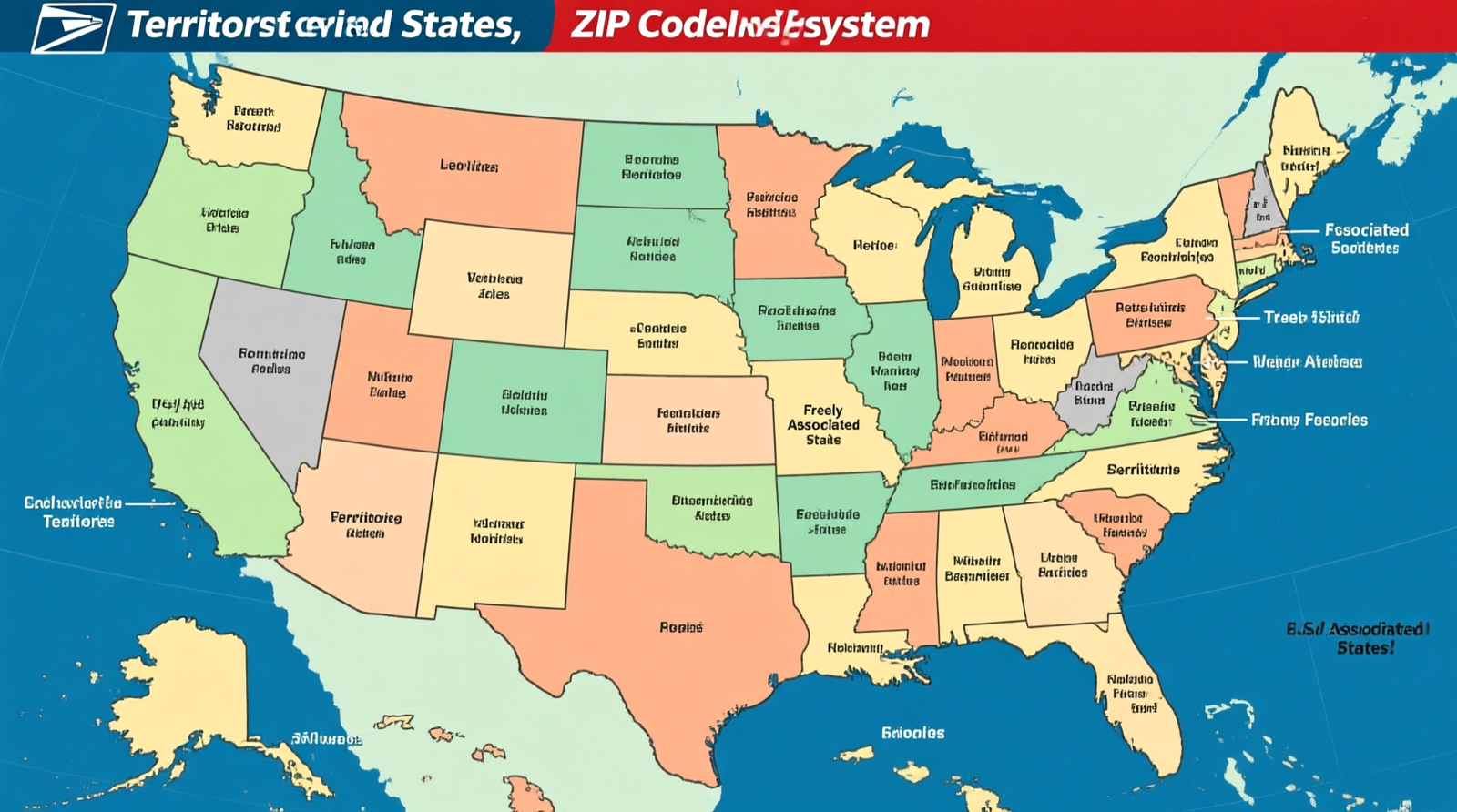
Beyond the 50 states, USPS recognizes the federal district and several U.S. territories for domestic-style addressing with ZIP Codes. Importantly, political status (state vs. territory vs. freely associated state) is different from postal integration: some non-states still use USPS addressing conventions and ZIP Codes.
The Freely Associated States—the Republic of the Marshall Islands (MH), the Federated States of Micronesia (FM), and the Republic of Palau (PW)—participate in the U.S. ZIP Code system under the Compact of Free Association (COFA). They are not U.S. territories, but USPS mail routing treats them similarly for addressing and ZIP usage in many contexts.
| Name | Abbreviation | Country/Status | Uses |
|---|---|---|---|
| District of Columbia | DC | US (Federal district) | ZIP Code / ZIP+4 |
| Puerto Rico | PR | US Territory | ZIP Code / ZIP+4 |
| U.S. Virgin Islands | VI | US Territory | ZIP Code / ZIP+4 |
| Guam | GU | US Territory | ZIP Code / ZIP+4 |
| American Samoa | AS | US Territory | ZIP Code / ZIP+4 |
| Northern Mariana Islands | MP | US Commonwealth | ZIP Code / ZIP+4 |
| Republic of the Marshall Islands | MH | Freely Associated State (COFA) | ZIP Code / ZIP+4 |
| Federated States of Micronesia | FM | Freely Associated State (COFA) | ZIP Code / ZIP+4 |
| Republic of Palau | PW | Freely Associated State (COFA) | ZIP Code / ZIP+4 |
For official postal abbreviations and addressing conventions, see USPS resources like Publication 28.
TL;DR: DC and major U.S. territories use USPS ZIP Codes; MH, FM, and PW are not U.S. territories politically, but do participate in the ZIP Code system under COFA for mail routing.
Armed Forces Mailing Regions (APO/FPO/DPO): AA, AE, AP + Typical ZIP Code Ranges
Military and diplomatic mail uses special “state” codes and city designations:
APO (Army Post Office), FPO (Fleet Post Office), and DPO (Diplomatic Post Office).
USPS assigns these addresses to Armed Forces “state” codes:
| Region | State Code | Typical ZIP Code Ranges | Common City Field |
|---|---|---|---|
| Armed Forces Americas | AA | 340xx | APO/FPO/DPO |
| Armed Forces Europe | AE | 090xx–098xx | APO/FPO/DPO |
| Armed Forces Pacific | AP | 962xx–966xx | APO/FPO/DPO |
For current rules and examples, reference USPS APO/FPO shipping guidance.
TL;DR: Use AA/AE/AP as the “state,” APO/FPO/DPO as the “city,” and a military ZIP Code (commonly 340xx, 090xx–098xx, or 962xx–966xx).
Canadian Provinces and Territories (Official Abbreviations + Postal Code Requirements)
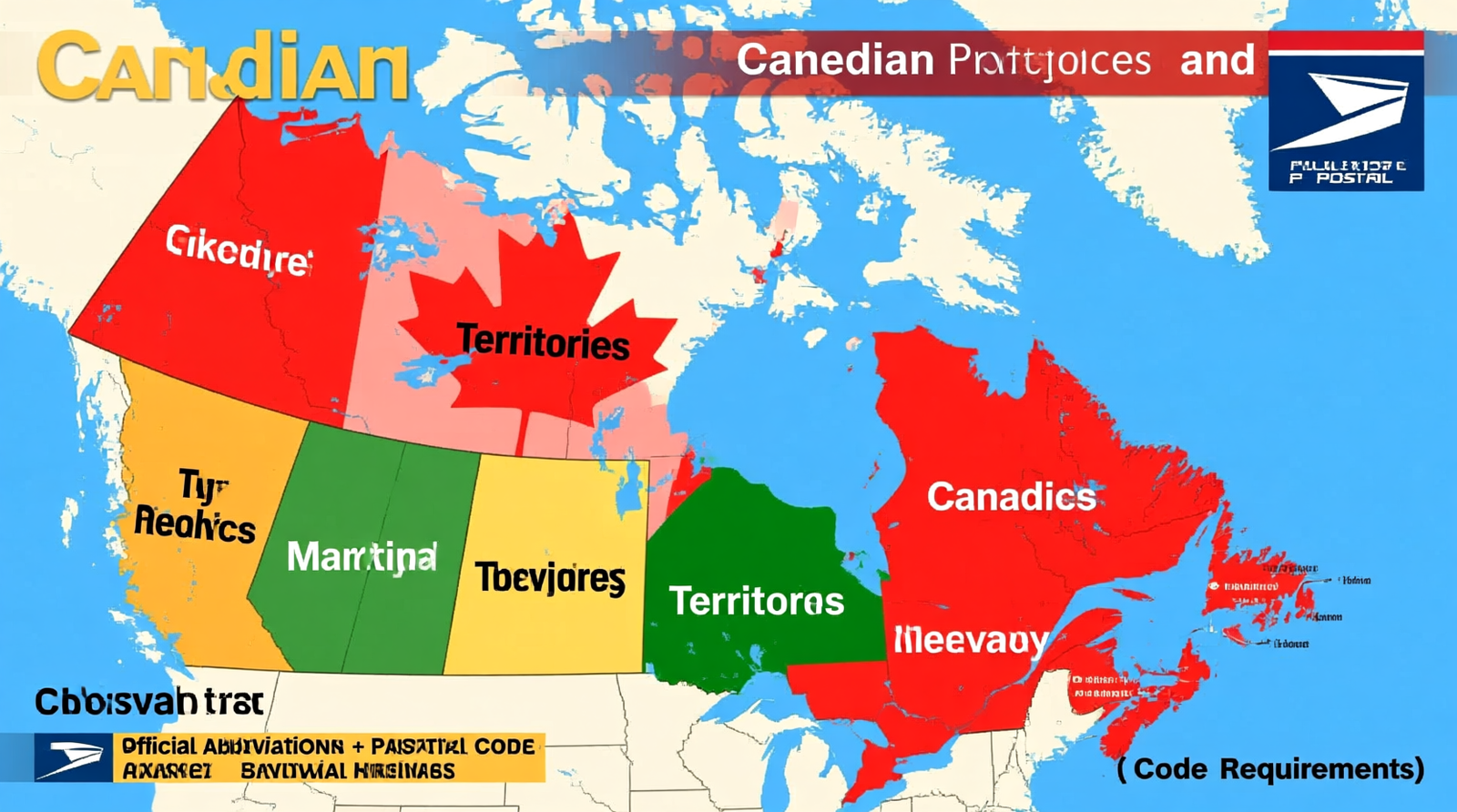
Canada uses postal codes (not ZIP Codes) and requires the correct province/territory abbreviation in addressing. Canadian postal codes follow the pattern A1A 1A1 (letter–digit–letter space digit–letter–digit).
Canada Post generally formats the last line as CITY PROVINCE POSTAL CODE (often in uppercase), with a space in the middle of the postal code (e.g., K1A 0B1). The province abbreviation is placed between the municipality and the postal code.
Official guidance is available from Canada Post.
| Name | Abbreviation | Country | Uses |
|---|---|---|---|
| Alberta | AB | CA | Postal code (A1A 1A1) |
| British Columbia | BC | CA | Postal code (A1A 1A1) |
| Manitoba | MB | CA | Postal code (A1A 1A1) |
| New Brunswick | NB | CA | Postal code (A1A 1A1) |
| Newfoundland and Labrador | NL | CA | Postal code (A1A 1A1) |
| Nova Scotia | NS | CA | Postal code (A1A 1A1) |
| Northwest Territories | NT | CA | Postal code (A1A 1A1) |
| Nunavut | NU | CA | Postal code (A1A 1A1) |
| Ontario | ON | CA | Postal code (A1A 1A1) |
| Prince Edward Island | PE | CA | Postal code (A1A 1A1) |
| Quebec | QC | CA | Postal code (A1A 1A1) |
| Saskatchewan | SK | CA | Postal code (A1A 1A1) |
| Yukon | YT | CA | Postal code (A1A 1A1) |
TL;DR: Canadian addressing requires province/territory abbreviations (ON, QC, BC, etc.) and an alphanumeric postal code with a space (e.g., K1A 0B1), typically in uppercase.
Practical Address Examples (U.S., Territories, APO/FPO/DPO, Canada)
Use these as templates when building forms, training staff, or troubleshooting misrouted shipments.
U.S. Address Example (with ZIP+4)
ACME INDUSTRIAL SUPPLY
1234 W MAIN ST STE 200
PHOENIX AZ 85001-1234
UNITED STATES
U.S. Territory Address Example (Puerto Rico – PR)
JUAN PEREZ
URB LAS FLORES CALLE 10 #123
SAN JUAN PR 00901-1234
UNITED STATES
U.S. Territory Address Example (Guam – GU)
PACIFIC PARTS CO
456 MARINE CORPS DR
HAGATNA GU 96910
UNITED STATES
APO/FPO/DPO Military Address Example
SGT JANE DOE
UNIT 2050 BOX 4190
APO AE 09350
UNITED STATES
Canadian Address Example (Line-by-Line, Postal Code Format)
ACME MANUFACTURING LTD
123 INDUSTRIAL AVE
OTTAWA ON K1A 0B1
CANADA
TL;DR: Follow country-specific formatting: U.S. uses STATE + ZIP/ZIP+4; territories still use USPS abbreviations; APO/FPO/DPO uses AA/AE/AP; Canada requires province abbreviation + postal code with a space and “CANADA” as the country.
Common Mistakes That Cause Shipping Delays (and How to Avoid Them)

- Omitting the country for Canadian shipments: Always include “CANADA” on cross-border labels and commercial invoices.
- Using a U.S.-style ZIP Code for Canada: Canada requires the A1A 1A1 postal code pattern with a space.
- Misusing Washington, D.C.: The correct USPS abbreviation is DC (not “Washington, D.C.” in the state field).
- Treating Puerto Rico (PR) as international: PR is addressed like a domestic USPS destination and uses ZIP Codes.
- Not normalizing abbreviations: Mixing “California” and “CA” across systems can break validation, tax rules, and carrier rating.
TL;DR: Most failures come from wrong country selection, wrong postal format (ZIP vs. Canadian postal), and non-standard region abbreviations (DC, PR, etc.).
Why Accurate Region + ZIP/Postal Code Matching Matters (Tax, Rates, and Data Quality)
Correctly pairing state/territory/province with the correct ZIP Code or postal code improves:
- Carrier rating and rate shopping: Shipping systems often rate by origin/destination zones derived from postal codes.
- Tax jurisdiction mapping: Many tax engines use state + ZIP (or province + postal code) to determine applicable sales tax/VAT/GST/HST/PST rules and boundary edge cases.
- Address validation and deliverability: Validation tools compare region codes against postal code patterns and known delivery points.
- Analytics and territory planning: Clean geography fields improve reporting, demand planning, and service coverage decisions.
For background on USPS addressing rules, start with USPS Publication 28. For Canadian rules, see Canada Post standards.
TL;DR: Region + postal code accuracy isn’t just deliverability—it also drives rating, taxation, reporting, and automation quality.
Address Validation and System Integration (APIs, Normalization, and Cross-Border Logic)
Most organizations validate and standardize addresses using a mix of official and commercial services:
- USPS tools: USPS offers address-related services and standards; many platforms integrate USPS-based validation workflows. Start with USPS addressing standards in Publication 28.
- Canada Post addressing: Follow the Canadian addressing standard from Canada Post.
- Commercial address validation providers: Often add autocomplete, geocoding, deliverability scoring, and multinational coverage.
Typical integration patterns:
- Web form validation: Validate on checkout/account creation, normalize to official abbreviations (e.g., “California” → “CA”; “Ontario” → “ON”), and enforce format rules by country.
- Backend validation: Batch-clean customer/vendor masters and deduplicate using standardized fields (company, street, city, region code, ZIP/postal code, country).
- Cross-border logic: If Country = CA, require province code + Canadian postal code pattern; if Country = US, require USPS state/territory code + 5-digit ZIP (optionally ZIP+4).
Best practices: normalize to official abbreviations, validate country-specific postal formats, store both raw input and standardized output for auditability, and keep rules aligned with carrier/tax engine expectations.
TL;DR: Integrate validation at the form and backend levels, normalize to official region codes, and enforce different postal rules for US vs. CA to prevent downstream rating/tax/shipping failures.
Conclusion
This is a high-level but practical reference for USPS state/territory abbreviations, Armed Forces AA/AE/AP, and Canadian province/territory abbreviations, along with key rules for ZIP Code/ZIP+4 and Canadian postal code formatting.
For the most current specifications, rely on official standards from USPS and Canada Post, and refresh your validation logic periodically.
TL;DR: Use official abbreviations everywhere, validate postal formats by country, and reference USPS/Canada Post standards for ongoing accuracy.
FAQ

Q: What are ZIP Code ranges for U.S. states and territories?
A: ZIP Codes are assigned by USPS for routing, and the first digit broadly indicates a U.S. region (for example, 0xx in the Northeast through 9xx on the West Coast), but ZIP boundaries do not perfectly match state borders. States and territories often have multiple ZIP prefixes, and some ZIPs can be associated with PO Boxes or large organizations. Use USPS tools/standards (e.g., Publication 28) and address validation to confirm valid combinations.
Q: Are Puerto Rico (PR) and Guam (GU) considered international for shipping and ZIP Codes?
A: No—PR and GU use USPS addressing conventions and ZIP Codes, and they generally should be handled as domestic-style USPS destinations in systems. Politically they are U.S. territories, but postally they are integrated into the USPS routing framework.
Q: How do PO Boxes affect ZIP Codes and address validation?
A: PO Box addresses still use valid ZIP Codes (and sometimes ZIP+4), but the deliverability rules differ from street delivery. Many carriers and services have restrictions on shipping to PO Boxes, and some address validation systems will flag “PO BOX” as non-residential or require different handling. Best practice is to store a clear indicator (PO Box vs. street) and validate accordingly.
Q: What’s the correct format for APO/FPO/DPO addresses and what do AA, AE, and AP mean?
A: Use APO/FPO/DPO as the city, and use AA (Americas), AE (Europe), or AP (Pacific) as the state code, followed by a military ZIP Code (commonly 340xx, 090xx–098xx, or 962xx–966xx). USPS provides guidance here: USPS APO/FPO.
Q: How often should we refresh USPS/Canada postal data and validation rules?
A: Refresh on a regular schedule (commonly quarterly or at least annually) because postal codes and routing data can change due to new developments, boundary adjustments, new delivery points, and administrative updates. Keeping data current reduces failed deliveries, improves rate accuracy, and prevents tax-jurisdiction mismatches—especially for high-volume ecommerce and ERP/CRM master data.