Mumbai, India | 24 March 2026
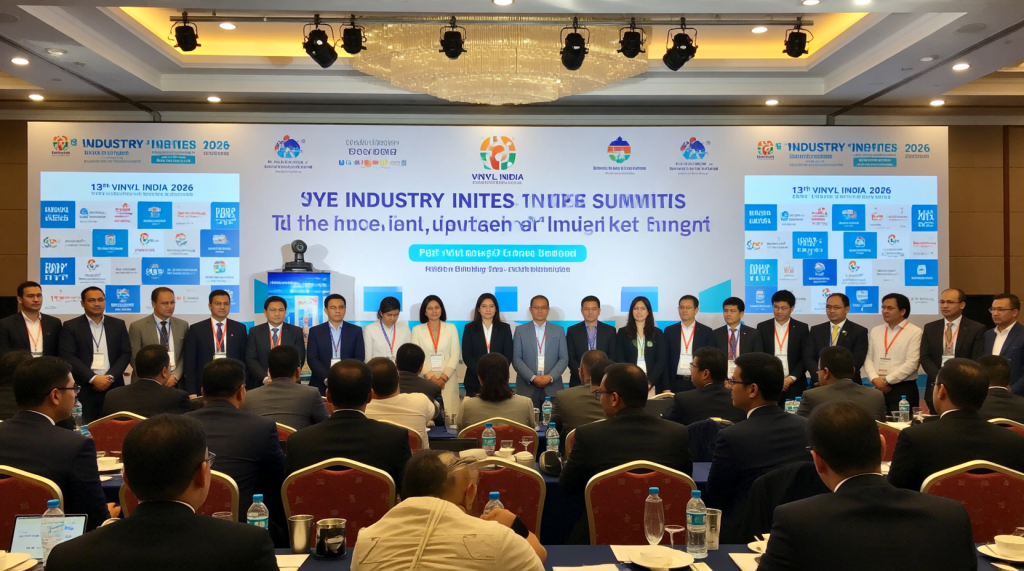
ElitePlus++ Business Services will host the 13th edition of VINYL INDIA 2026, a PVC summit and PVC exhibition, on 9–10 April 2026 at Hotel Sahara Star, Mumbai, India. Designed as a PVC conference in India with an international delegate mix, the event combines market outlook, technical sessions, and structured B2B meetings for the vinyl (PVC) value chain.
The organizer expects 1,200+ delegates from 500+ organizations and 19+ countries. As of 24 March 2026, 1,037 leaders from 441+ organizations across 19 countries have confirmed participation—useful context for international companies evaluating this global vinyl industry event in Mumbai.
TL;DR: VINYL INDIA 2026 is a large-format PVC conference and exhibition in Mumbai (9–10 April 2026) with 1,000+ confirmed participants and a focus on market intelligence, technology, and deal-making.
A critical PVC industry gathering in a VUCA market environment

VINYL INDIA 2026 is planned against a market backdrop often described as VUCA—Volatility, Uncertainty, Complexity, and Ambiguity—a framework used in strategic planning to explain environments where conditions shift quickly and signals are hard to interpret.
For PVC, VUCA is not theoretical. Recent disruptions that have materially affected pricing, lead times, and trade flows include:
- Energy and feedstock-linked cost spikes: PVC economics are tightly linked to ethylene (for the ethylene dichloride/vinyl chloride monomer route) and electricity/fuel costs (especially where chlor-alkali is power intensive). When energy benchmarks rise sharply, production costs and operating decisions can change rapidly across regions.
- Freight and route volatility: Global container availability, spot freight rate swings, and periodic route disruptions (e.g., diversions that lengthen Asia–Europe transit times) can shift the delivered cost of PVC resin and additives, impacting arbitrage trade and contract negotiations.
- Regional capacity moves: Start-ups, de-bottlenecking, and unplanned outages in Asia and the Middle East can quickly alter export availability into deficit markets such as India, especially during seasonal demand peaks in construction and irrigation.
To ground discussions in credible, comparable market data, delegates can also refer to public pricing and supply-chain indicators from organizations such as ICIS (petrochemical market intelligence) and trade statistics sources like UN Comtrade for import/export flows.
TL;DR: PVC decision-making in 2026 is shaped by VUCA—especially energy/feedstock swings, freight-route volatility, and fast-changing regional supply—making shared data and cross-value-chain dialogue highly practical.
PVC market outlook in India 2026: demand fundamentals, deficit, and capacity additions
Despite near-term volatility, most long-range demand cases for PVC in India remain linked to infrastructure and housing. India’s PVC consumption is supported by pipes (water supply, sanitation, irrigation), profiles (fenestration), wires & cables, and a broad set of construction products. This aligns with macro drivers frequently cited by multilateral and policy sources tracking infrastructure investment and urbanization (e.g., World Bank urban development insights).
Import dependency (indicative): India has historically been a net importer of PVC resin; industry estimates commonly place the import reliance at roughly 30–50% of annual demand depending on the year and operating rates. For readers who want to validate import trends, India’s official trade data can be cross-checked via the Government of India trade statistics portal and global mirrors such as UN Comtrade.
Capacity additions (what to watch): Two new PVC plants under implementation are expected to add meaningful domestic supply in the medium term. While final nameplate numbers and commissioning timelines can change, delegates will examine how new capacity could impact:
- import parity vs. domestic pricing
- availability of specific grades (pipe, profile, cable compounds)
- chlor-alkali integration and power-cost sensitivity
Downstream growth themes (typical ranges): In many Indian regions, organized uPVC (unplasticized polyvinyl chloride) profiles and modern plumbing systems continue to gain share; similarly, government and municipal projects sustain demand for pressure pipes. These segments often outpace baseline GDP growth when infrastructure spending is strong, which is a key reason the PVC market outlook in India 2026 remains a major agenda anchor.
TL;DR: India remains structurally short in PVC (often ~30–50% import reliance), with demand tied to infrastructure and housing; upcoming domestic capacity and grade availability will be central to 2026–2028 strategy.
What makes this PVC conference in India useful for senior decision-makers
This global PVC conference in Mumbai is structured for both commercial and technical leadership. Typical speaker and delegate profiles include CXO-level executives, business unit heads, procurement leaders, R&D (Research & Development) heads, plant/operations leaders, and regulatory/compliance professionals, alongside traders, logisticians, and industry associations.
To strengthen evidence-based discussion, sessions will reference market indicators, policy developments, and compliance frameworks relevant to PVC. For example:
- BIS (Bureau of Indian Standards) product standards that affect pipes, profiles, and building products in India: https://www.bis.gov.in/
- CPCB (Central Pollution Control Board) guidance and India’s broader EPR (Extended Producer Responsibility) direction under Plastic Waste Management rules, relevant to circularity discussions: https://cpcb.nic.in/
- REACH (Registration, Evaluation, Authorisation and Restriction of Chemicals) considerations for global supply chains selling into the EU and multinational customers: ECHA REACH overview
TL;DR: The conference is built for senior commercial, technical, and regulatory roles and anchors sustainability discussions in real standards (BIS), policy direction (CPCB/EPR), and global chemical compliance (REACH).
Two-day agenda overview: what delegates will learn
The program combines plenary market intelligence with technical breakouts designed for compounders, processors, additive suppliers, resin producers, and machinery providers. Below is a delegate-outcome view of key sessions.
Day 1: markets, strategy, and downstream transformation
- Keynotes & Plenary
Delegates will understand how macro conditions, trade shifts, and regional operating rates influence PVC price formation and contract strategy. - Business overview & macro indicators
Delegates will learn which India-specific demand drivers (infrastructure, housing, irrigation) are most correlated with PVC consumption and what leading indicators to track. - PVC market fundamentals and pricing
Delegates will review cost drivers (ethylene/EDC-VCM chain, power), typical spread behavior, and how freight and currency can change delivered economics. - Pipes & CPVC
Delegates will understand demand outlook in water and plumbing. CPVC (chlorinated polyvinyl chloride) will be discussed where hot-water plumbing and temperature resistance drive material selection. - Processing & downstream machinery
Delegates will learn how extrusion line productivity, automation, and scrap reduction programs translate into cost/ton and quality stability. - Sustainability and circularity
Delegates will evaluate practical pathways: design-for-recycling, traceability, additive selection, and compliance implications (BIS/CPCB/EPR; and REACH for export-linked supply chains). - Panel: diversification and value-chain integration
Delegates will hear how companies expand beyond commodity resin trading into compounds, specialty profiles, or application-led solutions (with examples and pitfalls discussed by operators).
TL;DR: Day 1 focuses on market and pricing logic, India demand drivers, pipes/CPVC growth, manufacturing efficiency, and regulatory-linked sustainability actions.
Day 2: manufacturing technology, additives, OPVC, and uPVC applications
- PVC manufacturing process developments
Delegates will compare key manufacturing routes—suspension PVC (S-PVC) vs. emulsion PVC (E-PVC)—and discuss de-bottlenecking, energy intensity, and emissions control improvements that impact cash cost and reliability. - Applications & machinery innovations
Delegates will see where product redesign (light-weighting, multilayer structures, performance upgrades) and newer machine controls improve throughput and reduce downtime. - Stabilizers technical session
Delegates will get updates on stabilizer systems, including Ca-Zn (calcium-zinc) stabilizers, lead-free conversion considerations, and performance tradeoffs for heat stability, weathering, and processing window—topics that matter directly to profiles, pipes, and cable compounds. - PVC additives and stabilizers technical sessions
Delegates will understand what’s new in low-VOC (low volatile organic compound) plasticizers, impact modifiers, processing aids, and potential bio-based modifiers, and how these choices influence odor, fogging, mechanicals, and compliance requirements. - Panel: OPVC pressure pipe technology in India
Delegates will explore OPVC (oriented PVC) for pressure pipes—where molecular orientation can enable higher pressure ratings at lower wall thickness, improving hydraulic performance and reducing material per meter in certain applications. - Panel: future of fenestration (uPVC)
Delegates will discuss uPVC (unplasticized PVC) windows and doors, including performance drivers such as thermal/acoustic insulation, weathering, and fabrication quality practices that influence customer outcomes and warranty risk. - Panel: advanced PVC applications
Delegates will review where PVC continues to expand into higher-value use cases through formulation and design—often requiring tighter control of additives, dispersion, and processing conditions.
TL;DR: Day 2 is more technical—manufacturing routes (S-PVC vs E-PVC), de-bottlenecking, additives/stabilizers (Ca-Zn, low-VOC), and application panels on OPVC pressure pipes and uPVC fenestration.
Who should attend (and who should not miss it)

If you are evaluating whether this PVC summit and PVC exhibition is relevant, the roles below typically get the highest ROI from the agenda and B2B format.
- Commercial & strategy: CEOs/MDs, business heads, strategy leaders, category managers
- Procurement & trading: purchasing managers, import/export managers, traders/indentors, supply-chain heads
- Technical & operations: plant heads, production managers, quality leaders, technical directors, compounding managers
- R&D and product development: formulation scientists, application engineers, NPD (new product development) teams
- Regulatory & compliance: EHS (environment, health & safety) managers, compliance officers handling BIS/CPCB/EPR/REACH-linked requirements
- Machinery & technology: OEMs, tooling suppliers, automation providers, recyclers and sorting technology companies
Who should not miss this event: if your 2026 priorities include resin sourcing strategy, stabilizer/additive reformulation (lead-free, low-VOC), OPVC adoption for pressure pipes, or entering India’s pipes/profiles market, the sessions and meeting formats are specifically aligned to those decisions.
TL;DR: Best-fit attendees include strategy, procurement, technical/ops, R&D, compliance, and machinery leaders; especially relevant for resin sourcing, additive reformulation, OPVC, and India market entry/growth.
B2B Speed Networking: how it works in practice
VINYL INDIA 2026 introduces B2B Speed Networking to make meetings more predictable for buyers, sellers, and partners.
Example workflow (typical):
- Pre-event profiling: delegates provide meeting preferences (buy/sell, product focus such as resin, additives, stabilizers, machinery, pipes/profiles).
- Online matching: suggested counterparties are shared for mutual acceptance to reduce irrelevant meetings.
- On-site meeting grid: short meetings (often 10–15 minutes each) in a scheduled block; delegates can typically complete 8–15 meetings depending on availability and demand.
- Follow-up: prioritized leads move to longer private discussions during breaks or post-event.
A separate networking evening program is also planned to support informal relationship-building among senior leaders, technical experts, and policymakers.
TL;DR: Speed Networking is structured: profile → match → 10–15 minute scheduled meetings → longer follow-ups, helping delegates fit many qualified conversations into two days.
Venue and logistics (helpful for international delegates)
Venue: Hotel Sahara Star, Mumbai. For overseas and out-of-city participants, the venue is widely known for its proximity to Mumbai’s primary airport corridors and access to key business districts, reducing local travel friction during a tight two-day schedule.
Proceedings language: Sessions at international business conferences in India are typically conducted in English; check the registration desk for any translation support requests or special accessibility needs.
TL;DR: The venue is chosen for convenient airport/business access, and proceedings are typically in English—useful for international planning.
Registration and participation
Register online:
https://eliteplus.co.in/evt/reg/register.php?evtcode=vin26
Group participation options are available for cross-functional teams (commercial + technical + compliance) that want aligned learnings from the same PVC conference in India.
TL;DR: Register via the official link; consider group registration if multiple functions (sales/strategy/technical/compliance) are attending.
About ElitePlus++ Business Services

ElitePlus++ Business Services organizes conferences and exhibitions across plastics, polymers, petrochemicals, and packaging. The VINYL INDIA format typically combines market outlook sessions with technical presentations and B2B meeting structures, aimed at practical outcomes (sourcing, partnerships, technology selection, and compliance readiness).
Support and policy engagement references include the DCPC (Department of Chemicals & Petrochemicals), Government of India.
TL;DR: ElitePlus++ runs industry-focused events with a mix of market, technical, and B2B formats, and engages with relevant government stakeholders such as DCPC.
Connect with us
For delegate registrations, partnership opportunities, or stall/exhibition bookings:
Email: delegate@eliteplus.co.in | partner.support@eliteplus.co.in
Phone: +91 96196 34690
Website: https://www.eliteplus.co.in
TL;DR: Use the emails above for registration help, partnerships, and exhibition/stall discussions.
FAQ
Q: What is VINYL INDIA 2026 and who should attend this PVC summit and exhibition?
A: VINYL INDIA 2026 is a two-day PVC summit, PVC exhibition, and PVC conference in India (Mumbai) covering resin markets, additives, stabilizers, processing machinery, OPVC, and uPVC applications. It is best suited for CXOs, strategy heads, purchasing managers, technical directors, R&D leaders, plant heads, traders, and regulatory/compliance officers across the vinyl value chain. Visit the registration link: https://eliteplus.co.in/evt/reg/register.php?evtcode=vin26.
Q: What topics will be covered in the PVC market outlook in India 2026 sessions?
A: The agenda focuses on India’s supply-demand balance, import dependency, pricing drivers (feedstocks, energy, freight), and downstream growth in pipes, profiles/fenestration, and cables—plus how upcoming capacity additions may change sourcing strategies. To register or ask agenda questions, contact delegate@eliteplus.co.in.
Q: Are there dedicated PVC additives and stabilizers technical sessions, and what will they focus on?
A: Yes. The PVC additives and stabilizers technical sessions cover themes such as Ca-Zn stabilizers, lead-free transition considerations, low-VOC plasticizers, impact modifiers, and processing aids—linking formulation choices to performance, processing window, and compliance expectations (including BIS/CPCB/EPR/REACH considerations). For speaking/exhibiting inquiries, email partner.support@eliteplus.co.in.
Q: How does B2B Speed Networking work at this global vinyl industry event?
A: Delegates typically create a profile, receive suggested matches, confirm meeting requests, and then attend short scheduled meetings (often 10–15 minutes each) during a dedicated on-site block—followed by longer discussions with priority leads. To participate and share your meeting preferences, register and then write to delegate@eliteplus.co.in.
Q: Can you help with visas or invitation letters for international delegates attending the global PVC conference in Mumbai?
A: Yes. International delegates commonly request an invitation letter after registration to support visa processing. Register first at https://eliteplus.co.in/evt/reg/register.php?evtcode=vin26, then email delegate@eliteplus.co.in with your passport details and required timeline for assistance.
Q: What is the difference between booking an exhibition stall and registering as a delegate?
A: Delegate registration provides access to conference sessions and networking. Exhibition/stall booking is intended for companies showcasing products/services (e.g., PVC machinery, additives, stabilizers, testing systems, recycling solutions) and typically includes branding and booth space options. For stall packages and availability, contact partner.support@eliteplus.co.in; for delegate tickets, use the registration link.