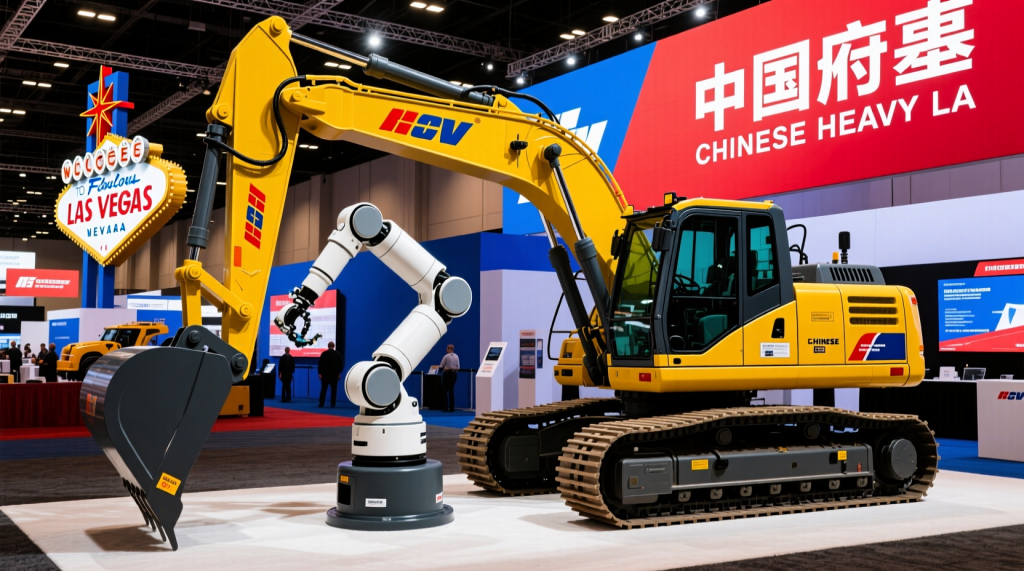
Audience and key takeaways: This article is written for contractors, fleet managers, equipment rental companies, and project owners evaluating AI-enabled heavy equipment, construction telematics, and remote operation. You’ll learn what current Chinese OEM (original equipment manufacturer) systems can realistically do, how they compare technically with North American/European competitors, what infrastructure and safety frameworks matter, and how to plan a pilot with measurable KPIs (key performance indicators).
TL;DR: Teleoperation and AI are moving from trade-show demos into pilots—success depends on connectivity, safety engineering, cybersecurity, and integration with existing fleet systems.
Remote Operation: Controlling a Tower Crane Across Continents

At CONEXPO-CON/AGG, Zoomlion demonstrated a tower crane remote operation system where an engineer in Las Vegas controlled a crane located in Changde, Hunan (over ~11,000 km away). The operator used a dual-joystick teleoperation console with multiple high-definition camera feeds to replicate key in-cab viewpoints (hook, load path, and surrounding exclusion zone).
How these systems typically work (technical view):
- Command-and-control loop: Operator inputs are encoded and transmitted to the crane’s control unit. Video and telemetry return to the operator station. The overall experience is dominated by end-to-end latency (time delay from joystick movement to visible machine response).
- Edge vs. cloud processing: Safety-critical functions (e.g., motion limits, anti-sway, collision envelopes) are generally executed at the edge—on the crane controller/PLC (programmable logic controller)—because cloud latency is variable. The cloud is more commonly used for logging, analytics, and non-real-time optimization.
- Latency management across continents:跨-continent teleoperation introduces latency and jitter (variation in latency). In practice, long-distance public internet paths can range from tens to hundreds of milliseconds and can suffer occasional packet loss. Vendors mitigate this with adaptive bitrate video, forward error correction, and control smoothing, plus “local autonomy” behaviors that keep the crane stable during brief dropouts.
- Fail-safe modes: If communications degrade or are lost, a well-designed system should transition to a safe state (e.g., controlled stop, brake engagement, load stabilization) and require deliberate re-arming before resuming. This is where safety engineering and validation become more important than the demo itself.
Safety and compliance note: For remote crane operations, buyers should ask how the OEM maps the system to recognized functional safety practices such as ISO 13849-1 (Safety-related parts of control systems) and how risk assessment is documented. For operator safety and work practices on North American sites, OSHA (Occupational Safety and Health Administration) requirements and training expectations still apply even if the operator is offsite; see OSHA’s crane resources at https://www.osha.gov/cranes-derricks.
Jobsite perspective (implementation reality): A tower crane manager with 15+ years on high-rise projects summarized the biggest hurdle as “not the joystick—it’s the network.” In their experience, remote ops become viable only after validating network redundancy, camera cleanliness/maintenance, and clear “stop-work” rules when latency spikes.
TL;DR: Cross-continent crane teleoperation can work, but long-distance latency and connection-loss behavior must be engineered with edge-based fail-safes and validated against functional safety expectations.
Intelligent Excavator Control for Hazardous Worksites
SANY presented an intelligent excavator teleoperation setup where the operator sits in a cockpit and runs the machine remotely using a dual-joystick teleoperation interface. This is especially relevant for hazardous or hard-to-staff environments (tailings ponds, unstable slopes, extreme cold/heat, contaminated sites).
What “intelligent” usually means in remote excavator control:
- Perception sensors: camera arrays for situational awareness, sometimes supplemented by LiDAR (Light Detection and Ranging) or radar for obstacle detection; and GNSS (Global Navigation Satellite System) positioning for geo-referenced work zones.
- Machine-state sensing: pressure transducers in hydraulic circuits, temperature sensors, accelerometers (for vibration/impact), and angle sensors on boom/stick/bucket for precise kinematics.
- Assist functions (semi-autonomy): grade guidance, swing/boom motion constraints near exclusion zones, and “bucket profile” assistance to maintain slopes and depths with less rework.
Quantitative expectations (typical ranges, project-dependent): Across the wider heavy-equipment market, telematics plus condition monitoring commonly targets measurable gains such as 10–20% reductions in idle time and 5–15% improvements in fuel efficiency when operators receive feedback and job plans are optimized. For teleoperation specifically, the business case is often strongest when it prevents a single high-severity incident or enables production in zones where manned operation is restricted; productivity may be comparable to on-board operation after training, but it can also drop when camera coverage is insufficient or latency is inconsistent.
Field quote (operator adoption): A Canadian superintendent familiar with excavators but new to teleoperation described the learning curve as “surprisingly fast,” but emphasized that “camera placement and depth perception are make-or-break—operators need time to adapt and the site needs a spotter policy during the ramp-up.”
TL;DR: Remote excavator operation is most valuable in hazardous or access-limited work; results hinge on sensor quality (especially cameras), network stability, and structured operator training.
AI-Driven Systems: Predictive Maintenance, Hydraulic System Monitoring, and Autonomy
Beyond remote control, Chinese OEMs including Zoomlion, XCMG, and SANY are pushing broader AI stacks combining construction telematics, hydraulic system monitoring, and operator-assist autonomy. “AI” in this context is typically a mix of analytics models, anomaly detection, and increasingly computer vision—deployed partly on the machine (edge) and partly in the cloud.
Predictive Maintenance (Condition-Based Monitoring + ML)
Predictive maintenance uses sensor data and historical failure patterns to estimate remaining useful life (RUL) for components and to flag abnormal behavior before breakdown. Common algorithm families include:
- Anomaly detection: statistical baselines, isolation forests, or autoencoders to spot deviations in vibration/temperature/pressure signatures.
- Time-series forecasting: gradient-boosted trees or recurrent neural networks (RNNs) for trends such as cooling-system degradation or hydraulic leakage signatures.
- Rule + ML hybrids: domain rules (e.g., pressure/flow thresholds) combined with models to reduce false positives.
Instrumentation detail: For excavators and cranes, high-value signals often include pump pressures, pilot pressures, hydraulic oil temperature, engine load, particulate contamination indicators (where available), and vibration data near rotating assemblies. A practical goal is to detect issues like cavitation, pump wear, valve sticking, and hose leakage before they become downtime events.
Performance metrics to request from OEMs: rather than “AI-powered” claims, ask for audited numbers such as:
- Downtime reduction: e.g., percentage drop in unplanned downtime hours per 1,000 operating hours after deploying condition monitoring.
- Alert quality: precision/recall (false alarm rate vs. missed detections) for major failure modes.
- Lead time: typical days/hours of warning before a failure (e.g., bearing or pump degradation).
TL;DR: Predictive maintenance is not magic—it’s sensors + time-series analytics; decision-makers should demand measured downtime reductions and false-alarm rates, not generic “AI” language.
Real-Time Operational Analytics (Construction Telematics for Utilization and Fuel)
Construction telematics platforms aggregate location, utilization, idle time, fuel burn, cycle counts, and operator-event data across fleets. For industrial buyers, the biggest value often comes from consistent KPI tracking and integration with dispatch and maintenance workflows.
What to measure (examples that tie to profit):
- Idle ratio: lowering idle time can reduce fuel burn and engine hours; many fleets target 10–20% idle reduction with coaching and site changes.
- Fuel per unit work: liters per truck loaded, per cubic meter moved, or per cycle—more meaningful than total fuel.
- Cycle time variability: detecting bottlenecks (haul road congestion, queuing, or operator technique differences).
Integration nuance: Large contractors often already run fleet systems (ERP/CMMS and mixed-OEM telematics). A key evaluation point is whether the OEM can export data via API (application programming interface), support common formats, and clarify data ownership and retention—who can access raw data, for how long, and under what contract terms.
TL;DR: Telematics value comes from actionable KPIs and integration into maintenance/dispatch—not from dashboards alone.
Semi-Autonomous Features (Operator Assist vs. Full Autonomy)
Most real deployments today are semi-autonomous (operator-assist) rather than fully unmanned. Typical functions include:
- Machine guidance: GNSS-based grading, 3D models, and depth/slope constraints.
- Collision/exclusion awareness: camera/LiDAR-based detection with warnings and speed limits near geofences.
- Crane motion assistance: anti-sway, envelope limits, and trajectory constraints to reduce operator workload.
Safety integrity and verification: When autonomy influences motion control, buyers should ask how the OEM aligns to functional safety concepts and how software updates are validated. ISO functional safety standards such as ISO 19014 (earth-moving machinery—functional safety) are relevant to risk-based design for control systems on earthmoving equipment.
TL;DR: The near-term win is operator-assist autonomy with clear safety envelopes and validated update processes—not fully driverless machines on open jobsites.
How Chinese OEM Solutions Compare Technically with North American and European Competitors
The competitive landscape is shifting, but differences are often more about system maturity and ecosystem fit than a single “better AI” claim. Here are differentiated, technical comparison angles procurement teams can use:
- Edge controls and fail-operational behavior: North American/European incumbents often have longer histories documenting safety cases and integrating controls with established service tools. Chinese OEMs are rapidly improving; buyers should specifically compare connection-loss behavior, recovery procedures, and whether safety-critical logic runs locally on certified controllers.
- Telematics ecosystem breadth: Incumbents commonly offer mature integration with dealer networks and parts logistics, while Chinese OEMs may compete with flexible feature packaging and fast iteration. The practical difference shows up in service SLAs (service-level agreements), spare parts lead times, and software support coverage.
- Computer vision vs. sensor fusion maturity: Some vendors emphasize camera-first approaches (lower hardware cost, easier retrofit), while others use sensor fusion (camera + LiDAR/radar) for higher robustness in dust, glare, or low light. Decision-makers should test performance in real site conditions (dust, rain, night shifts).
- Cloud and data governance: Multinationals may provide region-specific hosting and clearer enterprise controls; Chinese OEM offerings vary. Buyers should confirm hosting location options, tenant isolation, encryption, and API access for mixed fleets.
Engineer-to-engineer takeaway: Ask for a technical deep dive: network architecture, edge controller design, cybersecurity controls, and update strategy. The differentiator is often “operational reliability at scale,” not the demo capability.
TL;DR: Compare OEMs on safety-case maturity, service ecosystem, sensor robustness, and data governance—not on marketing claims about “AI.”
Implementation Challenges and Considerations (Connectivity, Cybersecurity, Change Management, ROI)
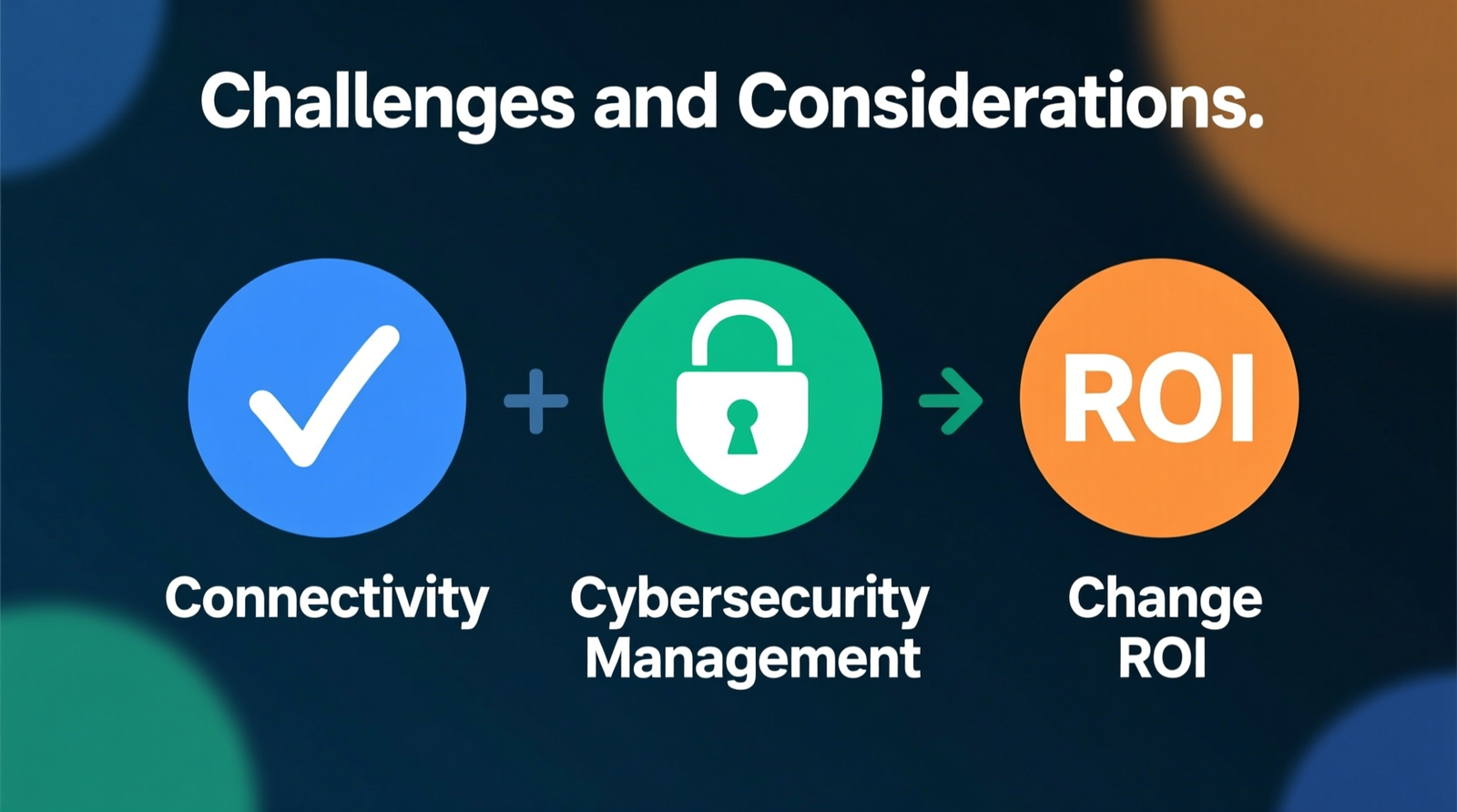
Real deployments succeed or fail on four non-negotiables: connectivity, cybersecurity, people/process, and economics.
Connectivity and Latency
Teleoperation needs predictable uplink/downlink performance for video and control. Typical options include public 5G, private LTE (Long-Term Evolution) networks, jobsite Wi-Fi/mesh, or fiber where available. For critical operations:
- Redundancy: dual-carrier cellular, dual modems, and automatic failover.
- QoS: Quality of Service settings to prioritize control and video traffic where possible.
- Degraded-mode logic: brief dropouts should trigger local stabilization; longer loss should transition to safe stop.
Cybersecurity for Remote Control Systems
Remote-control channels and telematics platforms expand the attack surface. Contractors should require a cybersecurity posture aligned with recognized guidance such as NIST Cybersecurity Framework (CSF) and industrial security principles like network segmentation and strong identity management. For industrial automation environments, IEC 62443 is a widely referenced series for industrial cybersecurity programs.
A product manager overseeing telematics rollouts on multi-site civil projects noted that “the first hard conversation is always account control—who can remote-start, remote-stop, or push updates. If you can’t audit it, you can’t scale it.”
Operator Acceptance and Training
Teleoperation changes the skill profile: operators must adapt to camera-based depth cues, alternate viewpoints, and different “feel” due to latency. Training programs that work best usually include:
- Simulator time + supervised production hours
- Standard camera cleaning/inspection routines
- Clear radio protocols and on-ground spotter procedures during ramp-up
ROI (Return on Investment) and Where Teleoperation Makes Economic Sense
Teleoperation is most defensible when it materially reduces exposure or enables production otherwise constrained by safety or staffing:
- Hazardous sites: tailings ponds, contaminated remediation, steep slopes, high-risk demolition
- Remote or labor-short regions: where attracting certified operators is difficult
- High-consequence lifts or operations: where risk reduction has disproportionate value
TL;DR: The biggest barriers aren’t the machine—they’re network resilience, cybersecurity governance, operator change management, and proving ROI with the right use cases.
Practical Adoption Plan: Steps, KPIs, and Questions to Ask OEMs
For decision-makers, a structured pilot reduces risk and creates a clean path to scaling.
Step-by-step approach for contractors and rental fleets
- 1) Pick the right pilot job: choose a site with a clear hazard reduction goal or measurable productivity constraint (e.g., unstable ground zone) and manageable complexity.
- 2) Define KPIs upfront: unplanned downtime hours/1,000 hrs, near-miss rate, idle %, fuel per unit work, cycle time variance, maintenance lead time, and operator proficiency milestones.
- 3) Validate IT/OT integration: connect telematics to CMMS (computerized maintenance management system) workflows, ensure APIs/data export, and confirm data ownership terms.
- 4) Build a training and certification path: include simulators, supervised hours, and documented competency checks; align with your internal safety management system.
- 5) Run a staged rollout: start with daylight shifts and controlled tasks; expand to more complex operations once latency and camera coverage are proven.
Questions to ask OEMs (teleoperation + AI)
- Safety: What standards do you design to (e.g., ISO 13849-1, ISO 19014)? What is the fail-safe behavior on packet loss, high latency, or total disconnect?
- Latency and bandwidth: What are the tested operating ranges (ms latency, Mbps throughput) for acceptable performance? How is video adapted under congestion?
- Cybersecurity: Is data encrypted in transit and at rest? How are credentials managed (MFA, role-based access control)? Is there audit logging for remote commands?
- Software lifecycle: How are OTA (over-the-air) updates validated and rolled back? What is the patch policy and disclosure process for vulnerabilities?
- Support: What are parts availability, dealer coverage, response times, and uptime commitments under an SLA?
TL;DR: Treat AI and teleoperation like an engineered system rollout—pilot the right use case, track KPIs, integrate with maintenance/IT, and interrogate safety and cybersecurity in detail.
Conclusion

CONEXPO-CON/AGG showcased how Chinese manufacturers such as Zoomlion, XCMG, and SANY are accelerating AI-enabled heavy equipment capabilities—from remote crane and excavator operation to predictive maintenance, hydraulic system monitoring, and semi-autonomous assist functions. The bigger story for industrial buyers is not whether the technology can be demonstrated, but whether it can be deployed with consistent network performance, validated safety behavior, strong cybersecurity, and measurable ROI.
For North American and global contractors, the decision framework should focus on: (1) functional safety and fail-safe design, (2) telematics integration and data governance, (3) service coverage and software lifecycle support, and (4) pilot results tied to real KPIs (downtime, fuel, and safety outcomes).
TL;DR: AI and remote operation are credible tools for risk reduction and efficiency—but only when backed by standards-aligned safety engineering, secure connectivity, and enterprise-grade support.
FAQ
Q: What infrastructure is required for remote operation (5G, private LTE, wired networks)?
A: Most teleoperation deployments use 5G or private LTE for mobility, with fiber or wired backhaul where available. Minimum requirements typically include stable uplink for multiple HD camera streams plus low and consistent latency for control. For higher reliability, contractors often specify dual-carrier cellular, redundant routers/modems, and a site network design that prioritizes control traffic (QoS). If bandwidth is limited, systems may reduce video resolution/frame rate, but you should validate whether that still supports safe depth perception and situational awareness.
Q: How secure are remote control and construction telematics systems?
A: Security depends on the vendor’s architecture and your governance. Look for encryption in transit/at rest, strong identity controls (MFA and role-based access), audit logs for remote commands, and clear patch/update policies. Many organizations align requirements to frameworks like the NIST Cybersecurity Framework and industrial guidance such as IEC 62443. A practical test: ask the OEM to explain how they prevent unauthorized remote commands and how quickly they patch disclosed vulnerabilities.
Q: What training do operators need to transition to teleoperation?
A: Operators usually need structured time to adapt to camera-based perception and latency. Effective programs combine simulator sessions, supervised field hours, and standard operating procedures for camera checks, communications, and stop-work triggers during network degradation. Expect some initial productivity dip until the operator learns camera viewpoints and the site tunes camera placement and lighting.
Q: How do teleoperation systems handle latency or a lost connection during a lift or dig cycle?
A: Well-designed systems rely on edge-based safety logic: brief dropouts may trigger local stabilization (e.g., hold position, damp sway), while longer losses should transition the machine to a defined safe state (controlled stop, brakes engaged) and require deliberate re-arming before resuming. Buyers should require a documented fail-safe sequence and evidence of validation against functional safety expectations (e.g., ISO 13849-1 concepts for safety-related control functions).
Q: How can I evaluate whether AI-enabled predictive maintenance will actually reduce downtime?
A: Ask for proof metrics: reduction in unplanned downtime hours per 1,000 operating hours, alert precision/false-alarm rates, and average warning lead time before failures. Also confirm which components are covered (hydraulic pumps, swing motors, cooling systems) and what sensors are required (pressure transducers, temperature, vibration). The best results come when alerts feed directly into your maintenance planning and parts workflow—not when they remain isolated in a dashboard.