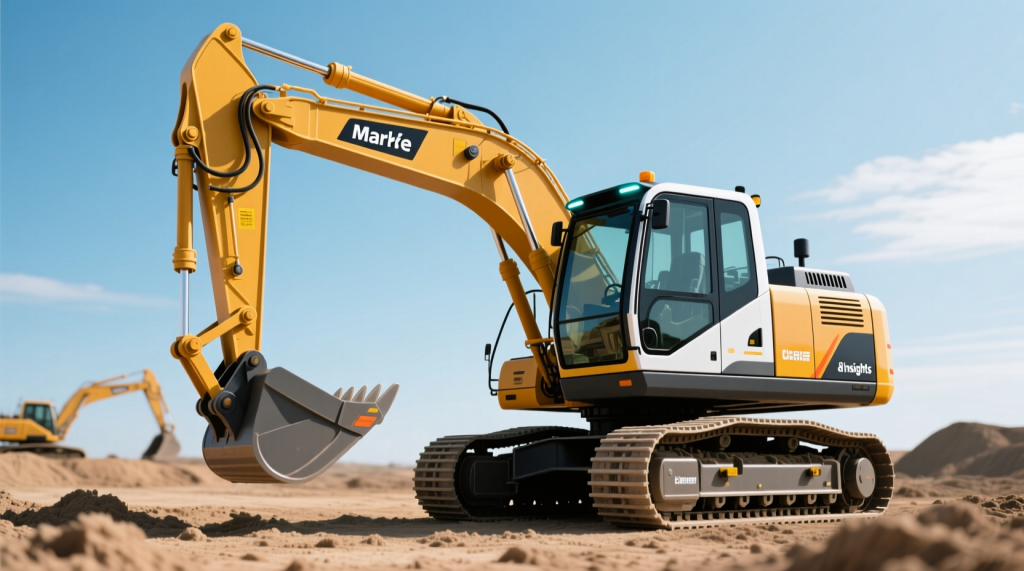
For construction contractors, mining operators, infrastructure owners, original equipment manufacturers (OEMs), and investors, this outlook summarizes the autonomous excavation machinery market over 2026–2036—covering market size and forecast, demand drivers, segmentation, regional adoption, competitive dynamics, implementation guidance, and key risks that influence real-world deployment.
TL;DR: This report-style overview is written for decision-makers evaluating autonomous excavators for productivity, safety, and labor resilience, with practical adoption considerations and market context.
Autonomous Excavation Machinery Market Size and Forecast (2026–2036)
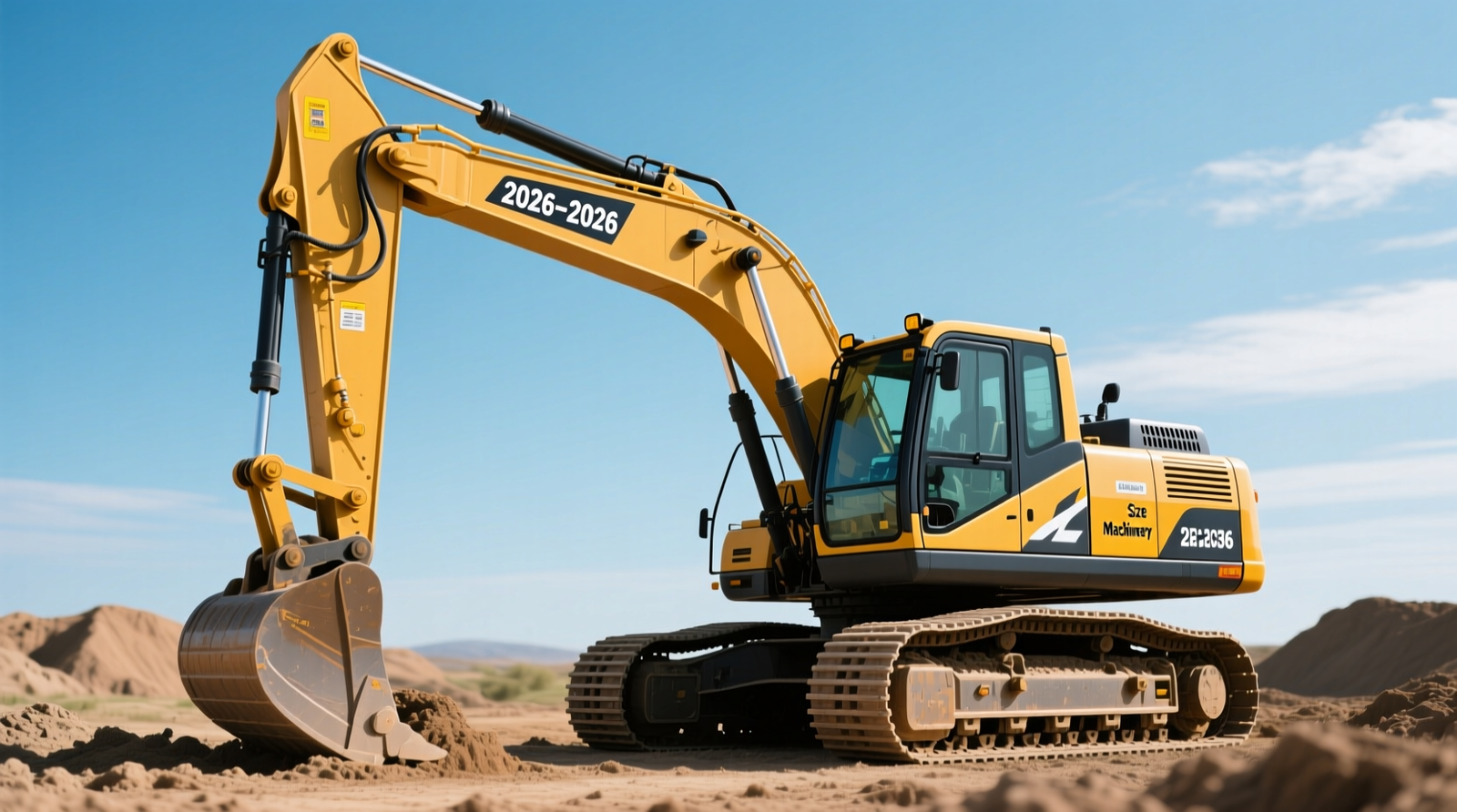
In this analysis, the global autonomous excavation machinery market is projected to expand from USD 4.6 billion (2026) to USD 14.2 billion (2036), reflecting a compound annual growth rate (CAGR) of 11.9% across 2026–2036. Figures are expressed in current USD (nominal) and are intended to represent a combined view of equipment sales plus autonomy-related software and services, including integration and retrofitting where applicable (scope clarified further below).
Autonomous excavation demand is moving from controlled trials to scaled deployments as large employers seek measurable improvements in cycle time consistency, grade accuracy, safety exposure reduction, and utilization across multi-site fleets.
TL;DR: The market forecast is consolidated here: USD 4.6B (2026) to USD 14.2B (2036), 11.9% CAGR, covering equipment plus autonomy software/services.
Market Overview: What “Autonomous Excavation” Means in Practice
Autonomous excavation machinery refers to excavators and related earthmoving machines that can execute digging, grading, loading, or trenching tasks with reduced direct control by a human operator. Autonomy typically relies on a sensor suite and control stack that combines:
- GNSS (Global Navigation Satellite System) for positioning
- LiDAR (Light Detection and Ranging) and radar for obstacle detection and ranging
- Cameras for classification, situational awareness, and safety monitoring
- Onboard compute running perception, planning, and control (often supported by edge-to-cloud connectivity)
- Telematics for health monitoring, utilization, and fleet analytics
In practical workflows, autonomous excavation increasingly connects to BIM (Building Information Modeling) and digital twins. For example, a 3D design surface can be loaded into a machine-control system to guide target grades, while as-built progress data is pushed back to the project team to reduce rework and improve schedule control.
TL;DR: “Autonomous excavation” combines GNSS + LiDAR/radar/cameras + onboard control software, and increasingly consumes BIM models while feeding back as-built data.
Levels of Automation: Fully Autonomous vs Operator-Assist vs Tele-Remote

Buyers often evaluate autonomy by “who has control” and “how much the machine decides.” A practical way to distinguish deployment models is:
- Operator-assist (semi-autonomous): The operator remains in-the-loop (actively controlling), while automation handles functions such as grade control, swing assist, payload estimation, or collision warnings.
- Tele-remote (remote controlled): The operator is off-machine, controlling via a remote station—typically used for hazardous zones (highwalls, unstable ground, contaminated sites) while keeping a human in control.
- Fully autonomous: A human is typically on-the-loop (supervising), intervening by exception while the machine executes a defined task plan within geofenced boundaries.
This mix is not temporary—many fleets will keep a blended autonomy model based on job complexity, regulatory constraints, and risk tolerance.
TL;DR: Operator-assist keeps humans in control, tele-remote moves the operator off-machine, and fully autonomous shifts humans to supervisory exception handling.
Growth Drivers and Technology Trends Shaping Buyer Decisions
Demand is anchored in operational realities: tighter schedules, labor gaps, and stronger expectations around predictable delivery and safety performance. The most consistent drivers are:
- Labor resilience
- Fewer qualified operators for peak workload periods
- Standardizing output across shifts and sites
- Safety and compliance
- Reducing exposure during trenching, confined work zones, or unstable ground
- Supporting documented safe work procedures and audit trails
- Quality and rework reduction
- Higher repeatability in grade and slope outcomes
- Fewer over-excavation errors and less rework cost
- Fleet utilization and lifecycle economics
- Higher productive hours through consistent cycle execution
- Condition monitoring to reduce downtime and unplanned maintenance
Technology direction is also becoming clearer:
- Edge vs. cloud processing: Safety-critical perception and control increasingly run on the machine (edge), with cloud used for model updates, reporting, and multi-site benchmarking.
- V2X (Vehicle-to-Everything) connectivity: Emerging jobsite coordination where machines share intent, zones, or hazard alerts with other equipment and site systems.
- Retrofit autonomy kits: Growth in add-on sensor/compute kits and machine-control upgrades that extend the useful life of existing excavators—especially attractive in fleets with mixed ages.
- Perception and safety monitoring stacks: Increasing use of multi-sensor fusion (LiDAR + cameras + radar) to improve object detection reliability under dust, rain, or low light.
For broader context on construction technology adoption and equipment innovation priorities, industry bodies such as the Association of Equipment Manufacturers (AEM) provide guidance and market signals used by buyers as informal benchmarks.
TL;DR: The business case centers on labor resilience, safety, rework reduction, and utilization—enabled by edge compute, V2X connectivity, and a growing retrofit ecosystem.
Use-Case Mini-Scenarios (Where Autonomy Delivers the Most Differentiation)
Autonomous excavation adoption accelerates when the job can be standardized, geofenced, and measured. Three scenarios that consistently show stronger ROI potential:
- Tunnel approach excavation and portal works
- Tele-remote excavation can reduce operator exposure near unstable faces and confined zones.
- Autonomy can hold consistent profiles using 3D design surfaces, improving downstream lining and fit-out efficiency.
- Urban utilities and night work (high congestion)
- Operator-assist grade control reduces accidental strikes and over-dig in tight right-of-way constraints.
- Connected as-built updates help reconcile design vs field reality faster for inspectors and utility owners.
- Brownfield and contaminated sites
- Tele-remote or supervised autonomy can limit time humans spend in exclusion zones.
- Automated dig plans and geofencing support compliance documentation and consistent soil handling workflows.
TL;DR: Best-fit early deployments are bounded, repeatable jobs: tunnel portal works, congested urban utilities, and brownfield/contaminated sites.
Market Segmentation (How Buyers Evaluate the Market)
- Application type: Construction operations; mining operations; infrastructure development; other
- End use: Construction sites; mining facilities; quarrying operations; other
- Machine type: Hydraulic excavators; wheeled excavators; tracked excavators; other excavation machinery
- Deployment model: Fully autonomous; semi-autonomous (operator-assist); remote controlled (tele-remote); hybrid/other
- Region: North America; Europe; Asia Pacific; Latin America; Middle East & Africa
TL;DR: Segmentation follows how procurement happens: application/end-use first, then machine class, autonomy mode, and region.
Segment Insights: Demand Concentration and Practical Buying Triggers
Construction operations represent the largest application category, accounting for approximately 67.9% of demand, because tasks such as bulk earthmoving, trenching, and grading are frequent, measurable, and repeatable across projects.
Construction sites are the leading end-use environment at roughly 47.0% share, reflecting the scale of excavation work in general contracting and civil infrastructure delivery.
Across both segments, purchase decisions tend to be triggered less by “autonomy for autonomy’s sake” and more by whether the solution can:
- Hold grade and line tolerances consistently to reduce rework
- Operate safely within defined exclusion zones and traffic plans
- Integrate with digital workflows (BIM surfaces, machine control, progress tracking)
- Provide audit-ready reporting (utilization, safety events, as-built surfaces)
TL;DR: Construction dominates because excavation tasks are repeatable and measurable; buying triggers are grade accuracy, safety zoning, workflow integration, and reporting.
Enterprise Spending Outlook (Next 12–24 Months) + Budget Allocation Examples
Enterprise spending is shifting from experimentation to disciplined rollouts with clearer governance, safety cases, and ROI targets. Common near-term spend patterns include phased deployments on high-impact projects, followed by standardization across districts or mines once operating data proves repeatability.
To make planning more actionable, typical budget allocation ranges in early deployments often resemble:
- Hardware and sensors (machine options, LiDAR/radar/cameras, onboard compute): 50–70%
- Software (autonomy stack licenses, machine control, analytics): 10–20%
- Integration and connectivity (telematics, fleet systems, BIM/model workflows): 10–20%
- Training and change management (operator upskilling, supervisors, safety procedures): 5–15%
Emerging business models are expanding beyond direct purchases:
- Autonomy-as-a-service: Subscription pricing tied to machine hours, enabling faster pilots and clearer operating-cost forecasting.
- Retrofit programs: Upgrading existing assets with autonomy-ready sensors and machine-control packages to reduce capital burden.
- Outcome-based contracting: Limited but growing—pricing linked to productivity metrics, rework reduction, or availability (requires strong data governance).
TL;DR: Near-term budgets increasingly cover full deployment cost (hardware, software, integration, training), and business models are expanding to subscriptions and retrofits.
Implementation Considerations (Adoption Roadmap for Contractors and Mining Firms)
A practical deployment roadmap usually follows five stages:
- Site and task assessment: Select bounded tasks (e.g., trenching, mass cut/fill) and define tolerances, safety zones, and success metrics.
- Pilot design: Decide autonomy mode (assist vs tele-remote vs supervised autonomy), connectivity needs, and supervision ratios.
- Systems integration: Connect machine control to 3D models, align coordinate systems, and integrate telematics with fleet maintenance and reporting.
- Training + operating model: Define roles (operator, remote supervisor, field tech), retrain teams, and update standard operating procedures.
- Scale and governance: Expand to additional machines/sites with consistent safety cases, cybersecurity controls, and KPI reporting.
TL;DR: Successful adoption is staged: assess tasks, run a structured pilot, integrate with models/systems, train and redesign roles, then scale with governance.
Autonomous Excavator Adoption by Region and Application
Segment demand (construction-led, jobsite-heavy deployment) feeds directly into regional adoption patterns: regions with sustained infrastructure programs, high labor constraints, and stronger digital construction maturity tend to commercialize faster.
Selected forecast growth rates (2026–2036) across high-visibility markets include:
- India: 12.5%
- China: 11.9%
- United Kingdom: 10.5%
- France: 10.0%
- United States: 6.7%
- Germany: 5.4%
TL;DR: Regions with heavy infrastructure spend and higher digital maturity generally adopt faster; India and China lead among the listed markets.
Country-Level Insights (Selected Markets)
India is positioned for rapid growth as large infrastructure corridors and urban development programs increase demand for repeatable earthmoving productivity. Adoption is likely to skew toward operator-assist and tele-remote in early phases, then expand into supervised autonomy on standardized tasks as contractors build internal capability.
China benefits from extensive infrastructure execution capacity and a mature local ecosystem for sensors, machine control, and automation integration. Large engineering firms are well-placed to standardize autonomous workflows across multiple projects, particularly in bulk earthworks and “smart jobsite” environments.
United Kingdom shows strong alignment with BIM-based project delivery and digital twin initiatives, which supports machine control and structured progress reporting. Utility and rail works—often constrained by space, safety rules, and schedule windows—are common candidates for early deployment.
France is seeing increased interest where automation can improve safety performance and mitigate labor constraints. EU-aligned compliance requirements also increase attention to documented safety functions and conformity practices.
United States remains highly performance-oriented, with procurement often justified by measurable outcomes such as rework reduction, fuel optimization, and utilization gains—particularly when autonomy integrates cleanly into existing telematics and asset management systems.
Germany tends to prioritize high-precision outcomes, structured engineering processes, and integrated planning. Adoption often emphasizes interoperability with digital planning tools and strong conformity to safety expectations.
TL;DR: Country differences are less about “interest” and more about delivery environments—digital workflows, labor constraints, and standardization capacity determine how quickly autonomy scales.
Key Challenges and Market Risks (Adoption Barriers Buyers Should Plan For)
Real deployments face constraints that market forecasts can understate. Key risks include:
- Regulatory and liability uncertainty: Rules for autonomous operation on mixed-traffic sites vary by jurisdiction and by job type; liability frameworks may remain conservative.
- Interoperability and vendor lock-in: Autonomy stacks, machine control, and telematics can be difficult to integrate across mixed fleets, creating switching costs.
- Cybersecurity exposure: Connected machines increase the attack surface; buyers need hardening, access control, and incident response plans. (See the NIST Cybersecurity Framework for baseline governance concepts.)
- Workforce and labor response: Unions and frontline teams may resist if autonomy is framed as job replacement; adoption is smoother when positioned as safety and skills uplift (remote supervision, higher-value operation).
- Safety validation complexity: Proving safe operation across weather, dust, lighting, and changing site geometry can be time-consuming and requires disciplined testing and documentation.
TL;DR: The biggest blockers are regulatory/liability ambiguity, integration friction, cybersecurity, workforce acceptance, and the effort required to validate safety in messy real jobsites.
Standards, Safety, and Compliance Signals (E-E-A-T)

Autonomous excavation deployments are increasingly shaped by safety engineering and conformity expectations, even when local laws are not autonomy-specific. Buyers commonly align programs to recognized references such as:
- ISO 12100 (Safety of machinery—risk assessment and risk reduction) for hazard identification and mitigation planning (overview: ISO 12100).
- OSHA (Occupational Safety and Health Administration) requirements and guidance for excavation safety and safe work practices in the U.S. (reference: OSHA Excavations).
- CE marking (Conformité Européenne) for machinery placed on the EU market, which influences how safety functions and documentation are approached (reference: European Commission—CE marking).
In practice, these frameworks push buyers to demand clearer safety cases, defined operational design domains (ODDs), robust emergency-stop behavior, and auditable maintenance/training procedures.
TL;DR: Even without autonomy-specific laws everywhere, ISO/OSHA/CE expectations shape procurement by requiring risk assessment, documented safety functions, and auditable processes.
Competitive Landscape and Differentiation Factors
The market includes global equipment OEMs, autonomy software providers, and integrators. Competitive differentiation increasingly depends on “deployment readiness,” not just demos:
- Autonomy performance in real conditions: dust, rain, poor GNSS environments, mixed traffic
- Safety architecture maturity: redundancy, fail-safe behavior, validation evidence
- Integration depth: telematics, maintenance systems, and BIM-driven machine control workflows
- Service model strength: commissioning support, remote monitoring, parts availability, training programs
- Retrofit and fleet strategy: credible pathways for mixed fleets, not only new machines
Representative players include Caterpillar, Komatsu, Volvo Construction Equipment, Hitachi Construction Machinery, JCB, Liebherr, Doosan Infracore, XCMG, Sany, and Hyundai Construction Equipment.
TL;DR: Winners will be judged on field reliability, safety validation, interoperability, and service/retrofit strategies—not just autonomous features.
Scope of the Report and Methodology (Data Sources)

This market view covers autonomous excavation machinery across application type, end use, machine type, deployment model, and region. The forecast period is 2026–2036 with 2026 as the base year.
High-level methodology assumptions include:
- Data inputs: OEM financial disclosures and product announcements, industry association signals (e.g., AEM), public infrastructure investment plans, and observable adoption patterns in construction/mining automation.
- Model approach: A blended top-down and bottom-up triangulation using segment adoption rates, expected penetration by task suitability, and average revenue per unit including software/services where bundled.
- Scope boundaries: Market sizing is intended to reflect equipment plus autonomy-enabling software/services (including integration and retrofits where commercialized), rather than bare metal-only excavator sales.
TL;DR: Base year is 2026; the forecast uses triangulated inputs (OEMs, associations, public programs) and assumes the market includes equipment plus autonomy software/services and retrofit/integration value.
Key Takeaways (Executive Scan)
- Market growth: Consolidated forecast points to strong expansion through 2036 (see Market Size and Forecast section for core figures).
- Where demand concentrates: Construction operations lead (67.9%), with construction sites as the primary deployment environment (47.0%).
- What buyers should prioritize: Safety validation, interoperability, and integration with BIM/machine control and fleet systems.
- Fast adoption pathways: Tele-remote and operator-assist first, then supervised autonomy for bounded, repeatable tasks.
- Main risks: Regulation/liability, cybersecurity, and workforce adoption can slow rollouts if not managed early.
TL;DR: Construction-led demand, phased autonomy adoption, and execution risks (integration/safety/cyber/workforce) define winners more than headline growth.
Conclusion

Autonomous excavation is transitioning from isolated pilot projects to operationally governed deployments, especially where tasks can be standardized and measured. The strongest programs combine the right autonomy mode (assist, tele-remote, or supervised autonomy) with BIM-driven machine control, robust safety validation, and a clear integration plan across telematics and maintenance systems.
Organizations that treat autonomy as an operating model change—supported by training, cybersecurity, and vendor interoperability planning—are more likely to achieve reliable productivity gains and scalable, multi-site performance.
TL;DR: Autonomy scales when it’s deployed as a managed operating model (safety + integration + training), not just a machine feature.
FAQ
Q: What is included in the autonomous excavation machinery market size—equipment only or also software and services?
A: In this outlook, the market sizing is intended to cover autonomous-capable excavation equipment plus autonomy-related software and services that are commonly bundled or sold alongside deployment (e.g., autonomy licenses, sensor/compute packages, integration, and in some cases retrofit kits). Scope details are summarized in the “Scope of the Report and Methodology” section.
Q: What ROI timeframe should contractors expect for autonomous excavators?
A: ROI depends on task repeatability, utilization hours, site constraints, and labor availability. Many buyers evaluate payback in the context of reduced rework, improved utilization, fewer safety incidents, and the ability to keep production moving during operator shortages. In practice, payback is often targeted within 2–5 years for well-scoped, high-utilization use cases, but pilots should be designed to measure job-specific drivers (cycle time, grade accuracy, downtime, and supervision ratios).
Q: Should I retrofit existing excavators or buy new autonomous-ready models?
A: Retrofitting can be attractive for mixed fleets or when capital budgets are constrained, especially if the excavator has sufficient remaining useful life and the job is suitable for bounded autonomy. New autonomous-ready machines can reduce integration complexity and may offer tighter OEM support, warranty alignment, and more mature safety architectures. Many enterprises pursue a hybrid approach: retrofit for scalable trials and selective new purchases for mission-critical, high-utilization sites.
Q: How do autonomous excavators use BIM models or digital twins on a real jobsite?
A: Typically, a 3D design surface or alignment from BIM is exported into the machine control system so the excavator can target grades, slopes, and boundaries. As the machine works, as-built surfaces and progress data can be captured and shared back to the project team to confirm quantities, reduce rework, and improve coordination with survey and scheduling.
Q: What are the biggest safety and compliance requirements for deploying autonomous excavation equipment?
A: Requirements vary by region and site type, but most deployments align with established machinery risk assessment practices (e.g., ISO 12100 concepts), local workplace safety rules (such as OSHA expectations in the U.S.), and conformity practices (such as CE marking approaches in Europe). Buyers should plan for documented hazard analysis, geofencing/exclusion zones, emergency-stop behavior, operator/supervisor training, and auditable operating procedures.