Introduction

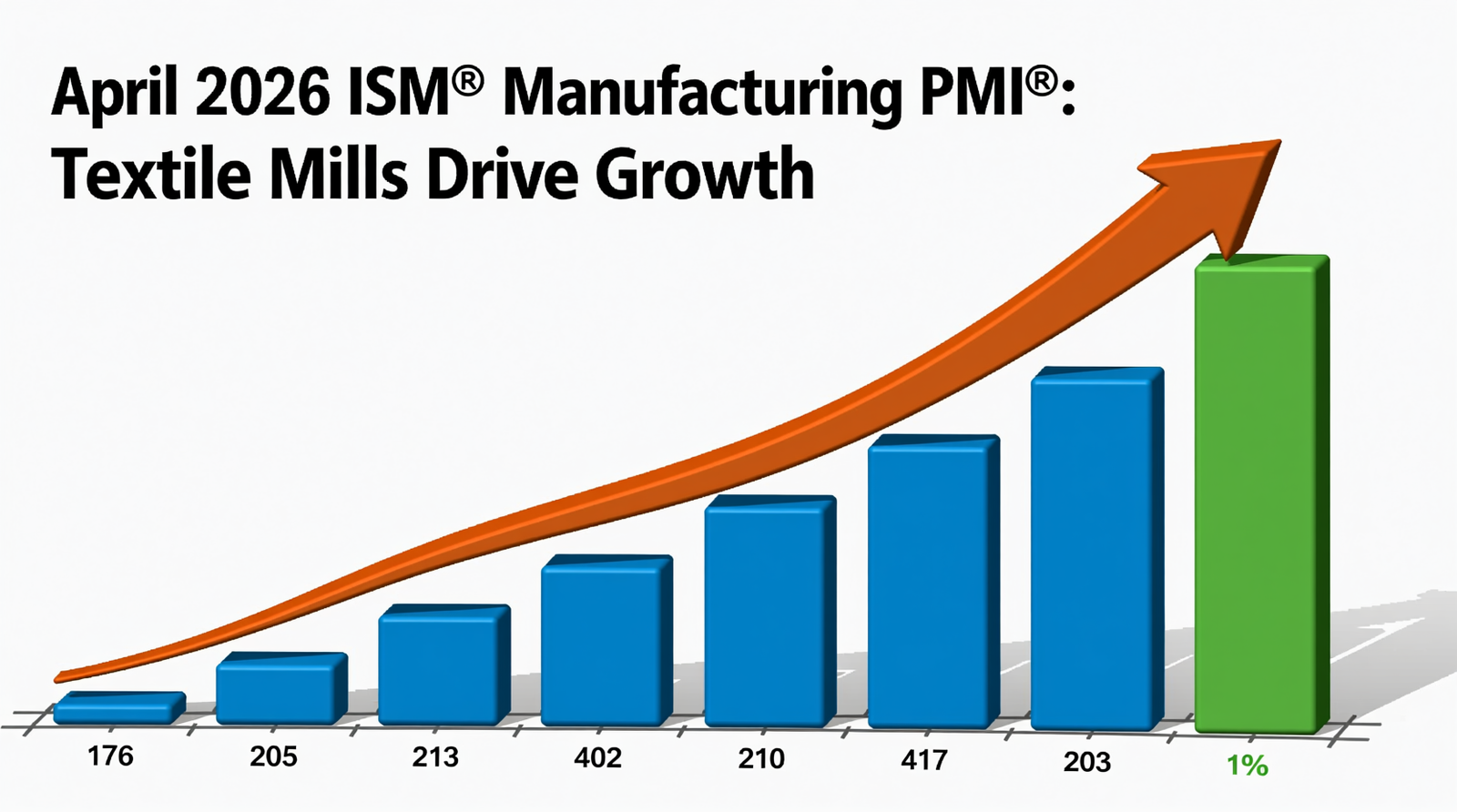
U.S. manufacturing activity remained in expansion in April 2026, according to the April 2026 PMI report from the Institute for Supply Management (ISM). The headline ISM Manufacturing PMI April 2026 registered 52.7%, unchanged from March. A Purchasing Managers’ Index (PMI) reading above 50 signals expansion; over long periods, a PMI above 47.5 has generally aligned with growth in the overall U.S. economy, per ISM’s historical comparisons with real gross domestic product (GDP).
Because the ISM survey covers new orders, production, employment, supplier deliveries, inventories, and prices, it is widely used for ISM PMI interpretation and near-term planning across operations, procurement, finance, and industrial supply chains.
TL;DR: April’s ISM data show continued manufacturing growth, but with intensifying cost inflation, lengthening lead times, and weaker labor momentum.
Executive summary / key takeaways
- Demand: New orders expanded (54.1%), but exports stayed weak (47.9%).
- Output: Production expanded (53.4%) even as growth cooled from March.
- Prices: Input inflation surged; the Prices Index hit 84.6% (highest since April 2022).
- Employment: Jobs contracted faster (Employment Index 46.4%) despite higher output.
- Risk: Elevated industrial supply chain risk from tariffs and disruption in key Middle East shipping lanes, lifting freight and energy costs.
TL;DR: Expansion continues, but decision-makers should plan for sticky inflation, longer lead times, and labor productivity pressure.
Headline Overview: April 2026 Manufacturing PMI® (What the 52.7 Reading Signals)
For the ISM Manufacturing PMI April 2026 report period:
- Manufacturing PMI: 52.7 (unchanged from March)
- Overall U.S. economy: expanded for the 18th consecutive month (based on ISM’s long-run framework)
- Manufacturing sector: expanded for the fourth consecutive month
- Estimated real GDP implication: about 1.8% annualized growth using ISM’s long-term correlation approach
Five key subindexes (directional read):
- New Orders: expanding faster
- Production: expanding, but slower
- Supplier Deliveries: slowing faster (i.e., longer lead times)
- Employment: contracting faster
- Inventories: contracting, but stabilizing
For source context and methodology, reference ISM’s official releases and PMI background materials at ISM Report On Business and the PMI overview at ISM PMI information.
TL;DR: The April 2026 PMI is steady in expansion, but the “mix” is less comfortable: prices and lead times are rising while employment remains weak.
Macroeconomic and Geopolitical Context: Industrial Supply Chain Risk in Key Middle East Shipping Lanes

April’s survey was conducted during the second month of the Iran War scenario referenced by respondents. To stay analytically balanced, treat this as a risk factor with impacts that depend on duration, escalation pathways, and policy responses.
Sentiment snapshot (what respondents said):
- Positive comments: 31%
- Negative comments: 69%
- Positive-to-negative ratio: 1 to 2.2, indicating sentiment remains decisively pessimistic despite growth
- Middle East conflict mentioned: 47% of comments
- Tariffs mentioned: 18% of comments
Why it matters: disruptions and risk premiums tied to routes such as the Red Sea/Strait of Hormuz/Suez Canal can raise freight rates, insurance, and transit times, amplifying cost inflation and lead-time variability across energy, metals, and chemical feedstocks.
For background on maritime chokepoints and global trade exposure, see the U.S. Energy Information Administration (EIA) overview of chokepoints at eia.gov (World oil transit chokepoints).
TL;DR: The dominant macro signal is risk-driven: higher logistics and energy uncertainty is feeding manufacturing inflation trends and longer lead times.
Demand Conditions: New Orders, Backlogs, Exports, and Customers’ Inventories
New Orders: Demand Expands, with Some Pull-Forward Buying
The New Orders Index improved, indicating continued demand growth:
- New Orders: 54.1% (up from 53.5%)
- Demand sentiment: ~1.6 positive comments per 1 negative
- Behavioral note: some customers are ordering early to get ahead of anticipated price increases
Industry pattern: demand strength is broad across industrial and consumer-adjacent categories, with a smaller set of laggards.
Industries reporting higher new orders: Apparel, Leather & Allied Products; Nonmetallic Mineral Products; Textile Mills; Plastics & Rubber Products; Transportation Equipment; Miscellaneous Manufacturing; Computer & Electronic Products; Primary Metals; Machinery; Electrical Equipment, Appliances & Components; Fabricated Metal Products; Chemical Products.
Industries reporting lower new orders: Printing & Related Support Activities; Wood Products; Food, Beverage & Tobacco Products.
Action ideas (Sales/Operations Planning):
- Operations: stress-test capacity plans for a short restocking burst if customers rebuild inventories quickly.
- Finance: model margin sensitivity if demand holds but pricing power weakens while input costs stay elevated.
TL;DR: Demand is still expanding, but part of it may be “pulled forward” by price expectations—watch for volatility if inflation stays high.
Backlog of Orders: Still Expanding, but Cooling
- Backlog of Orders: 51.4% (down from 54.4%)
Cooling backlogs can signal less pressure on future production growth if new orders also soften; however, the backlog remains expansionary, which still supports near-term output.
Industries with higher backlogs: Textile Mills; Fabricated Metal Products; Nonmetallic Mineral Products; Miscellaneous Manufacturing; Paper Products; Primary Metals; Computer & Electronic Products; Chemical Products.
Industries with lower backlogs: Petroleum & Coal Products; Machinery; Plastics & Rubber Products; Transportation Equipment; Wood Products.
TL;DR: Backlogs remain supportive, but momentum cooled—an early sign to tighten production commitments if demand wobbles.
New Export Orders: External Demand Remains a Drag
- New Export Orders: 47.9% (down from 49.9%)
- Comment tone: for every positive export comment, ~1.6 were negative
Exports are pressured by trade frictions, tariffs, and logistics uncertainty tied to key Middle East shipping lanes.
Export growth industries: Miscellaneous Manufacturing; Primary Metals; Computer & Electronic Products.
Export declines (selected): Wood Products; Petroleum & Coal Products; Paper Products; Furniture & Related Products; Apparel, Leather & Allied Products; Food, Beverage & Tobacco Products; Plastics & Rubber Products; Electrical Equipment, Appliances & Components; Machinery; Chemical Products.
TL;DR: Domestic demand is doing the heavy lifting; export weakness increases downside risk for globally exposed plants.
Customers’ Inventories: “Too Low,” Supporting a Potential Restocking Cycle
- Customers’ Inventories Index: 39.1% (down from 40.1%)
A reading below 50 indicates customers’ inventories are viewed as too low, which can support future orders if demand remains resilient.
Scenario link (low inventories + high prices): low inventories can trigger a mini restocking cycle, but persistent input inflation may create a margin squeeze if manufacturers can’t pass through costs. If inflation persists, some customers may delay replenishment, raising the risk of a demand pullback.
TL;DR: Low customer inventories are a tailwind for production, but high prices raise the probability of choppy ordering patterns.
Output and Capacity: Production and Employment
Production: Output Up, Growth Rate Slows
- Production Index: 53.4% (down from 55.1%)
- Output comments: ~2 positive for every 1 negative
Production is still expanding, aligning with the broader “growth but constrained” story: demand exists, but inflation, lead times, and labor strategy are shaping how companies execute.
TL;DR: Output remains in expansion, but the pace softened—watch whether this is normalization or the start of demand cooling.
Employment: Output Up, Jobs Down
- Employment Index: 46.4% (down from 48.7%)
- Consecutive contraction: 31 straight months of contraction excluding a brief expansion in September 2023
- Long-run pattern: since January 2023, the index contracted in 39 of 40 months (i.e., persistent weakness with one temporary improvement)
How firms are managing labor:
- Headcount management vs. hiring: 60% reported actively managing headcounts rather than hiring
- Tactics within headcount management: 34% layoffs; 43% attrition/not backfilling
- Hiring vs. reducing: ~1.7 comments about reducing headcount for each hiring comment
Implications for operations leaders:
- Automation: persistent contraction alongside expanding output often accelerates automation/line redesign and digital work instructions to protect throughput.
- Overtime strategy: consider targeted overtime and cross-training to cover bottlenecks, but monitor safety/quality drift as utilization rises.
- Workforce planning: prioritize critical roles (maintenance, controls, scheduling, quality) and protect institutional knowledge during attrition cycles.
TL;DR: The labor market signal remains restrictive: manufacturers are producing more with fewer people, pushing productivity, automation, and overtime decisions to the forefront.
Supply Chain Conditions: Supplier Deliveries, Inventories, and Imports
Supplier Deliveries: Lead Times Lengthen Further
- Supplier Deliveries Index: 60.6% (up from 58.9%)
Definition note: Supplier Deliveries is the only ISM index where above 50 means slower deliveries (longer lead times), typically seen when demand or supply constraints tighten.
Practical guidance (procurement/operations):
- Procurement: renegotiate service-level agreements (SLAs) and add lead-time buffers; consider dual-sourcing for components with recurring delays.
- Operations: adjust safety stocks for long-lead items; revisit material availability gates in the master production schedule (MPS).
TL;DR: Lead times are worsening—plan for variability, not averages.
Inventories: Still Contracting, Stabilizing vs. March
- Inventories Index: 49.0% (up from 47.1%)
This suggests manufacturers are slowing the pace of inventory reduction. If low customer inventories translate into restocking, inventory policy becomes a key working-capital lever.
Action ideas (finance/supply chain):
- Finance: update working-capital forecasts for higher unit costs and longer cash conversion cycles if lead times extend.
- Supply chain: segment inventory (A/B/C or criticality) so buffers are concentrated where line-stops are most expensive.
TL;DR: Inventory contraction is easing, but the combination of longer lead times and high prices can increase cash tied up per unit.
Imports: Growth Slows
- Imports Index: 50.3% (down from 52.6%)
Imports are only slightly expansionary, consistent with a cautious sourcing environment shaped by tariffs, freight uncertainty, and cost inflation.
TL;DR: Import momentum cooled—an additional signal to diversify sourcing and strengthen supplier risk management.
Prices and Cost Pressures: Manufacturing Inflation Trends Hit Highest Since 2022

Prices Index: Highest Inflation Reading Since April 2022
- Prices Index: 84.6% (up from 78.3%)
- Notable milestone: highest since April 2022 (also 84.6%)
- Duration: prices increased for 19 consecutive months
Prices and cost pressures (key drivers):
- Metals: broad-based steel and aluminum increases affecting multiple value chains
- Trade policy: tariffs raising the landed cost of a wide range of inputs
- Energy/feedstocks: petroleum-based product costs rising with conflict-related uncertainty and logistics premiums
For external benchmarks on producer inflation, see the U.S. Bureau of Labor Statistics (BLS) Producer Price Index (PPI) resources at bls.gov/ppi.
Action ideas (procurement/finance):
- Procurement: evaluate indexed pricing, caps/collars, or longer-term contracts for critical inputs where supplier power is rising.
- Finance: reforecast gross margin with commodity pass-through timing assumptions (lag effects often matter more than headline inflation).
TL;DR: Inflation is the dominant constraint right now; contract strategy and pass-through discipline are key to protecting margins.
Commodities: What’s Rising, What’s Falling, What’s Constrained
Commodities up in price included acrylic products; adhesives; aluminum and aluminum products; caustic soda; copper and copper-based products; corrugated products; diesel fuel; electronic components; freight/fuel/logistics services; high-density polyethylene (HDPE); memory components; methanol; nickel products; nylon; oil and oil-based products; packaging; paint; paper products; petroleum-based products; plastic-based products/plastics; polyester; polyethylene resins; polyethylene terephthalate; polyvinyl chloride (PVC); resins; solvents; soybean products; steel (including carbon, hot rolled, stainless, and steel products); sulfur products; transportation costs; tungsten products; wire and cable.
Commodities down in price: natural gas.
Commodities in short supply included aluminum; bearing components; electrical components; electronic components; memory; propylene glycol; semiconductors.
Definition note: numbers in parentheses indicate consecutive months in that status, highlighting persistent constraints (especially in electronics and metals).
Exposure synthesis (who is most at risk):
- Metals-intensive value chains: fabricated metals, machinery, transportation equipment (margin risk from steel/aluminum).
- Petrochemical/plastics value chains: chemicals, plastics & rubber (risk from feedstocks, resins, logistics premiums).
- Electronics value chains: computer & electronic products (risk from components, semiconductors, memory constraints).
Typical mitigation steps: dual sourcing, regional diversification, strategic inventory for constrained parts, and multi-quarter price agreements where feasible.
TL;DR: Metals, petrochemicals, and electronics inputs are the primary inflation/availability hotspots—match mitigation to the value chain you operate in.
Industry-Level Performance: Breadth of Growth vs. Pockets of Contraction
Overall pattern: most industries reported expansion, while a small group remained in contraction—useful for benchmarking plant/segment performance against the market.
Industries reporting overall growth (13): Textile Mills; Nonmetallic Mineral Products; Primary Metals; Plastics & Rubber Products; Miscellaneous Manufacturing; Transportation Equipment; Machinery; Electrical Equipment, Appliances & Components; Paper Products; Fabricated Metal Products; Computer & Electronic Products; Chemical Products; Furniture & Related Products.
Industries in contraction (3): Wood Products; Petroleum & Coal Products; Food, Beverage & Tobacco Products.
TL;DR: Growth is broad but not universal; contraction clusters matter if your portfolio is concentrated in the lagging groups.
Respondent Commentary: What Manufacturers Are Seeing On the Ground

Respondents highlighted a consistent operating reality: demand is generally present, but planning is complicated by tariffs, energy/feedstock inflation, and supply chain volatility tied to key Middle East shipping lanes.
Selected comments (condensed for readability):
- Transportation Equipment: demand is trending higher vs. last year, but uncertainty and higher oil/diesel costs are weighing on decisions.
- Transportation Equipment (tariffs/logistics): businesses are actively mitigating tariff exposure and rerouting where possible to reduce transit-time and cost risk.
- Computer & Electronic Products: tariff fluctuations and constrained materials are affecting business; AI-related investment signals are mixed.
- Chemical Products: crude-, resin-, and energy-linked items are seeing multiple price spikes tied to the Iran crisis scenario and inflation.
- Fabricated Metal Products: business levels are decent, but cost pressure is compressing margins.
TL;DR: The qualitative data reinforces the quantitative story: stable growth, rising costs, and elevated uncertainty.
Trend Analysis: Last 12 Months of Manufacturing PMI® and Turning Point from 2025 Contraction
The last 12 months show a clear inflection from mostly sub-50 readings in 2025 to sustained low-50s expansion in early 2026:
- Apr 2026: 52.7
- Mar 2026: 52.7
- Feb 2026: 52.4
- Jan 2026: 52.6
- Dec 2025: 47.9
- Nov 2025: 48.0
- Oct 2025: 48.8
- Sep 2025: 48.9
- Aug 2025: 48.9
- Jul 2025: 48.4
- Jun 2025: 49.0
- May 2025: 48.6
- 12‑month average: 49.9
- 12‑month high: 52.7
- 12‑month low: 47.9
TL;DR: The data support a genuine turn from 2025 contraction to 2026 expansion, though inflation and labor remain key constraints.
Manufacturing GDP Coverage and Why Weak Industries Still Matter

ISM also estimates how much of manufacturing gross domestic product (GDP) is expanding or contracting. This helps explain why some companies may feel softness even when the headline PMI is above 50.
- Manufacturing GDP in contraction: 19% (up from 16% in March)
- Manufacturing GDP in strong contraction (PMI ≤ 45): 2% (down from 4% in March)
Why sub-50 pockets matter: a few large industries can materially affect supplier networks, freight lanes, and pricing. Even when the aggregate PMI is expansionary, localized contraction can reduce volumes for upstream tiers, compress utilization, and shift negotiating leverage.
TL;DR: Headline expansion can coexist with meaningful weakness in certain industries—important for portfolio and supplier exposure mapping.
Buying Policy and Lead Times: Planning Horizons Remain Extended
ISM’s buying policy metrics reflect how far in advance companies must commit to purchases.
Capital Expenditures (CapEx): average lead time 174 days (up from 170). CapEx refers to longer-lived investments such as equipment and major plant upgrades.
Production Materials: average lead time 81 days (down from 82).
Maintenance, Repair and Operating (MRO) Supplies: average lead time 46 days (up from 44). MRO includes items needed to keep facilities and equipment running (e.g., spare parts, safety supplies, routine consumables).
What to do with this (practical):
- Operations: align preventive maintenance windows and spare-part stocking with longer replenishment cycles.
- Procurement: review reorder points and supplier capacity commitments for critical categories with recurring lead-time extensions.
TL;DR: Planning horizons remain long—lead-time discipline is still a competitive advantage.
Summary and Outlook: U.S. Manufacturing Outlook 2026 (Short-Term vs. Medium-Term)

The ISM Manufacturing PMI April 2026 reading of 52.7% indicates continued expansion, supported by new orders and low customer inventories. However, the operating environment is increasingly defined by manufacturing inflation trends (Prices Index 84.6%), longer lead times, and employment contraction.
Short-term implications (next 3–6 months):
- Base case: production remains supported by expanding new orders and “too low” customer inventories.
- Key watch items: whether backlog cooling continues and whether export weakness spills into domestic production schedules.
- Margin risk: if input inflation stays high while end-market pricing power softens, expect margin compression and tougher contract negotiations.
Medium-term considerations (6–18 months):
- Restocking vs. demand pullback: low inventories could drive a restocking cycle, but persistent inflation and higher logistics premiums could also suppress demand.
- Workforce model shifts: ongoing employment contraction alongside output expansion may accelerate automation and productivity investments.
- Industrial supply chain risk: the Iran War scenario and tariff policy are uncertainty multipliers; impacts depend heavily on duration and escalation, especially for energy and shipping costs.
Bottom line: the April 2026 PMI report supports an expansionary view, but the most actionable signal for leaders is the cost-and-lead-time shock embedded in the Prices and Supplier Deliveries readings.
TL;DR: Growth is real, but the constraint set is tightening—protect margins, plan for lead-time variability, and prepare for demand swings if inflation persists.
FAQ
Q: How should a CFO use the ISM Manufacturing PMI April 2026 data in budgeting?
A: Use the PMI as a directional input for revenue sensitivity (new orders/backlogs) and cost assumptions (Prices Index). For April 2026, the combination of a 52.7 headline PMI with an 84.6 Prices Index suggests budgeting should include higher input-cost baselines, potential margin compression, and higher working-capital needs if lead times and unit costs rise together.
Q: What does “Supplier Deliveries above 50” mean in ISM PMI interpretation?
A: In the ISM survey, Supplier Deliveries is inverted versus most indexes: a reading above 50 means deliveries are slower (lead times are longer). April 2026’s 60.6 indicates broad-based slowing, which typically increases scheduling risk and justifies higher buffers for long-lead components.
Q: How can procurement leaders respond to the spike in manufacturing inflation trends?
A: Common responses include adding indexed pricing clauses (or caps/collars), securing longer-term agreements for constrained materials, qualifying alternate suppliers, and revising should-cost models to reflect metals/energy exposure. In April 2026, metals-, petrochemical-, and electronics-heavy bills of material appear most exposed.
Q: Plant managers: what should we do when production expands but employment contracts?
A: This “output up, jobs down” pattern often requires operational levers such as cross-training, targeted overtime, line balancing, and selective automation. It also increases the importance of maintenance reliability and quality controls to avoid throughput gains being offset by downtime or scrap.
Q: If the headline PMI is above 50, why do some manufacturers still feel weak demand?
A: The PMI is an aggregate diffusion index across industries. ISM also tracks the share of manufacturing GDP in contraction; in April 2026, 19% of manufacturing GDP was contracting. If your industry or customer base is in those pockets, you can experience softness even when the headline index signals overall expansion.
Q: How should teams factor geopolitical risk like the Iran War scenario into planning?
A: Treat it as an uncertainty driver rather than a forecast. Build scenarios around duration and escalation (energy price spikes, freight rerouting, insurance costs, and lead-time volatility). Then link each scenario to specific actions—inventory buffers for constrained parts, alternate lanes/suppliers, and customer pricing clauses—to reduce exposure to sudden shocks.