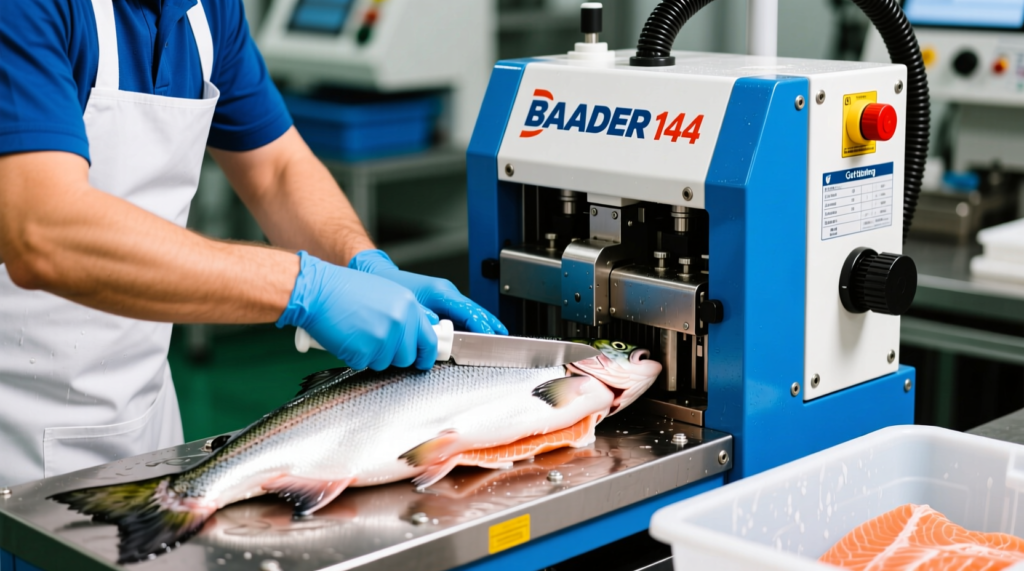
This page explains how the BAADER 144 supports automatic salmon gutting at high throughput with hygienic design, camera-based quality control in fish processing, and scalable feeding via the BAADER 1570—plus what plant managers should expect for yield, labor, cleaning, and integration in an industrial salmon processing equipment environment.
Introduction: Where the BAADER 144 fits in an industrial primary processing line
The BAADER 144 Salmon Gutting Machine is built for modern salmon plants that need stable throughput, repeatable gutting quality, and sanitation concepts aligned with HACCP (Hazard Analysis and Critical Control Points) programs. In practice, the BAADER 144 is typically installed in the primary processing line after bleeding and heading and before final washing, grading, and downstream filleting/portioning.
Often showcased alongside the BAADER 1570 Speed Feed System, the setup targets plants that want to reduce manual trimming, stabilize yield, and document cleaning performance through automated inspection.
For hygiene expectations and compliance context, many salmon processors align equipment selection and procedures with regulations and guidance such as the EU’s food hygiene framework (Regulation (EC) No 852/2004) and FDA seafood HACCP guidance in the US.
- EU Regulation (EC) No 852/2004 on the hygiene of foodstuffs
- FDA Fish and Fishery Products Hazards and Controls Guidance (Seafood HACCP)
TL;DR: BAADER 144 is positioned as a high-throughput gutting step in a primary processing line, designed to support HACCP-style control and auditability.
High-speed salmon gutting and yield stability (what happens mechanically)
In an automatic salmon gutting workflow, repeatability depends on three fundamentals: fish positioning, controlled cutting depth, and consistent removal/evacuation of viscera (offal). The BAADER 144 concept is built around indexing the fish (holding it in a defined position relative to tools) so the same cutting path can be applied fish after fish—even when size varies.
While exact tool geometry depends on configuration and product specification, high-capacity gutting machines in this class typically rely on a combination of:
- Guided belly opening tools (knife/blade assemblies) with fixed mechanical references to keep the cut aligned with the belly seam.
- Stabilizing/centering elements (guides/holders) that reduce roll and yaw so the fish presents consistently to the cutting zone.
- Timed removal mechanics (scraping/suction/water-assisted evacuation depending on design) that separate viscera without spreading contamination through process water.
With the BAADER 1570 Speed Feed System providing controlled feeding, the combined line speed is typically quoted at up to 25 fish/min depending on fish size and layout. For plants evaluating OPEX, speed only matters if it comes with yield stability—i.e., fewer belly tears, fewer kidney remnants, and less rework downstream.
Typical performance ranges (plant-dependent):
- Yield improvement: commonly ~0.2–0.8% vs. less controlled gutting/variable manual work, mainly by reducing over-trimming and downgrades.
- Rework reduction: often ~20–50% fewer fish requiring manual cavity re-cleaning when positioning + inspection are dialed in.
- Running at partial loads: the line can typically be operated at reduced speed (e.g., during startup, short harvest windows, or mixed-size deliveries) without losing basic process control—useful for plants that cannot always feed at peak capacity.
Case-style example: A salmon plant processing 80–120 tons/day that previously staffed multiple rework stations after gutting may see a 25–40% reduction in manual trimming touches when camera-based inspection is used to target only the fish that truly need intervention (actual results vary with fish condition, spec, and training).
TL;DR: Beyond 25 fish/min, the value is stable positioning + controlled cutting that typically lifts yield by ~0.2–0.8% and reduces rework by ~20–50% when tuned and staffed correctly.
Camera-based gutting inspection and quality assurance (defects, thresholds, control logic)
The BAADER 144 line includes camera-based cleaning control designed to evaluate the belly cavity after gutting. In industrial terms, this is an inline machine vision inspection step: a camera captures images of each fish cavity, and the control system classifies whether the cleaning result is acceptable.
What the camera typically looks for (examples of detectable conditions):
- Residual viscera or membranes in the belly cavity
- Kidney remnants/bloodline contamination that may require re-cleaning
- Incomplete cut/opening that can lead to downstream handling issues
- Foreign matter or abnormal discoloration (as configured by tolerance rules)
How tolerance thresholds usually work: the system applies an “acceptable vs. reject/rework” rule set based on measured area/contrast/shape features in defined regions of interest (ROI). Plants typically set thresholds to match their product spec (e.g., stricter for premium whole-fish export; more forgiving if a downstream wash/trim step exists). When a fish exceeds threshold limits, the control logic can:
- Trigger an alarm to prompt operator intervention
- Flag the fish for sorting to a rework lane (if the line includes a diverter/sorter)
- Log inspection outcomes for QA trend analysis and audits (useful for HACCP verification records)
Operational note: camera systems are only as good as their calibration and hygiene. Stable lighting, clean viewing windows, and a clear definition of “defect” are essential. Many plants include a short verification routine at startup (test pieces or known-good fish) to confirm detection sensitivity before running at full speed.
TL;DR: The camera system acts as inline QA—detecting residuals/defects against configurable thresholds and triggering alarms, sorting, and data logs to reduce unnecessary manual inspection.
Wide working range for salmon sizes (2–11 kg) and recipe-based control
The BAADER 144 is designed to handle a broad weight range—about 2 kg to 11 kg—covering common Atlantic salmon (Salmo salar) harvest sizes. Handling a wide range without constant mechanical tinkering typically requires a combination of mechanical references (to keep fish centered) and electronic parameter control.
The control system supports recipe storage (saved parameter sets) so operators can quickly switch between size classes and fish shapes. In practical plant terms, recipes reduce setup time and help keep yield consistent across changing deliveries.
Typical changeover expectations (plant-dependent):
- Recipe selection and minor adjustments: often 2–10 minutes between batches
- More significant format changes or inspections: may be 10–30 minutes if verification and tool checks are required
Challenge & mitigation: fish condition varies by season, handling, and farming site (soft belly, full gut, deformities). Plants usually mitigate this by (1) grouping deliveries by size/condition where possible, (2) using recipes tuned to condition factor, and (3) leveraging camera feedback to detect drift and correct settings before quality losses propagate.
TL;DR: Recipe-driven control helps the BAADER 144 handle 2–11 kg fish with quick batch switching (often 2–10 minutes for minor changes) while managing condition variability.
Typical line layout: integrating BAADER 144 + 1570 into a salmon primary processing flow

For decision-makers designing a primary processing line, placement and interfaces matter as much as the machine itself. A typical high-capacity salmon flow may look like:
- Stunning/bleeding (time/temperature controlled)
- Washing (gross soil removal)
- Heading (automated heading machine)
- Gutting: BAADER 1570 Speed Feed System + BAADER 144 gutting machines
- Post-gut wash (cavity rinse as specified)
- Weighing & grading (weight classes, quality categories)
- Downstream: filleting, trimming, portioning, freezing, or whole-fish packing
In multi-machine installations, the BAADER 1570’s role is to provide controlled spacing and orientation so each BAADER 144 receives fish consistently. This stabilizes cut accuracy and reduces “random events” that drive manual rework.
TL;DR: BAADER 144 typically sits after heading and before wash/grading; the 1570 feed system is used to stabilize orientation and spacing for consistent gutting at industrial line speeds.
BAADER 1570 Speed Feed System: staffing impact and throughput utilization
The BAADER 1570 is an automatic feeding and distribution concept designed to supply up to eight BAADER 144 machines (line layout dependent). Its practical impact is not only speed, but labor shaping: fewer people spending time on manual presentation and “un-jamming,” and more time spent on targeted QA and preventive checks.
Typical staffing patterns (illustrative; varies by plant and automation scope):
- Without an automated feed system: often 2–4 operators per gutting area to maintain orientation, manage flow, and handle exceptions—plus QA spot checks.
- With the BAADER 1570: often 1–2 operators to supervise feeding + 1 QA/inspector to respond to camera flags and verify trends (especially at startup).
Case-style example: A processor running two shifts and targeting consistent export-grade cavity cleanliness can often justify automation when it replaces even 1–2 full-time equivalents per shift and reduces rework touches—especially during peak harvesting weeks.
TL;DR: The 1570 is mainly an OPEX and stability lever—commonly shifting staffing from 2–4 hands-on feeders to 1–2 supervisors plus targeted QA, while keeping machines utilized at high throughput.
Hygiene, waste handling, and CIP-ready seafood machinery (design, materials, and cleaning reality)

For CIP-ready seafood machinery, “hygienic design” means more than smooth surfaces—it means predictable drainage, minimal harborage points, and components protected against water ingress. The BAADER 144 is positioned around modern cleanability expectations: controlled offal handling, separation of waste streams, and designs that reduce contamination spread.
Hygiene design features typically expected in this class:
- Stainless steel construction in washdown zones (commonly AISI 304 and/or 316; 316 is often preferred where chlorides are higher). Material choice should match your sanitation chemistry and water quality.
- Sloped surfaces and drainage concepts to avoid standing water and support fast dry-down.
- Avoidance of dead zones (no unsealed box sections in product zones; minimized crevices; hygienic welds where applicable).
- Washdown-rated components: sensors and electrical devices with suitable IP ratings (Ingress Protection; e.g., IP66/IP67 in wet areas depending on design) to withstand foam/rinse.
Waste handling: offal is typically separated and conveyed/collected in a controlled way (e.g., cyclone separation concepts) so it does not continuously contaminate process water and so by-products can be routed to rendering or silage systems more cleanly.
CIP readiness—what it usually means in practice:
- CIP-prepared circuits/areas: internal rinse circuits, spray bars/nozzles aimed at belly-cavity contact zones, and pipework designed to be cleaned without disassembly.
- Still manual (typical): targeted hand cleaning for guarding interfaces, external frames, some tool interfaces, and any areas where direct spray coverage is shadowed by mechanical assemblies.
- Cleaning media: common sequences use potable water pre-rinse, alkaline foam/detergent, intermediate rinse, and (where required) acid descaling—always matched to OEM guidance and local water hardness.
- Cycle structure (illustrative): 5–10 min pre-rinse → 10–20 min detergent circulation/foam dwell → 5–10 min rinse → optional acid step 5–15 min → final rinse and inspection.
Cleaning time savings (typical): compared with older designs, plants often report 15–30% shorter manual cleaning time due to better access + CIP-prepared spray coverage, though this depends heavily on sanitation standards and staffing.
TL;DR: The BAADER 144 targets hygienic design (drainage, fewer dead zones, washdown-rated components) and CIP-prepared cleaning for key internal zones, typically cutting manual cleaning time by ~15–30% vs. older layouts—while some manual detail cleaning remains necessary.
OPEX and maintenance planning: intervals, spares, lubrication, utilities
For plant decision-makers, total cost is driven by uptime, spare parts strategy, sanitation labor, and utilities—not just machine speed.
Maintenance and spares (typical expectations for gutting equipment):
- Daily: visual inspection of cutting components, verification of camera window cleanliness, quick checks of guides/holders, and washdown integrity.
- Weekly: check tool wear, alignment references, and sensor function; verify fasteners and guards after repeated wash cycles.
- Planned wear parts: cutting blades/knife sets, seals, scrapers/guides, bearings, and washdown gaskets (exact BOM depends on configuration).
- Lubrication: use food-grade lubricants where applicable and follow OEM schedules; many plants aim to minimize lubrication points in wet zones to reduce contamination risk.
Utilities considerations:
- Water: camera inspection and hygiene performance depend on stable wash quality; water consumption is strongly affected by rinse strategy and nozzle selection.
- Energy: main drivers are motors, pumps, and compressed air (if used for actuators); measure at site because utility load varies with line integration.
Challenge & mitigation: integration complexity (utilities, space, conveyors, and control signals) can drive hidden costs. Plants reduce risk by doing a FAT/SAT (Factory Acceptance Test / Site Acceptance Test) plan, defining interface points early (mechanical, electrical, data), and training leads before commissioning.
TL;DR: OPEX planning should include wear parts (blades/seals/guides), daily/weekly checks, food-grade lubrication strategy, and site-measured utility loads; FAT/SAT and training reduce integration-driven downtime.
Safety features for industrial salmon processing equipment (guards, interlocks, safety PLC)

In high-speed fish processing, safety engineering is non-negotiable. Typical safety concepts for industrial gutting lines include:
- Fixed and interlocked guards around cutting and drive zones
- Emergency stop (E-stop) circuits accessible from operating and service positions
- Interlock logic to prevent operation when access doors/guards are open
- Safety PLC (Programmable Logic Controller) or safety relays integrated with the line so upstream feeding and downstream conveying stop safely during an event
- Lockout/Tagout (LOTO) provisions for maintenance (site procedure dependent)
Plants operating under CE requirements typically expect machinery supplied into the EU/EEA to follow the Machinery Directive/Regulation framework and carry appropriate conformity documentation.
TL;DR: Expect standard industrial safeguards—guarding, interlocks, E-stops, and safety PLC integration—plus documented conformity expectations in CE-regulated markets.
BAADER 144 vs BAADER 142: key upgrades buyers usually care about
For comparison-search intent, the BAADER 144 is commonly positioned as an evolution over BAADER 142 concepts in areas that affect hygiene, automation, and uptime.
- Cleaning and hygiene: updated hygienic design details and CIP-ready preparation that can reduce manual cleaning effort.
- Quality assurance: addition/upgrade of camera-based cleaning control for objective inspection and documentation.
- Operational flexibility: improved control interface and recipe storage for faster changeovers and repeatability across size classes.
- Line automation: stronger positioning for high-throughput feeding via the BAADER 1570 ecosystem.
TL;DR: Compared to BAADER 142, BAADER 144 is typically evaluated for better cleanability/CIP readiness, camera-based inspection, recipe-driven flexibility, and easier integration into automated high-throughput lines.
Use cases / typical applications (who benefits most)
This setup is most often a fit when variability, labor cost, and audit pressure are high:
- High-capacity sea-based farming regions needing stable primary processing throughput during peak harvest weeks
- Land-based RAS (Recirculating Aquaculture Systems) with tighter biosecurity and documentation expectations, where consistent hygiene and traceable QA records matter
- Secondary processors handling mixed size classes who need recipes, fast changeovers, and targeted rework rather than blanket manual inspection
It can also be valuable for plants that sometimes run slower or partial loads: the combination of controlled feeding and inspection can keep quality stable even when staffing or inbound volume fluctuates.
TL;DR: Best fit is high-volume or high-variability operations (including RAS and mixed-size processors) that value auditability, labor reduction, and stable quality—even at partial loads.
Challenges in real plants (and how to overcome them)
Even strong automation can underperform if the plant doesn’t plan for real-world variability. Common challenges include:
- Variation in fish condition: soft bellies, deformities, or high gut fill can increase exceptions. Mitigation: condition-based recipes, camera thresholds tuned to product spec, and clear exception handling (rework lane vs stop).
- Training needs: operators must understand not only buttons, but what drives cavity cleanliness and yield. Mitigation: short skills matrix, startup verification routine, and refresher training after seasonal changes.
- Integration complexity: mechanical interfaces, hygiene zoning, utilities, and data signals (alarms/sorting) can create delays. Mitigation: define interfaces early, run FAT/SAT, and align with MES/SCADA requirements.
TL;DR: Most issues come from variability, training, and integration; recipe discipline, tuned camera thresholds, and structured FAT/SAT reduce risk and protect yield.
Conclusion
The BAADER 144 Salmon Gutting Machine—especially when paired with the BAADER 1570 Speed Feed System—targets high-throughput automatic salmon gutting with stronger hygiene outcomes and more objective quality control. For plant managers, the practical advantages are typically seen in yield stability, reduced rework, faster sanitation routines through CIP-ready seafood machinery concepts, and clearer QA documentation via camera-based quality control in fish processing.
When specifying the system, the best results come from treating it as a line module (feeding + gutting + inspection + sorting interface), supported by training, planned maintenance, and an integration plan that matches your primary processing flow and audit requirements.
TL;DR: BAADER 144 + 1570 is a scalable gutting module for primary processing lines—built to improve yield stability, reduce rework and cleaning time, and strengthen QA documentation when properly integrated and operated.
FAQ
Q: What throughput can I expect from a BAADER 144 gutting line with BAADER 1570 feeding?
A: A commonly cited top speed is up to about 25 fish per minute per machine setup (depending on fish size and layout). Many plants run below peak to maximize yield stability and reduce exceptions, especially during mixed-size deliveries.
Q: How does camera-based cleaning control actually reduce labor in salmon gutting?
A: Instead of manually inspecting every fish, the camera system flags only fish that exceed configured defect thresholds (e.g., visible residual viscera or contamination indicators). Plants often see roughly 20–50% fewer fish sent to manual cavity re-cleaning once thresholds and lighting/cleanliness are stabilized.
Q: What does “CIP-ready” mean on seafood machinery, and what still needs manual cleaning?
A: CIP (Clean-In-Place) readiness usually means key internal product-contact zones can be cleaned via built-in spray coverage and rinse circuits without disassembly. Manual cleaning is still typically required for some external frames, guarding interfaces, and shadowed areas. A common cleaning structure is 5–10 min pre-rinse, 10–20 min detergent step, and 5–10 min rinse (plus optional acid step depending on water hardness and plant standards).
Q: What are typical maintenance requirements and the main wear parts for a salmon gutting machine?
A: Expect daily checks (tool condition, camera window cleanliness, guide wear), weekly verification of alignment/sensors, and planned replacement of wear parts such as blades/knife sets, seals, scrapers/guides, bearings, and washdown gaskets. Actual intervals depend on hours run, fish condition, and sanitation chemistry.
Q: Can the BAADER 144 integrate with MES/SCADA and data collection systems for traceability?
A: In many industrial lines, gutting and inspection outcomes are logged and can be connected to broader line control for QA trending and compliance documentation. Integration scope depends on the plant’s architecture (signals, protocols, and data fields), so it’s typically defined during engineering to ensure inspection flags, alarms, and sorting decisions are captured reliably.