

Date: April 30, 2026
Author: Sean Tarry
Introduction: A Practical Roadmap to Low‑Carbon Construction Sites
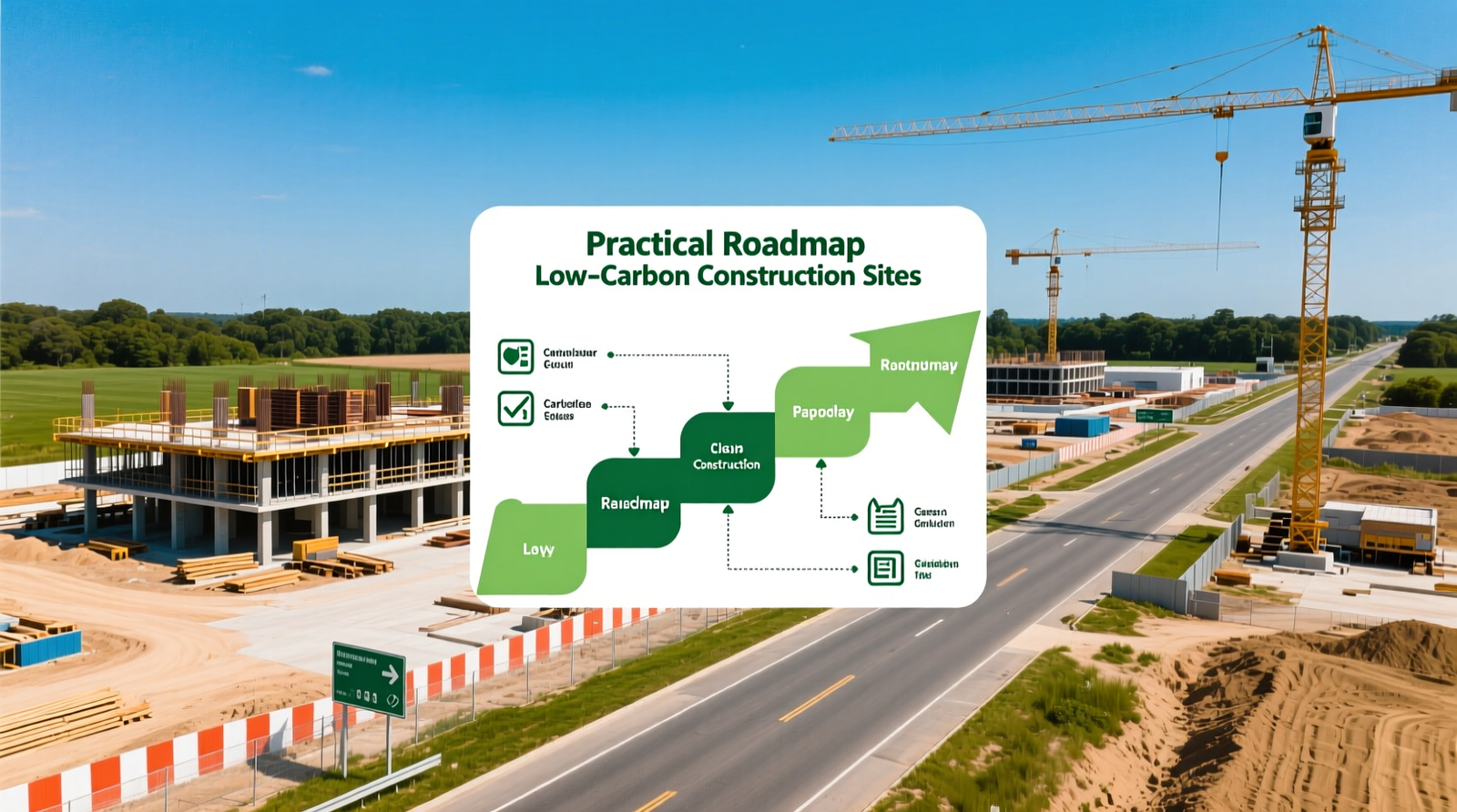
A new industry-backed roadmap is giving Canadian general contractors clear, data-driven tools for low-carbon construction practices in Canada—aimed at cutting jobsite greenhouse gas (GHG) emissions without sacrificing cost, schedule, or performance.
The report, titled Growing and Greening Canadian Construction, outlines five practical steps that can reduce jobsite (Scope 1 and 2) emissions by up to ~75% on some projects. It was developed by nine of Canada’s largest contractors in collaboration with the Transition Accelerator, and is grounded in real project data from more than 600 jobs across North America.
Important clarification on the “75%” figure: the percentage reductions shown for each step are best understood as potential contributions against a baseline jobsite emissions profile and may overlap depending on how your site is powered and which equipment categories dominate. In practice, you should expect non-additive results (i.e., you typically can’t just add 15% + 10% + 15% + 25% + 10% and always get 75%). A proper construction emissions reporting approach (metering + fuel tracking + an emissions factor method) is needed to avoid double-counting.
Baseline assumptions used in this article (for clarity): a typical mid-size commercial project’s direct jobsite emissions often concentrate in (a) diesel generators/temporary power, (b) temporary heating (diesel/propane/natural gas), (c) heavy equipment diesel, and (d) light-duty vehicles and small tools. The exact mix varies by season, grid access, and project type.
TL;DR: The roadmap is a practical guide to decarbonizing construction equipment and site energy; the “up to 75%” outcome depends on your baseline, grid carbon intensity, and avoiding overlapping counts.
Who Is Behind the Growing and Greening Canadian Construction Report?
The report was co-developed by nine leading Canadian general contractors:
- Aecon
- Bird
- Chandos
- EllisDon
- Graham
- Ledcor
- Multiplex
- PCL Construction
- Pomerleau
These firms represent a significant share of the commercial, civil, and institutional construction market in Canada—signaling that jobsite decarbonization is now a mainstream operational and procurement priority.
The work was completed in partnership with Transition Accelerator, a Canadian non-profit focused on practical, economy-wide decarbonization pathways. For background and related publications, see the Transition Accelerator’s website.
E‑E‑A‑T note (Experience, Expertise, Authoritativeness, Trust): For maximum credibility in your internal reporting, reference the original consortium report directly (and archive the PDF internally once obtained). Also consider aligning jobsite measurement practices with recognized standards such as ISO 14064-1 (GHG quantification and reporting) and, where applicable, Canadian guidance such as the Government of Canada’s National Inventory Report (for emissions accounting context).
TL;DR: The roadmap comes from a major contractor consortium with Transition Accelerator; strengthen trust by citing the original report and using recognized GHG reporting standards (e.g., ISO 14064-1).
Why Reducing Jobsite Emissions Matters Now

Construction sites emit GHGs through diesel-powered equipment, temporary generators, on-site heating, and logistics. Globally, the buildings and construction sector is a major contributor to emissions; the UN’s buildings program summarizes this landscape and the need for rapid reductions (see UN GlobalABC).
In Canada, owners and regulators are tightening expectations around construction emissions reporting, low-carbon procurement, and climate disclosures. Canada’s national climate targets and plans are published by the federal government (see Canada’s climate plan overview).
For many contractors, the immediate business driver is practical: fuel and power are volatile cost centres, while owner requirements increasingly reward quantified reductions and transparent reporting.
TL;DR: Jobsite emissions reduction is being driven by owner requirements, evolving regulations, and the financial reality of fuel/power costs—making low-carbon construction a competitiveness issue.
Data-Driven Insights: Real Projects, Not Theoretical Models
A key strength of the roadmap is its reliance on real-world project data rather than purely theoretical modeling. The analysis draws from over 600 construction projects across North America, spanning different climates, project scales, and delivery methods.
Anton Pojasok, Head of Sustainability for PCL Construction, highlights this practical focus:
“The report uses real-world project data to identify where emissions are generated on jobsites and where the most effective reduction opportunities exist. Because the data is aligned to how construction projects are actually delivered, versus relying on theoretical models, these are steps construction teams can implement right away.”
That matters for implementation: recommendations tied to actual duty cycles, heating loads, and temporary power constraints are more likely to be adopted—and less likely to create schedule risk.
TL;DR: The roadmap’s credibility comes from real job data—useful for practical jobsite electrification and fuel-switch decisions.
Five Practical Steps to Cut Jobsite Emissions (and How the “Up to 75%” Can Work)

The report describes five strategies that can reduce total jobsite emissions by up to ~75% on certain project types. To reduce confusion, here’s how to interpret the percentages:
- They are not strictly additive. For example, if you connect to the grid and eliminate most generator runtime, you can’t also claim the same generator emissions reductions again via another measure.
- They depend on your baseline. A winter build with heavy temporary heating has different opportunities than a summer project; a remote site with no grid access differs from an urban infill project.
- They depend on provincial grid carbon intensity. Electrification benefits are larger in hydro/nuclear-heavy grids than in fossil-heavy grids (more detail below).
Baseline example for a mid-size commercial project (numeric, simplified): Assume a 12–18 month project with 1,000 tCO2e (tonnes of carbon dioxide equivalent) of jobsite emissions (Scope 1+2), broken down as follows:
- Heavy equipment diesel: 450 tCO2e (45%)
- Temporary power (diesel generators): 200 tCO2e (20%)
- Temporary heating (diesel/propane): 200 tCO2e (20%)
- Light-duty vehicles + small tools: 150 tCO2e (15%)
The sections below show how each measure might reduce these categories in a way that avoids double counting.
TL;DR: Treat the five steps as levers against different parts of your emissions pie; the “up to 75%” outcome depends on baseline shares and overlapping effects.
1) Electrify Vehicles and Small Equipment (Typical contribution: ~5–15% of total)
Switching from gasoline/diesel to electric vehicles and small equipment is often one of the fastest operational changes—especially in urban projects with predictable daily usage and easy charging.
This typically includes:
- Battery electric light-duty vehicles where duty cycles allow
- Battery-powered tools and compact equipment (e.g., breakers, compactors, small loaders)
- Planned charging (Level 2 or DC fast charging where appropriate)
Numeric example (from the 1,000 tCO2e baseline): If light-duty vehicles + small tools are 150 tCO2e, and you electrify enough of that fleet/tooling to cut that category by ~50%, you reduce total jobsite emissions by:
- 150 tCO2e × 50% = 75 tCO2e (i.e., 7.5% of the total)
Operations & safety co-benefits: electric tools can reduce on-site exhaust exposure and often lower noise and vibration, supporting worker health and better conditions for nearby communities.
TL;DR: Electrifying light vehicles and small equipment usually yields single-digit to low-teens total reductions, with meaningful noise/air-quality benefits.
2) Improve and Electrify Temporary Heating (Typical contribution: ~5–15% of total)

Temporary heating is a major jobsite emitter in cold-weather construction. “Temporary heating” here includes portable heaters and indirect-fired units used to maintain temperatures for worker comfort, curing, drying, and freeze protection.
Common measures:
- Better enclosure/insulation to reduce heat loss (often the biggest, quickest win)
- Smarter controls (zoning, thermostats, runtime scheduling)
- Electrified heating (where power capacity and costs make sense), including heat pumps in some configurations
Numeric example: If temporary heating is 200 tCO2e, and weatherization + controls cut fuel burn by ~30% (even without full electrification), that’s:
- 200 tCO2e × 30% = 60 tCO2e (i.e., 6% of total)
Operations & safety co-benefits: better heating control can improve indoor air quality (less combustion equipment indoors/near intakes) and stabilize working conditions, helping productivity and reducing cold-stress risks.
TL;DR: Heating efficiency and electrification can be a major lever on winter projects; enclosure and controls often deliver fast, reliable reductions.
3) Connect to Grid Power Instead of Diesel Generators (Typical contribution: ~10–20% of total, grid-dependent)
Jobsite electrification often starts with reducing generator runtime. Many sites run diesel generators longer than necessary due to connection lead times, planning gaps, or perceived complexity.
Key actions:
- Start utility engagement early (often at pursuit or early precon) to plan service upgrades and timelines
- Design temporary power distribution to maximize grid use (and meter it)
- Use generators as bridging/backup rather than primary supply
Regional context (Canada): the emissions benefit of grid connection depends heavily on provincial/territorial grid carbon intensity. Hydro- and nuclear-heavy grids generally yield larger GHG benefits from electrification than fossil-heavy grids. Canada-wide electricity mix data is tracked by the federal government (see Natural Resources Canada: Canada’s electricity facts).
Numeric example: If diesel generators account for 200 tCO2e, and a grid connection eliminates ~80% of generator runtime, you reduce:
- 200 tCO2e × 80% = 160 tCO2e (i.e., 16% of total)
Note: you may add some grid electricity emissions back depending on the province and metered kWh. In very low-carbon grids, that “add-back” is small; in higher-carbon grids, the net benefit shrinks.
TL;DR: Grid connection can be one of the biggest levers, but the true GHG win varies by provincial grid mix—track diesel avoided and metered kWh to quantify net reductions.
4) Use Renewable Diesel for Heavy Equipment (Typical contribution: ~15–30% of total, supply-dependent)
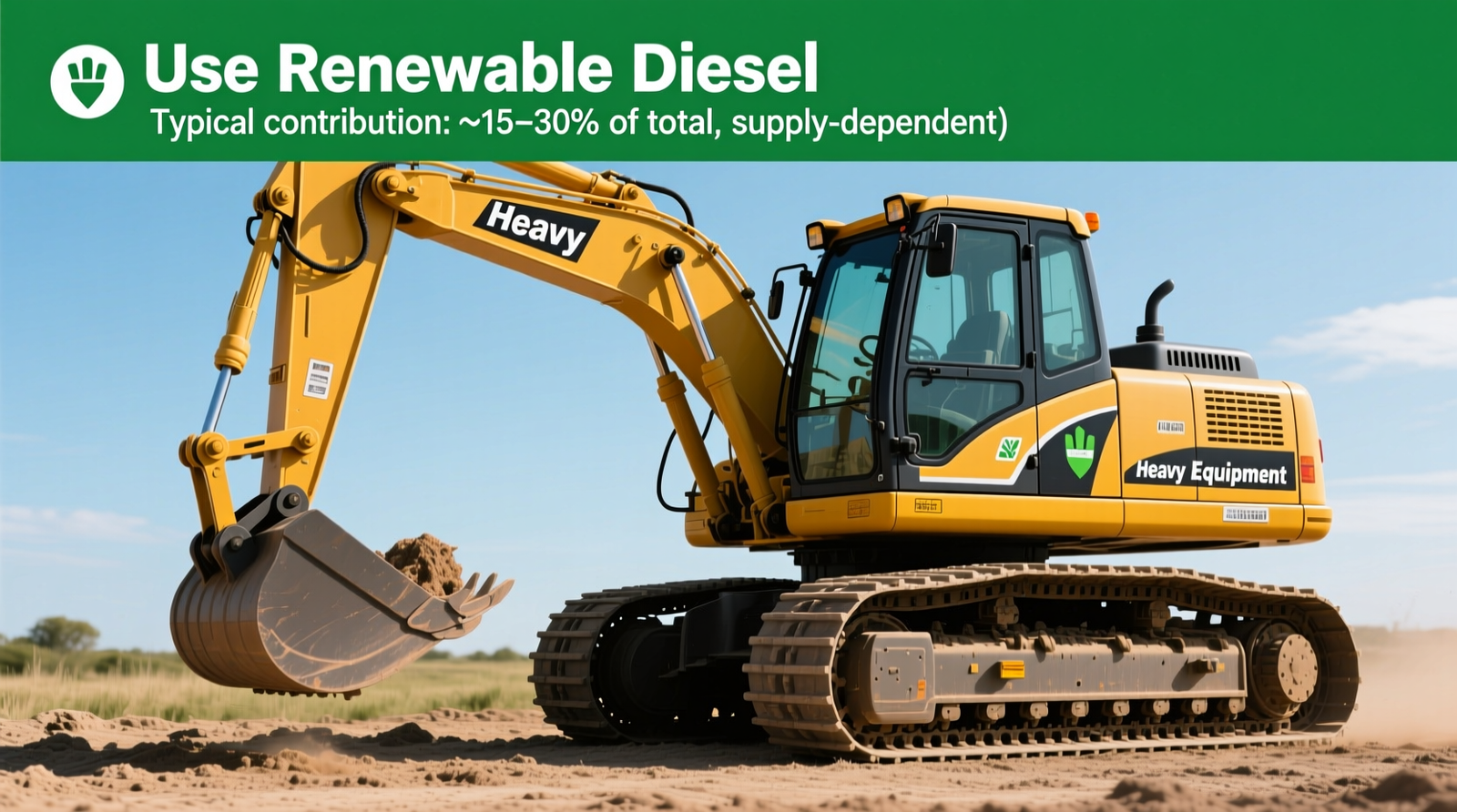
Many heavy equipment categories are still difficult to electrify at scale due to energy density needs, refueling speed, and charging infrastructure constraints. In the near term, renewable diesel (a “drop-in” diesel substitute typically produced from waste oils/fats and other feedstocks) can reduce life-cycle GHG emissions versus petroleum diesel, depending on feedstock and pathway.
Actions to prioritize:
- Target highest-hour equipment first (excavators, dozers, loaders, telehandlers depending on scope)
- Secure fuel quality/spec confirmation and consistent supply with suppliers
- Document chain-of-custody and emissions factors for credible reporting
Numeric example: If heavy equipment diesel is 450 tCO2e and renewable diesel achieves a conservative 50% life-cycle reduction on that fuel (actual values vary), then:
- 450 tCO2e × 50% = 225 tCO2e (i.e., 22.5% of total)
Reporting note: Life-cycle treatment can vary by program and standard; for consistent construction emissions reporting, document the emissions factor source and methodology (e.g., ISO-aligned accounting). In Canada, regulatory context for clean fuels is evolving (see Environment and Climate Change Canada: Clean Fuel Regulations).
TL;DR: Renewable diesel can drive large near-term reductions for heavy equipment, but benefits depend on verified fuel pathways and reliable supply.
5) Introduce Hybrid and Electric Excavation Equipment (Typical contribution: ~5–15% of total, project-fit dependent)
Hybrid (diesel-electric) and fully electric options are expanding for mid-size excavation and material handling. “Hybrid” equipment combines an internal combustion engine with an electric drive or energy recovery system to reduce fuel use; “electric” relies on batteries and charging.
Practical adoption steps:
- Pilot hybrid excavators/loaders on predictable duty cycles (repetitive work, limited travel distances)
- Deploy electric equipment where charging logistics and runtime needs align
- Capture utilization and energy data to build internal benchmarks
Numeric example (avoiding overlap with renewable diesel): If 200 tCO2e of the heavy equipment category is suitable for hybridization/electrification and you reduce that portion by 30% through hybrid/electric adoption and operational optimization, that’s:
- 200 tCO2e × 30% = 60 tCO2e (i.e., 6% of total)
Operations & safety co-benefits: electric and hybrid machines can reduce idling, noise, and localized exhaust—helpful for indoor/near-building work, night shifts, and health & safety environment (HSE) goals.
TL;DR: Hybrid/electric excavation is a growing lever for decarbonizing construction equipment—best deployed where duty cycles and charging can be planned.
Putting It Together: One Simple, Non-Additive 1,000 tCO2e Example
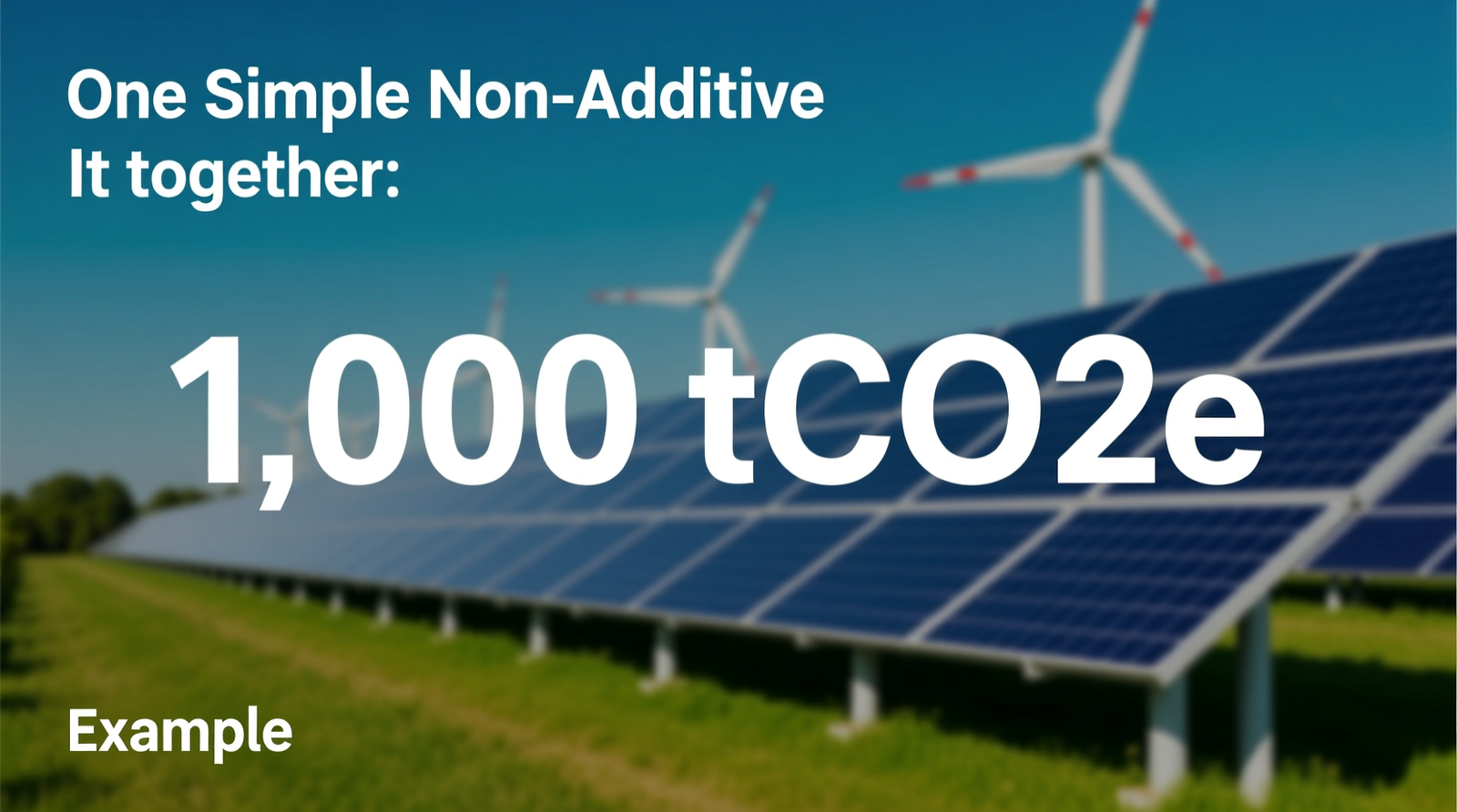
Using the baseline 1,000 tCO2e project and the conservative example reductions above (while avoiding double counting):
- Electrify light-duty + small tools: −75 tCO2e
- Heating efficiency improvements: −60 tCO2e
- Grid connection reduces generator runtime: −160 tCO2e
- Renewable diesel on heavy equipment (portion not electrified): −225 tCO2e
- Hybrid/electric equipment pilots: −60 tCO2e
Total illustrated reduction: 75 + 60 + 160 + 225 + 60 = 580 tCO2e, or ~58% reduction in this simplified scenario.
How “up to ~75%” can be realistic: that higher figure tends to require a combination of (a) high generator/heating shares, (b) early grid connection in a low-carbon province, (c) high renewable diesel coverage for remaining diesel loads, and (d) broader electrification/hybrid penetration with strong utilization. Some projects will exceed this example; others will be lower due to grid constraints, winter severity, remote access, or equipment availability.
TL;DR: A realistic mid-size project could cut ~40–70% depending on baseline and region; “up to 75%” is achievable in favorable conditions but is not guaranteed or strictly additive.
Cost, Schedule, and Performance: What “Cost-Neutral” Can Mean in Practice
The roadmap argues reductions can often be achieved without increasing total project cost—especially when measures are planned early. In practice, cost outcomes vary by site conditions, utility timelines, rental availability, and procurement strategy.
Indicative cost ranges and examples (directional, project-dependent):
- Fuel savings: Electrified tools/vehicles and reduced generator runtime can materially lower diesel consumption. Many contractors see meaningful savings when diesel prices spike; conversely, savings shrink when diesel is cheap. Tracking litres avoided is the simplest way to quantify.
- Maintenance savings: Electric tools and some electric equipment often have fewer moving parts, reducing routine maintenance and downtime risk (benefits depend on utilization and site handling).
- Grid vs. generators: Where grid connection is available, electricity can be more price-stable than diesel. However, you may face one-time costs (temporary transformer, distribution, engineering, deposits) and schedule risk if connection is delayed.
- Payback periods: For “quick win” measures (better heating controls, enclosure improvements, generator runtime reduction), payback can be within a single season on some winter projects; for higher-capital items (fleet electrification, larger electric equipment), payback more often spans multiple projects and depends on asset utilization across the contractor’s portfolio.
Caveat: treat any payback claim as site-specific. The best approach is to run a simple project pro forma: baseline diesel litres + rental costs + expected runtime changes + utility costs + any incentive programs.
TL;DR: Many measures can be cost-neutral or saving, but outcomes depend on fuel prices, grid access, and utilization—do a project-specific cost-and-carbon estimate early.
Implementation Barriers (and How Teams Commonly Overcome Them)

Even when the technology exists, execution can be blocked by practical constraints. Common challenges include:
- Upfront capital and rental premiums: electric/hybrid equipment and charging may cost more initially.
- Grid connection delays: utility lead times, service upgrades, permitting, and coordination can disrupt schedules.
- Renewable diesel availability: supply can be inconsistent by region, and contracting/verification can be unfamiliar.
- Labor training and change management: operators, superintendents, and maintenance teams need familiarity with charging, safe handling, and new operating practices.
- Data gaps: without metering and fuel tracking, construction emissions reporting becomes slow, manual, and less credible.
Mitigation strategies that often work:
- Lock in early utility engagement and include temporary power in preconstruction planning (not as a last-minute site start-up task).
- Bundle equipment pilots with OEM (original equipment manufacturer) support and operator training; require simple performance reporting (hours, kWh, downtime).
- Negotiate fuel supply and verification requirements early; document emissions factors and chain-of-custody for renewable fuels.
- Build an internal “standard playbook” (checklists, preferred vendors, standard metering kits) to reduce repeat friction across projects.
- Look for enabling policies and programs (federal/provincial incentives, utility programs) where available; requirements change frequently, so confirm current offerings with relevant agencies and utilities.
TL;DR: The biggest blockers are capital, grid timelines, fuel supply, training, and data—mitigate them with early planning, standardized playbooks, supplier agreements, and simple performance tracking.
Collaboration Across the Value Chain (Utilities, OEMs, Owners, and Suppliers)
Scaling jobsite decarbonization requires coordination beyond the contractor alone:
- Owners: specify measurable targets, accept reasonable pilot risk, and recognize low-carbon methods in bid evaluations.
- Utilities: streamline temporary/permanent service coordination and provide clear timelines for grid connections.
- OEMs and rental houses: expand electric/hybrid availability, provide parts/service support, and publish performance data.
- Fuel suppliers: improve renewable diesel logistics and verification documentation.
For third-party credibility, align internal carbon accounting with recognized frameworks (e.g., GHG Protocol guidance) and formal standards such as ISO 14064-1.
TL;DR: Contractor action is necessary but not sufficient—owners, utilities, OEMs, and suppliers enable faster, lower-risk adoption and more credible reporting.
Call to Action: A Simple Next-Step Checklist for Contractors

If you want to start decarbonizing construction equipment and site energy this quarter, focus on measurable, repeatable actions:
- 1) Audit your baseline: capture generator litres, equipment litres, and temporary heating fuel by month; add basic power metering where feasible.
- 2) Identify your top two emission drivers: heavy equipment, generators, or heating typically dominate—pick the biggest first.
- 3) Prioritize quick wins: reduce generator runtime, improve heating enclosure/controls, electrify the easiest vehicle/tool categories.
- 4) Engage utilities early: request timelines and costs for temporary/permanent service; design site power around grid-first assumptions where possible.
- 5) Line up suppliers: confirm renewable diesel availability/verification; reserve electric/hybrid rentals early.
- 6) Train crews: operator and electrician training for charging, lockout/tagout, and safe cable management.
- 7) Report results: publish litres avoided, kWh used, and tCO2e reduced using a consistent method (ISO/GHG Protocol-aligned).
TL;DR: Start with a baseline audit, target the biggest emitter on your site, lock in grid/supply early, and track results with consistent construction emissions reporting.
FAQ
Q: How do I estimate jobsite emissions for a typical Canadian commercial construction project?
A: Start by tracking fuel use (litres) for diesel generators, temporary heating, and heavy equipment, plus metered electricity use (kWh) for trailers and charging. Convert to tCO2e using a consistent emissions factor source and methodology (often aligned with GHG Protocol and ISO 14064-1). A simplified baseline for a mid-size project can be ~500–2,000 tCO2e depending on duration, winter conditions, and generator/heavy equipment intensity.
Q: Are the five emissions reduction percentages additive to reach 75%?
A: Not reliably. The reductions can overlap (for example, grid connection reduces generator fuel, which changes what’s left to reduce). “Up to 75%” is best viewed as a maximum achievable outcome under favorable conditions (high diesel baseline, strong grid access, low-carbon electricity, and high coverage of renewable diesel/electrification). Use project-specific tracking to avoid double counting.
Q: How does provincial grid carbon intensity affect jobsite electrification benefits?
A: Provinces with lower-carbon grids (often hydro- and/or nuclear-heavy) typically deliver larger net GHG reductions when you switch from diesel generators and combustion heating to electricity. In more fossil-heavy grids, electrification can still reduce local air pollution and noise, but the net GHG benefit may be smaller—so you should quantify using metered kWh and province-appropriate emissions factors.
Q: What are the biggest practical barriers to decarbonizing construction equipment on jobsites?
A: The most common barriers are grid connection lead times, upfront equipment costs or limited rental availability, renewable diesel supply/verification, and workforce training. Mitigation usually includes early utility engagement, standardized site power planning, supplier agreements, operator training, and basic metering/fuel tracking to prove results.
Q: Can low-carbon construction practices in Canada be cost-neutral or cost-saving?
A: Often yes, especially when reductions come from lower diesel consumption (less generator runtime), improved heating efficiency, and lower maintenance for electric tools/equipment. However, outcomes are site-specific and depend on fuel prices, utility costs, connection timelines, and equipment utilization. The most credible approach is to estimate both carbon and cost impacts during preconstruction and then validate them with real project data during execution.