
Introduction

Taiwan’s Advanced Semiconductor Engineering (ASE), the world’s largest outsourced semiconductor assembly and test (OSAT) provider, is expanding its outsourced semiconductor test services and advanced packaging footprint to keep pace with AI accelerators, high-performance computing (HPC), and next-generation connectivity. As device complexity rises—especially with heterogeneous integration (mixing multiple dies, memory stacks, and chiplets in one package)—test time, test coverage, and test infrastructure have become critical constraints that directly affect yield, lead time, and ramp schedules.
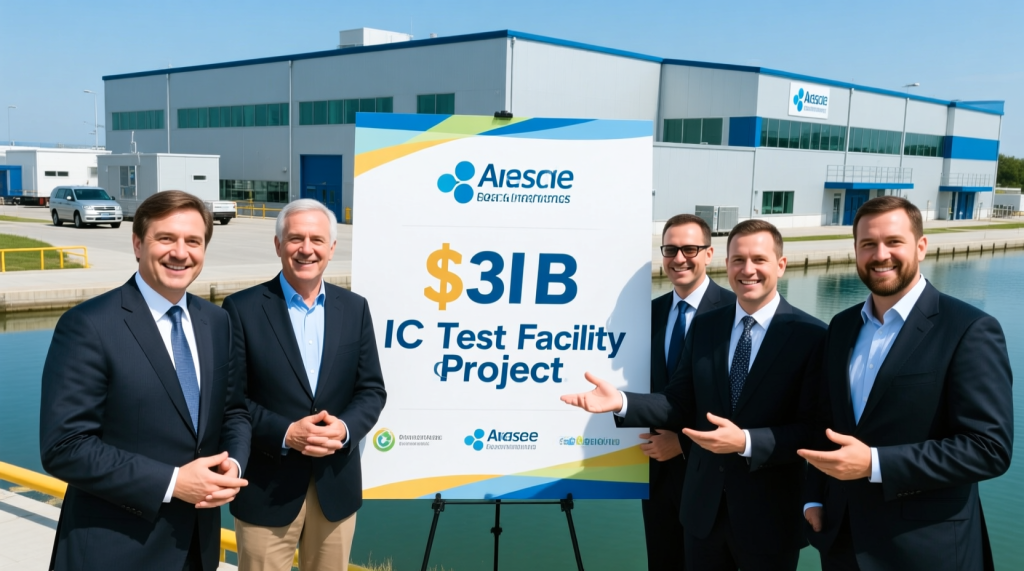
ASE’s latest move is a major new IC test facility planned for Kaohsiung, Taiwan, within a growing semiconductor test cluster in Kaohsiung Renwu Industrial Park. The investment aligns with broader OSAT capacity expansion trends and reinforces Taiwan’s role in advanced IC packaging in Taiwan.
TL;DR: ASE is scaling test and advanced packaging to address AI/HPC-driven test time and complexity, using a new Renwu (Kaohsiung) site to strengthen Taiwan’s backend semiconductor ecosystem.
New ASE IC Test Facility in Kaohsiung (Renwu Industrial Park)
ASE has broken ground on a new integrated circuit (IC) test facility in Kaohsiung, southern Taiwan. Local reporting and company disclosures cite a planned investment of NT$108.3 billion (about US$3.41 billion) for the Renwu project. The facility is planned for Renwu Industrial Park and is expected to begin operations in April 2027, subject to construction progress, tool delivery, and site qualification.
For sourcing and operations teams, the timing matters because modern automatic test equipment (ATE) delivery lead times can stretch from quarters to more than a year depending on configuration and demand cycles. “Tool-ready” does not equal “production-ready”: bringing up a new test floor typically requires electrical correlation (matching results to existing sites), golden unit baselining, and test program transfer with customer sign-off.
Primary/regional sourcing note: The Renwu cluster and investment totals were reported by Taipei Times (article referenced in the original draft; readers can track the Renwu coverage archive at https://www.taipeitimes.com/). ASE’s regulatory disclosures and risk factors are published in its annual filings (see ASE Technology Holding’s investor relations at https://www.aseglobal.com/).
TL;DR: ASE’s Renwu (Kaohsiung) project is a multi-billion NT$ test expansion targeted for April 2027 start, with practical ramp dependencies on ATE lead times, correlation, and customer qualification.
What an IC Test Facility Does (Consolidated Technical View)

An IC test facility is a production environment that runs semiconductor devices through electrical test across the product lifecycle, using automatic test equipment (ATE)—computer-controlled measurement systems that source/measure voltage and current, generate high-speed digital patterns, and validate analog and RF behavior against datasheet limits.
Core operations typically include:
- Wafer sort / wafer probing: testing individual dies (unpackaged chips) on the wafer using a wafer prober (a precision motion system that aligns probe needles or MEMS probe cards to die pads/bumps). This screens gross defects early and provides yield-learning data.
- Final test: testing packaged devices using a handler (automation that loads packaged parts into a test socket, often with temperature forcing). Final test is where binning (performance grading) and shipment quality decisions are made.
- System-level test (SLT) (when applicable): validating a device in a board-level environment closer to real use conditions (common for complex SoCs, AI accelerators, and some automotive parts).
- Reliability / stress: including burn-in (operating parts at elevated temperature/voltage to accelerate early failures) and qualification testing aligned to standards such as JEDEC (Joint Electron Device Engineering Council). See JEDEC’s reference site: https://www.jedec.org/.
From an economics standpoint, test cost scales with seconds per unit, temperature requirements, parallelism (how many devices are tested simultaneously), and coverage (how many corners and interfaces are validated). AI/HPC devices tend to increase all of the above.
TL;DR: IC test facilities combine ATE + probers/handlers + thermal and reliability infrastructure to execute wafer sort, final test, and sometimes SLT—where cost is driven by coverage, temperature, and test time/parallelism.
Planned Test Capabilities for the New Kaohsiung Facility (What “Advanced Test” Likely Means)
ASE has not publicly released a full line-by-line specification sheet for the Renwu site’s testers, but based on ASE’s disclosed supplier base (Teradyne, Advantest, and Tokyo Electron/TEL group references in filings) and the device mix implied by AI/HPC and advanced packaging demand, the Kaohsiung facility is expected to emphasize high-performance digital, mixed-signal, and memory/HBM-adjacent test capacity. For expert readers, the planned capability set typically needs to cover:
- High-speed digital / SoC test: pattern rates and pin electronics suited for advanced-node SoCs (commonly associated with 5nm/3nm/7nm-class devices; “nm” refers to technology node naming used by foundries). These programs often require high pin counts, multi-site test, and advanced timing accuracy/jitter control.
- High-current, low-voltage power delivery: AI accelerators frequently demand aggressive power rails (sub-1V domains with large transient currents). ATE and load board design must support high-current sourcing, tight voltage regulation, and fast dynamic load steps for power integrity checks. This drives requirements for low-inductance sockets, optimized decoupling, and careful ground strategy.
- Mixed-signal capability: validating ADCs/DACs (analog-to-digital/digital-to-analog converters), PLLs (phase-locked loops), high-speed clocks, and power management IC (PMIC) interfaces found in modern compute and connectivity devices. Mixed-signal testing often adds precision measurement resources and calibration complexity.
- RF support (for wireless/connectivity adjacent content): while the Renwu facility is positioned as an IC test plant rather than a specialty RF lab, a competitive Kaohsiung test operation typically needs some RF coverage for 5G/6G-adjacent components (RF = radio frequency). Practical RF test support depends on handler shielding, RF instrumentation modules, and controlled impedance test interfaces. (For RF fundamentals and standards context, see 3GPP—the cellular standards body—at https://www.3gpp.org/.)
- Thermal test and characterization: AI/HPC packages increasingly require testing across multiple temperature points (e.g., cold/room/hot) and sometimes extended thermal dwell for stability. This pushes investment in temperature-forcing handlers, contactor/socket thermal design, and potentially liquid-cooled or advanced air-cooling infrastructure for high-power parts.
- Parallelism / multi-site scaling: to control cost, OSATs drive multi-site test where feasible (testing multiple devices per ATE insertion). For high-pin-count, high-power parts, parallelism can be limited by power delivery and thermal constraints—so facility design (power, chilled water, airflow) becomes part of “test capability.”
In other words, the new facility’s differentiation is less about a single headline spec and more about the combined stack: ATE class, load board competence, socket/probe ecosystem, thermal infrastructure, and data/analytics that reduce test time while maintaining coverage.
TL;DR: Renwu’s test floor is expected to be optimized for advanced-node SoC and AI/HPC testing—high-speed digital + mixed-signal, strong power delivery, thermal capability, and practical multi-site throughput economics.
Supporting AI and HBM Test Requirements (Strategies That Matter)
AI accelerators increasingly rely on HBM (High Bandwidth Memory) integrated in 2.5D/3D packages. Testing these systems is not “just more pins”; it requires a layered strategy across memory stacks, interconnects, and high-speed links.
Key test requirements and how an OSAT like ASE typically addresses them include:
- HBM stack test strategy: HBM devices may be tested at multiple stages—wafer sort for known-good-die (KGD), stack-level test during assembly, and package-level test after integration with logic. “KGD” reduces the risk of stacking bad die into expensive assemblies, but it raises the bar for wafer probing, probe card performance, and test escape control.
- Interconnect test coverage: for 2.5D/3D integration, failures can occur in microbumps, TSVs (through-silicon vias), and interposer routing. Interconnect-focused tests (continuity, shorts, leakage, boundary-scan where applicable, and at-speed link training checks) become critical—especially because rework options can be limited once fully assembled.
- High-speed SerDes validation: modern accelerators and switch chips depend on SerDes (serializer/deserializer) links. Validation requires jitter tolerance measurement, eye margin assessment (directly or via built-in monitors), BER (bit error rate) testing, and compliance with standards roadmaps such as PCIe (Peripheral Component Interconnect Express) and CXL (Compute Express Link). For standards context: PCI-SIG at https://pcisig.com/ and the CXL Consortium at https://www.computeexpresslink.org/.
- Power integrity and thermal characterization: AI parts stress voltage droop, package PDN (power delivery network), and hotspot behavior. Test flows increasingly combine on-tester monitors (current signatures, droop events, clock stability) with temperature-aware binning and guard-banding decisions. In some cases, customers require correlation between ATE results and SLT or system rack telemetry.
- Adaptive test and binning optimization: rather than running every test on every device, adaptive strategies use early results and parametric trends to skip redundant coverage (within agreed quality limits) and to optimize bins (performance tiers) for product mix—especially important when seconds of test time translate into major capacity swings.
TL;DR: AI/HBM testing requires multi-stage KGD/stack/package strategies, interconnect-focused coverage, high-speed SerDes validation (PCIe/CXL-class), and power/thermal-aware characterization plus adaptive binning to control cost and yield risk.
Advanced Packaging Flows (2.5D, 3D, Chiplets, SiP) and How They Change Test
ASE’s growth thesis is tightly tied to heterogeneous integration. Definitions (first use):
- 2.5D packaging: multiple dies mounted side-by-side on an interposer (a routing substrate), typically enabling dense wiring between dies.
- 3D packaging: vertical die stacking with direct die-to-die interconnect (often via TSVs or hybrid bonding).
- Chiplets: partitioning a system into multiple smaller dies connected in-package rather than building one monolithic die.
- SiP (System-in-Package): integrating multiple components (logic, memory, passives, RF front-end, etc.) into one package module.
From a manufacturing and test perspective, the most important packaging details include:
- Interposer materials: silicon vs. organic: silicon interposers enable very fine wiring and high density but add cost and may introduce different thermal/mechanical behavior versus organic interposers. Organic interposers can be more cost-effective and scalable in panel-like flows but may have routing density limits and different warpage profiles. These tradeoffs influence whether certain tests (e.g., at-speed die-to-die links) can be executed reliably at intermediate steps.
- Bump pitch and contact strategy: advanced packages may use fine-pitch microbumps (often in the tens of microns pitch range) versus coarser C4 bumps. Finer pitch increases sensitivity to coplanarity, contamination, and mechanical stress—raising the importance of probe card technology, socket/contact design, and contact resistance monitoring.
- Warpage control: large body sizes (common in AI accelerators) and multi-die stacks can warp during reflow and thermal cycling. Warpage affects assembly yield and also test contact yield (the ability to make stable electrical contact in sockets/probe). Mitigation typically combines substrate selection, stiffeners, underfill/encapsulant choices, and process controls—plus handler/socket designs that tolerate package non-planarity.
- Test insertion points across the flow: advanced packages push test earlier (wafer sort/KGD), add mid-assembly checks (interposer/stack continuity), and expand final test + SLT coverage. The goal is to catch expensive failures before the cost of the package accumulates.
For readers tracking industry packaging roadmaps, an accessible overview of heterogeneous integration and advanced packaging drivers is published by SEMI (Semiconductor Equipment and Materials International) at https://www.semi.org/.
TL;DR: 2.5D/3D/chiplet/SiP flows raise the importance of interposer choice, bump pitch, and warpage control—and they add more test insertion points (KGD, interconnect checks, expanded final test/SLT) to manage cost-of-failure.
Building a Semiconductor Testing Cluster in Renwu Industrial Park (Ecosystem + Policy Context)
ASE’s Kaohsiung project is positioned to help form a local ecosystem of interface hardware, automation, and manufacturing services—effectively a semiconductor test cluster in Kaohsiung Renwu Industrial Park. The original article referenced ecosystem partners including:
- WinWay Technology – supplier of test interface solutions such as probe cards and test sockets (critical for high-pin-count devices and fine-pitch contact challenges).
- Horng Terng Automation (HTA) – supplier of automation equipment supporting packaging and production handling.
Cluster economics matter: proximity between OSAT production lines and interface/automation suppliers can reduce debug cycles, accelerate socket/probe iterations, and shorten response time during customer ramps.
Infrastructure and regulatory considerations: large test facilities are power- and water-sensitive. Test floors supporting high-power AI devices may require significant electrical capacity, cooling (including chilled water), and environmental controls. Taiwan’s industrial policy and grid reliability considerations can influence site selection and build-out sequencing. For broader context on Taiwan’s industrial and investment environment, see Taiwan’s Invest Taiwan portal: https://investtaiwan.nat.gov.tw/.
TL;DR: Renwu is designed as an ecosystem play—co-locating ASE with interface and automation suppliers—while facility ramp success depends heavily on power/cooling infrastructure and regulatory readiness.
ASE’s Role as a Leading OSAT Provider (Business Positioning)
ASE provides outsourced back-end manufacturing to fabless companies, integrated device manufacturers (IDMs), and system OEMs (original equipment manufacturers). Its portfolio spans conventional packaging and test as well as advanced integration—important because customers increasingly want a single partner that can co-optimize package design, test strategy, and production ramp.
ASE’s service scope includes wafer-level services, assembly, advanced packaging (including 2.5D/3D and SiP), wafer sort, final test, and reliability qualification. This breadth supports “design-to-manufacturing” engagement models where test constraints (power delivery, pin mapping, access points, DFT coverage) influence package architecture early.
TL;DR: ASE’s value proposition is breadth and integration—customers can align package architecture and test strategy with one OSAT partner to accelerate ramp and manage cost/yield.
Demand Drivers: AI, HPC, 5G/6G, and Automotive
Demand for advanced test and packaging is being pulled by:
- AI accelerators and GPUs with HBM and large-body advanced packages
- HPC and data center processors with high-speed I/O and strict power integrity requirements
- 5G and emerging 6G connectivity ecosystems (RF and mixed-signal content)
- Automotive electronics and ADAS (advanced driver-assistance systems), where qualification and traceability requirements add test burden
Technically, the driver is not just unit volume; it is test complexity per unit. High-speed interfaces, multiple power domains, advanced packaging interconnects, and reliability expectations expand test vectors, characterization corners, and the need for sophisticated analytics.
TL;DR: AI/HPC and advanced connectivity increase test time and complexity per device, not just volumes—raising the strategic value of OSAT test capacity and engineering depth.
Capital Spending and Construction: What’s Known vs. Estimated
ASE has communicated elevated investment to support advanced packaging and test. The original draft cites capital spending rising from US$5.5 billion in 2025 to about US$7 billion in 2026. Without the full citation embedded, readers should treat these as company guidance and/or press-reported figures rather than independently verified totals; the most reliable confirmation typically comes from ASE investor materials (earnings calls, investor presentations) and annual filings.
Similarly, reporting that ASE has “six factories under construction” was attributed to Taipei Times in the original text; readers should refer to the specific article instance for the date and wording via Taipei Times.
Practical constraint: even with budget approval, the gating factors for test expansion often include (1) ATE allocation and delivery schedules, (2) facility power/cooling readiness, and (3) availability of experienced test engineers and equipment technicians—especially for AI/HBM programs where bring-up is non-trivial.
TL;DR: Capex and factory counts should be read as company guidance/press reporting unless verified in filings; real ramp is gated by ATE lead times, infrastructure readiness, and specialized test talent.
Growth of ASE’s Testing and Advanced Packaging Business (Clarifying the Nature of the Numbers)

The article cites two key growth statements:
- ~36% test growth in 2025
- Advanced packaging revenue doubling from ~US$1.6B (2025) to ~US$3.2B (2026), with a ~75% packaging / 25% test split in the 2026 total
To strengthen decision-making, it’s important to clarify what these represent. In many semiconductor news and investor contexts, such figures may be a blend of company commentary (guidance/targets) and analyst/press estimates. The most defensible approach is to treat them as management guidance or market-reported projections unless the exact source (e.g., an ASE earnings call slide or a named investor presentation) is cited line-by-line.
For readers who want to validate: ASE’s investor relations site and annual reports (Form 20‑F for the relevant fiscal year) are the primary sources for segment reporting, capacity commentary, and risk factors (https://www.aseglobal.com/).
TL;DR: The 36% test growth and “doubling advanced packaging revenue” figures should be treated as guidance/projections unless tied to a specific ASE investor document; validate in ASE IR materials or annual filings.
ASE’s Test Operations: ATE Fleet, Mix, and Utilization Considerations
ASE disclosed that as of January 31, 2026, it operated 7,456 testers globally (as stated in the original draft referencing ASE’s Form 20‑F). In ATE terms, “testers” can include a range from high-end SoC digital systems to mixed-signal and memory-oriented configurations, each with very different throughput, cost, and applicability.
Tester mix and utilization: OSAT economics depend on how well the fleet is matched to demand segments (logic vs. memory vs. analog/RF) and on utilization (the percent of available test hours billed productively). AI/HPC ramps can create a paradox: demand is strong, but utilization may be constrained by long test times, thermal constraints, and limited multi-site capability. Conversely, mature-node analog or PMIC testing can achieve high parallelism and strong utilization when demand is steady.
How Renwu may shift the mix: if the Kaohsiung facility is optimized for AI/HPC (high-speed digital + high-power thermal handling), it likely increases ASE’s relative capacity in the high-end logic test category, which typically carries higher tool cost and engineering content than commodity test. This can raise barriers to entry—but also raises execution risk during ramp.
Competitive benchmark note: OSAT competitors such as Amkor and JCET also operate large tester fleets, but public disclosures vary in granularity and “tester” definitions, making direct apples-to-apples comparisons difficult without a common reporting basis. For market structure context and OSAT landscape coverage, SEMI and other industry organizations provide periodic reports and articles (https://www.semi.org/).
TL;DR: ASE’s 7,456-tester fleet is a major scale advantage, but the real story is mix and utilization; Renwu likely increases high-end logic/AI test capacity where throughput is limited by thermal and test-time constraints.
Smart Manufacturing and Data Analytics on the Test Floor (Practical Applications)
Modern test operations increasingly compete on data. In high-mix, high-complexity production (especially AI accelerators), ASE and leading OSATs typically deploy “smart manufacturing” approaches such as:
- Adaptive test: using early results, on-chip monitors, and statistical limits to reduce redundant vectors while maintaining agreed outgoing quality (requires tight controls and customer sign-off).
- Dynamic binning optimization: tuning parametric limits and bin splits to maximize revenue yield for performance-tiered products (common for GPUs/accelerators), while preventing systematic escapes.
- Predictive maintenance: monitoring handler/prober performance signals (contact resistance trends, alignment drift, vacuum/thermal module metrics) to schedule maintenance before catastrophic downtime.
- SPC and traceability: Statistical Process Control (SPC) across lots, sockets, probe cards, and ATE resources to isolate excursions rapidly—especially important for advanced packaging interconnect-related failures.
These tools matter because a few seconds of test time reduction, or a small improvement in contact yield, can translate into meaningful effective capacity—sometimes comparable to buying additional testers.
TL;DR: Analytics-driven test (adaptive coverage, binning optimization, predictive maintenance, SPC) is a capacity multiplier—especially for AI/HPC devices where seconds-per-unit and contact yield dominate economics.
Customer Engagement Model for New AI/HPC Programs (How OSAT + Customer Actually Co-Develop Test)
For advanced-node AI/HPC devices, OSAT engagement commonly starts well before mass production. A typical model includes:
- Joint DFT planning: DFT (design-for-test) collaboration to ensure scan, BIST (built-in self-test), boundary scan, and access mechanisms align with package and probe constraints.
- Test program co-development: developing vectors, characterization tests, and limit strategies jointly, including corner analysis for voltage/temperature and power states.
- Engineering lots and characterization flow: early lots run through expanded characterization to establish baselines, guard-bands, and binning strategies; correlation is performed vs. customer labs and other ASE sites.
- Ramp governance: change control for sockets/probe cards, firmware, and test limits; yield learning loops that tie assembly defects to electrical signatures.
For procurement teams, this implies that selecting an OSAT for AI/HPC is partly selecting an engineering partner—not only a capacity provider.
TL;DR: AI/HPC outsourcing is co-development: joint DFT + test program creation + engineering lots + tight ramp governance, with correlation and yield learning loops across package and test.
Impact on Customers (Fabless, IDMs, and System OEMs)

ASE’s Renwu expansion can affect customers in several concrete ways:
- Lead times and allocation: additional high-end test capacity can shorten queue times during peaks—though initial ramp may be constrained until correlation and staffing stabilize.
- Flexibility for advanced packages: co-locating packaging and test engineering resources can reduce iteration cycles for chiplets/HBM packages where interconnect and thermal behavior require rapid debug.
- Cost implications: advanced test content (longer time, thermal control, SLT) increases cost per unit; capacity expansions can help stabilize pricing, but high-end ATE and interface hardware costs remain structural.
- Risk management: multi-site qualification (being able to dual-source within ASE’s footprint) improves resilience if customers can complete correlation and audit processes early.
TL;DR: Customers should expect improved long-term capacity and co-optimization for advanced packages, but must plan for ramp/qualification time and the inherently higher cost structure of AI/HPC testing.
Taiwan’s Backend Ecosystem vs. Other Regional Hubs
Taiwan remains the most strategically dense hub for advanced backend services due to proximity to leading foundries, substrate/interposer suppliers, and deep OSAT engineering talent pools. However, other regions compete aggressively:
- South Korea: strong memory ecosystem and advanced packaging/test capabilities tied to large IDMs; often competitive for memory/HBM-adjacent supply chains.
- China: significant OSAT scale and rapid capacity buildout, with growing domestic demand; export controls and tool access can influence the leading-edge ceiling for some programs.
- Southeast Asia (e.g., Malaysia, Singapore, Vietnam): major assembly/test footprints and growing ecosystem depth; attractive for diversification and certain product mixes, though the highest-end AI/HPC co-packaging ecosystems are still more concentrated in Taiwan.
ASE’s Kaohsiung build strengthens Taiwan’s positioning not just in packaging, but in high-end test engineering—an area that becomes more differentiated as AI workloads drive new standards and tighter power/thermal constraints.
TL;DR: Taiwan’s backend advantage is ecosystem density; other hubs are scaling, but Renwu reinforces Taiwan’s edge in high-end test + advanced packaging integration.
Risks and Execution Challenges (Balanced View)
Even with strong demand, several risks can affect schedule, cost, and ramp effectiveness:
- Test engineering talent constraints: high-end AI/HBM test requires specialized expertise in high-speed signal integrity, power integrity, thermal methods, and data analytics.
- ATE and interface supply chain lead times: testers, load boards, sockets, and probe cards can be gating items; late changes to device specs can ripple into long re-spin cycles.
- Infrastructure constraints: high-power test raises facility demands for electricity, cooling, and uptime; regional grid or permitting constraints can impact scaling.
- Geopolitical and compliance risk: cross-border restrictions can affect customer mix, tool availability, and program placement decisions.
TL;DR: The biggest ramp risks are people (specialized engineers), tools/interfaces (lead times and iterations), infrastructure (power/cooling), and broader geopolitical/compliance constraints.
Conclusion
ASE’s new Kaohsiung (Renwu) IC test facility—planned at NT$108.3 billion investment and targeted for April 2027 operations—signals a strategic push to expand high-end outsourced semiconductor test services alongside advanced packaging. With a disclosed global base of 7,456 testers (as of Jan. 31, 2026 per the original Form 20‑F reference), ASE is building capacity and ecosystem depth in a region already central to the world’s semiconductor supply chain.
Forward-looking implications for engineering and sourcing teams include:
- Potential lead-time relief for AI/HPC test as new high-end logic/thermal-ready capacity comes online—after correlation and qualification cycles complete.
- Better support for emerging standards and interfaces (e.g., CXL, PCIe Gen6, and potentially more advanced RF/6G-adjacent test needs) as ATE and validation methods evolve.
- Portfolio mix shift toward higher engineering-content programs where advanced packaging (2.5D/3D, chiplets, SiP) and advanced test are co-optimized as one deliverable.
TL;DR: Renwu strengthens ASE’s ability to co-deliver advanced packaging + high-end test for AI/HPC, with likely improvements in capacity and standards readiness—tempered by ramp, qualification, and infrastructure realities.
FAQ

Q: What device types are most likely to be prioritized at ASE’s new Renwu (Kaohsiung) test facility?
A: Based on the demand drivers ASE highlights (AI/HPC and advanced packaging), early prioritization is likely to skew toward high-end logic/SoC test, advanced package final test, and programs with high power/thermal requirements—such as AI accelerators, GPUs, networking/switch silicon, and heterogeneous packages integrating HBM.
Q: How does advanced packaging (2.5D/3D, chiplets, SiP) change the semiconductor test strategy?
A: It adds more test insertion points (wafer sort/KGD, mid-assembly interconnect checks, expanded final test and sometimes SLT) and shifts failure risk toward interconnects (microbumps/TSVs/interposer routing), power integrity, and thermal behavior. Warpage and fine-pitch contact challenges also increase the importance of sockets, probe cards, and handler/prober capability.
Q: What should customers expect for site qualification when ASE brings the new Kaohsiung test plant online?
A: Typical qualification includes test result correlation versus an existing qualified site, golden unit baselines, process capability reviews, reliability alignment, audits (quality and security, where required), and controlled test program transfer. For AI/HPC, expect additional correlation work around high-speed I/O, power/thermal behavior, and binning consistency.
Q: Will the new facility reduce test lead times for AI accelerators and HBM-based packages?
A: It can, but not immediately on day one. Lead-time improvements generally follow once the new lines are fully tooled, staffed, and correlated, and once customers complete qualification. AI/HBM programs are often gated by thermal handling, long test times, and interface hardware readiness, so effective capacity depends on more than the number of testers installed.
Q: How is ASE likely to support high-speed SerDes and standards like PCIe and CXL in production test?
A: Production strategies usually combine ATE-based electrical tests with on-chip diagnostics (BIST/monitors), structured margining (where available), and correlation to characterization/systems. Compliance bodies such as PCI-SIG (PCIe) and the CXL Consortium define evolving requirements; OSAT test flows typically focus on screening and margin assurance rather than full protocol certification in production.