
Introduction

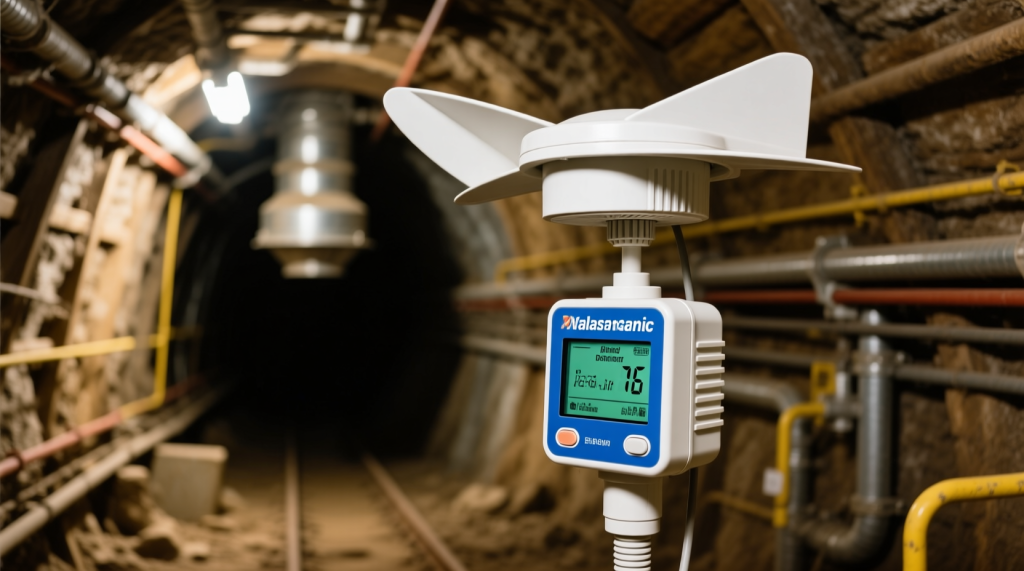
Accurate airflow monitoring is critical for coal mine safety, disaster prevention, and efficient ventilation management. Deep and ultra-deep mines add complexity: longer roadways, higher heat and humidity, more dust, and more dynamic air-routing changes due to production activities. That complexity creates a practical gap in mine ventilation instrumentation: engineers need measurements that are portable, repeatable, and reliable in harsh underground environments where many traditional tools struggle.
A peer-reviewed study in Scientific Reports evaluates a portable ultrasonic wind sensor (an underground airflow monitoring device) designed to improve day-to-day roadway wind-speed checks in Chinese coal mines. The paper (“Experimental study on portable multi-parameter intelligent wind measurement sensor”) reports wind-speed errors within about ±0.1 m/s under controlled and field conditions, using a reflective ultrasonic acoustic path to improve stability in dusty, confined spaces.
External reference: The full article is available via the publisher at Nature / Scientific Reports (DOI landing page).
TL;DR: Deep-mine ventilation is harder to control, and existing field instruments can be inconsistent; this portable reflective ultrasonic sensor targets that instrumentation gap with lab + mine validation.
Why Accurate Airflow Monitoring Matters in Deep Coal Mines
As coal mines go deeper, ventilation systems become more complex and harder to control. Typical deep-mine conditions include higher temperature and humidity, increased gas accumulation risks (especially methane), more dust, and more intricate roadway networks.
Airflow velocity (wind speed) across mine roadways is a key parameter in mine ventilation engineering because it directly supports:
- Compliance checks against site procedures and applicable ventilation measurement standards
- Air quantity calculations (velocity × cross-sectional area) used for gas dilution capacity
- Fan and regulator optimization (energy and air distribution)
- Early anomaly detection (unexpected drops, reversals, leakage paths)
Many modern approaches—ventilation network solvers, digital-twin concepts, or data-driven control—still rely on one foundation: credible measurement inputs taken at the right locations, at the right frequency, with documented uncertainty.
Practical impact example: In a 4 m-wide by 3 m-high roadway (~12 m²), at 2.0 m/s average velocity, the air quantity is ~24 m³/s. A ±0.1 m/s uncertainty corresponds to roughly ±5% in velocity (0.1/2.0) and about ±1.2 m³/s in air quantity (0.1 × 12), which can be meaningful for gas dilution margins and fan/regulator setpoints.
External reference: For general ventilation measurement concepts and terminology, see NIOSH mining ventilation resources: CDC/NIOSH — Mine Ventilation.
TL;DR: Velocity measurement uncertainty propagates into air-quantity estimates and therefore affects compliance, gas control, and fan/regulator decisions.
Development of the Portable Ultrasonic Wind Sensor (What It Measures and Why It’s Different)

The researchers developed a portable multi-parameter ultrasonic wind sensor tailored for underground use—functionally a coal mine wind speed sensor with extra environmental channels. Ultrasonic time-of-flight (ToF) is the core method: the sensor measures the travel time of sound pulses along a known path, and wind speed is inferred from the difference in ToF in opposite directions.
Key features reported include:
- Reflective ultrasonic transducer layout (sound path uses reflections rather than a single straight line)
- Integrated temperature and humidity sensing to correct the speed of sound (because sound speed varies with air temperature and water vapor content)
- High-resolution timing electronics (nanosecond-scale timing is referenced in the paper)
- Portable form factor intended for field surveys and inspections
Uni-directional vs bi-directional flow: Ultrasonic ToF systems are typically capable of bi-directional measurement (they can indicate sign/direction by comparing upstream vs downstream ToF). That matters underground because local flow reversals can occur during ventilation changes, regulator adjustments, or incident response. In deployment, confirm whether the device firmware reports a signed velocity (positive/negative) and how it flags flow reversal events for alarms and logs.
TL;DR: The sensor uses ultrasonic time-of-flight with temperature/humidity correction; confirm its bi-directional capability and reversal handling for emergency scenarios.
Wind Tunnel Testing and Experimental Setup (Controlled Accuracy Evidence)
To validate the instrumentation under controlled conditions, the team built a low-speed closed-circuit wind tunnel (a recirculating tunnel designed for stable, repeatable low-velocity airflow). Reported parameters include:
- Cross-section: 0.7 m × 0.7 m
- Test wind-speed range: 0.5 to 5 m/s (typical of many underground roadway velocities)
- A defined stable test region to reduce edge effects
- Side-by-side comparisons of reflective vs direct-through ultrasonic configurations
Reference instrumentation context: For accuracy claims to be meaningful in engineering decisions, wind-tunnel studies typically rely on a traceable reference such as a calibrated Pitot-static tube with differential pressure measurement, or a calibrated hot-wire/hot-film anemometer in low-speed flow. The study reports comparative error statistics; when adopting similar equipment at a site, it’s good practice to document what reference standard your mine uses for periodic verification (e.g., a calibrated vane anemometer or Pitot traverse kit) and how uncertainty is budgeted.
About turbulence: Low-speed tunnels can still have turbulence intensity that affects point measurements and alignment sensitivity. For underground applicability, what matters is that the sensor’s error remains bounded across realistic velocity gradients and moderate turbulence; the paper’s stable-region approach is intended to reduce uncontrolled variability so the sensor’s intrinsic behavior can be evaluated.
TL;DR: Controlled wind-tunnel testing (0.5–5 m/s) supports the ±0.1 m/s-level accuracy claim; mines should still document reference standards and verification methods for ongoing QA/QC.
Reflective vs Direct-Through Ultrasonic Design (Engineering Explanation + Dust Robustness)

A direct-through ultrasonic design sends sound straight from one transducer to another across an open measurement gap. In clean environments this can work well, but in mines it can be more susceptible to:
- Dust loading that attenuates the signal along the open path
- Partial obstruction (cables, mesh, support steel, scaling, water droplets)
- Misalignment sensitivity because the direct acoustic “line-of-sight” must be maintained
In a reflective design, the acoustic path is folded using one or more reflecting surfaces (mirrors/plates). Practically, that means the effective path length can be increased or geometrically “protected” while keeping the device compact. A reflective geometry can also be arranged so that the critical transducer-to-reflector alignment is mechanically constrained inside the housing, reducing field alignment errors and helping the signal remain detectable in dusty air where a long open direct path might degrade.
Path geometry nuance: While the paper describes a reflective layout rather than publishing a single universal “best” reflection angle, the engineering intent is clear: folding the acoustic path changes how much of the path is exposed and how sensitive the received signal is to minor blockage. Compared with direct-through, the reflective layout can maintain a usable signal under higher attenuation (dust) and minor obstructions, improving measurement stability.
Quantifying the “75% error reduction”: The study reports that the reflective layout reduced average measurement error by >75% versus direct-through and reduced the error standard deviation by ~4×. For operational readers, treat this as “the reflective design materially tightens both bias and scatter.” If you need an engineering-grade conversion (e.g., from X m/s to Y m/s), use the paper’s specific tables/figures for your expected velocity range and include those values in your site instrument justification file.
TL;DR: Direct-through is a straight acoustic line more sensitive to dust/obstruction; reflective folds the path to improve robustness and stability, with reported large reductions in mean error and variability.
Effect of Sensor Angle on Measurement Accuracy (Positioning Protocol)
The study confirms a practical truth for all airflow instruments: orientation matters. The sensor is most accurate when aligned with airflow (0° offset), and error increases with misalignment angle.
Positioning protocol for roadway surveys:
- Align to the local flow axis (not necessarily the roadway axis). Use smoke tube observation (where permitted) or compare readings while yawing the sensor ±10–15° to find the maximum magnitude (often closest to true alignment).
- Control the measurement point: keep a consistent height (e.g., mid-height or a specified distance below the roof) and consistent lateral offsets to support repeatable traverses.
- Avoid disturbance zones: stay away from sharp bends, doors, stoppings, and fan discharges unless the goal is specifically to quantify their influence.
Recommended sampling frequency (day-to-day operations): For routine compliance/survey work, collect 10–30 seconds of stable data per point (or longer if velocity fluctuates), and record the mean and standard deviation. For troubleshooting or regulator/fan tuning, use higher-rate logging (e.g., 1–10 Hz if supported) for several minutes before and after changes to capture transient responses.
TL;DR: Keep the sensor aligned with local flow and use consistent traverse points; log short stable windows for surveys and higher-rate trends for ventilation adjustments.
Wind Tunnel Velocity Distribution and Error Analysis (What ±0.1 m/s Means)
Wind tunnel mapping showed the expected pattern: slightly higher velocities near the center and lower velocities near boundaries. Within the stable region, the portable ultrasonic sensor maintained an average wind-speed error within approximately ±0.1 m/s.
Why this accuracy matters to ventilation decisions: In many mines, a 0.1 m/s change can be the difference between “no action” and “investigate,” especially in low-speed districts (e.g., 0.5–1.5 m/s) where a ±0.1 m/s uncertainty becomes a larger percentage. It also affects computed air quantity when you multiply by cross-sectional area.
Standards context: Ventilation rules vary by jurisdiction and mine type, but common engineering practice is to ensure instruments are suitable for the expected velocity range and that measurement uncertainty does not undermine compliance decisions. For broader international context on mine ventilation practice and instrumentation topics, see SME’s mining reference materials: Society for Mining, Metallurgy & Exploration (SME). (For site compliance, always follow your local regulator’s requirements and your mine’s approved ventilation plan.)
TL;DR: ±0.1 m/s is operationally meaningful—especially at low velocities—and directly influences air-quantity calculations and compliance confidence.
Two-Dimensional Velocity Field Model for Roadway Airflow (How Many Points You Actually Need)
The study also proposes a two-dimensional (2D) velocity field model to estimate average wind speed across a roadway cross-section (rather than relying on a single-point reading). From an engineering standpoint, this is best understood as an empirical or semi-empirical model: it uses measured point data to reconstruct a velocity distribution map suitable for averaging and visualization. (It is not presented as full CFD—computational fluid dynamics—though CFD can be used separately to inform expected patterns.)
Data density guidance for field use: A practical approach is a grid or traverse with enough points to capture boundary-layer slowdown and centerline acceleration. As a rule of thumb for routine roadway checks:
- Small roadways: 9 points (3×3 grid)
- Typical production roadways: 12–20 points (e.g., 4×3 or 5×4 depending on access and safety)
- Large or irregular cross-sections: increase points near ribs/roof/floor and near obstructions
The portable ultrasonic sensor provides the point measurements; the model then estimates the area-average velocity, which is what you need to compute air quantity and compare districts.
TL;DR: The 2D model is empirical/semi-empirical and turns multi-point readings into a defendable cross-sectional average; plan on ~9–20 points depending on roadway size and complexity.
Use Cases in Coal Mine Ventilation Surveys and Inspections

This portable sensor is most valuable where engineers need fast, repeatable checks without the fragility of moving parts:
- Quarterly/monthly ventilation surveys (spot-checking air quantities across districts)
- Regulator optimization (verifying downstream velocity response to incremental setting changes)
- Auxiliary ventilation checks (confirming duct discharge performance and capture in headings)
- After-change inspections (post-blast or post-maintenance verification of expected airflow)
- Incident readiness (documenting baseline airflow and confirming flow direction during abnormal events)
How results drive concrete ventilation actions:
- If measured velocity/quantity is below target in a district: consider increasing main fan speed (where permitted), adjusting regulator openings, or reducing leakage paths (doors/stoppings repairs).
- If airflow is imbalanced between parallel routes: re-balance with regulator settings to redirect air to higher-risk faces or return routes with higher gas load.
- If headings show localized low-velocity zones: adjust auxiliary fan/duct position, reduce duct leakage, or reposition duct to improve sweep at the face.
- If data indicates flow reversal or unstable direction: treat as a high-priority abnormal condition—check fan status, doors, regulators, and potential recirculation.
TL;DR: Use it for surveys, regulator tuning, and auxiliary ventilation verification; the measurements can directly support fan speed changes, regulator rebalancing, and duct/fan repositioning.
Field Deployment: Day-to-Day Engineering Workflow (Sampling, Positioning, Integration)
For mine ventilation engineers and safety managers, the key question is how this underground airflow monitoring device fits into existing workflows and systems.
Recommended day-to-day workflow:
- Pre-shift / weekly checks: quick spot checks at known control points (intakes/returns, regulator inby/outby, key splits).
- Monthly/quarterly surveys: full traverses for major roadways to update air quantities and validate the ventilation network assumptions.
- After any ventilation change (fan maintenance, regulator change, new stopping): before/after logging to quantify impact and ensure no unintended reversals.
Positioning protocol along a roadway (repeatable traverse):
- Mark a fixed station line (e.g., at a numbered rib bolt row) so repeated surveys are comparable over time.
- Use a consistent cross-section grid (e.g., 3×3 or 4×3) and record the exact offsets (distance from rib and floor).
- Hold the instrument steady and aligned; avoid standing directly upstream/downstream if it disturbs the flow at low velocities.
Integration with mine monitoring systems: Many mines already use SCADA (Supervisory Control and Data Acquisition) or centralized mine monitoring to trend fans, gas, and environmental parameters. When selecting or configuring a portable ultrasonic unit, confirm available outputs and data handling so results can be stored consistently with other ventilation records:
- Digital interfaces: commonly RS-485 with Modbus (a widely used industrial communication protocol), or USB/Bluetooth/Wi‑Fi depending on vendor design
- Data fields: velocity (with sign/direction), temperature, relative humidity, timestamp, device ID, station ID
- Data governance: calibration date, operator ID, and measurement method (grid size, averaging time) for auditability
TL;DR: Deploy it like a repeatable survey tool (fixed stations + grid), log stable averages, and integrate records into SCADA/ventilation databases via standard industrial interfaces where available.
Practical Field Deployment Checklist (Alignment, Calibration, Maintenance, Limits)
- Alignment best practices
- Yaw the sensor slightly to find maximum stable velocity (best alignment proxy).
- Keep the device centered on the intended grid point; avoid contact with ribs/mesh that can create local turbulence.
- Sampling & averaging
- Per point: record at least 10–30 seconds of steady data (or longer in pulsating flow).
- For change verification: log 3–10 minutes pre- and post-adjustment if possible.
- Calibration & verification intervals
- Follow manufacturer guidance; as a practical mine program, consider formal calibration every 6–12 months and field verification checks (against a reference) on a monthly or quarterly basis depending on use intensity and dust exposure.
- After any physical shock, water ingress, or unusual readings: perform a verification check before relying on results for compliance decisions.
- Maintenance checks
- Inspect transducer faces/reflectors for dust cake, moisture film, or damage; clean per manufacturer procedure (avoid abrasive cleaning that changes surfaces).
- Check housings and seals; water and fine dust ingress can cause drift or intermittent signal loss.
- Environmental limits (field reality)
- Confirm specified operating temperature, humidity/condensation tolerance, and dust rating (e.g., IP rating if provided).
- Document locations with heavy water spray, extreme dust bursts, or corrosive atmospheres; these can accelerate fouling and increase drift risk.
TL;DR: Get alignment right, average long enough to beat fluctuations, verify calibration on a schedule, and proactively manage dust/moisture fouling to prevent drift.
Field Validation in Gaojialiang Coal Mine (Scale and Reliability Signals)
The study reports field validation at Gaojialiang Coal Mine in China, comparing sensor-plus-model results with conventional mechanical measurements in active roadways. Reported differences between the model-based ultrasonic results and mechanical anemometer readings remained within about ±0.1 m/s, and the velocity contour patterns (center faster, edges slower) were consistent with wind-tunnel observations.
Experimental scale (what to look for when you assess reliability): The paper describes both controlled wind-tunnel experiments and mine deployment; for engineering adoption, you should extract and document from the paper the number of roadway sections, number of cross-sections, and test duration used in the field campaign (these are the key “sample size” markers). If your site requires a formal technology trial, mirror that approach by testing across multiple districts (intake/return, wet/dry, low/high velocity) over multiple shifts to capture operational variability.
E-E-A-T note (team/institution): This work is published in a major peer-reviewed journal and focuses on mine-ready sensing and experimental validation. For credibility assessment, readers should review the author affiliations and lab/institute background listed in the paper itself (typically mine ventilation, safety engineering, or mining instrumentation groups) and confirm experience in underground testing and sensor metrology.
TL;DR: Field results matched lab trends and stayed within ~±0.1 m/s versus mechanical readings; for adoption, document the field sample size and replicate across multiple roadway types at your mine.
Portable Ultrasonic vs Common Mechanical Instruments (Vane Anemometers, Pitot Tubes)
Ventilation teams commonly use mechanical instruments because they are familiar and often inexpensive, but each has tradeoffs:
- Rotating vane anemometers
- Pros: simple, widely used, easy to explain to inspectors; can be robust if maintained.
- Cons: moving parts can clog or wear in dust; response at low speed can be less stable; needs careful positioning and can be affected by turbulence.
- Pitot tubes (using differential pressure to infer velocity)
- Pros: strong reference method when used correctly; good for traverses with proper technique.
- Cons: more setup complexity; requires stable flow and careful alignment; low-speed sensitivity can be challenging; not as convenient for fast spot checks.
- Portable ultrasonic sensor
- Pros: no moving parts; fast response; can support logged data and multi-parameter correction (temperature/humidity); potentially better stability in dust when reflective geometry is used.
- Cons: still sensitive to angular misalignment; performance depends on transducer cleanliness and signal quality; requires calibration discipline and integration planning.
TL;DR: Mechanical tools remain useful, but portable ultrasonic sensing can improve durability and data logging—provided alignment, cleaning, and calibration practices are enforced.
Advantages for Deep Coal Mine Ventilation Management (Operational Value)
The study suggests several operational advantages of this reflective ultrasonic approach for underground airflow monitoring:
- Accuracy: reported average errors within ~±0.1 m/s in controlled tests
- Stability: substantially reduced error variability compared with direct-through ultrasonic configuration
- Multi-parameter correction: integrated temperature and humidity for sound-speed compensation
- Portability: supports routine inspections, troubleshooting, and survey traverses
- Model-ready data: supports cross-sectional averaging and contour mapping
In practical ventilation control, these benefits translate into higher confidence when making adjustments such as:
- Incremental fan speed changes (and verifying the measured response)
- Regulator setting optimization to rebalance splits
- Targeted changes to auxiliary ventilation (duct position, fan setting, leakage fixes)
TL;DR: The main value is better confidence and repeatability in measurements that drive fan/regulator/auxiliary ventilation adjustments.
Limitations and Future Directions (Linked to Operational Risk)
The study also clarifies what is not yet fully addressed—and why it matters operationally:
- No full closed-loop control demonstrated: Without an integrated control layer, the sensor improves measurement, but operators still must interpret and act. Risk: data may be underutilized if workflows and decision thresholds aren’t defined.
- Test velocity range of 0.5–5 m/s: This covers many roadways, but extremes (very low velocities in leakage zones or higher velocities near fan installations) may need additional validation. Risk: outside validated range, measurement uncertainty could increase and affect compliance judgments.
- Dust/gas extremes and long-term fouling not primary focus: Heavy dust or moisture films can attenuate ultrasound and bias ToF. Risk: gradual fouling could drift calibration, leading to systematic under- or over-reporting and potential non-compliance or mis-set regulators/fans.
Future work that would increase engineering confidence includes longer-duration underground trials (seasonal changes), explicit fouling studies with cleaning protocols, broader velocity-range validation, and standardized integration into mine monitoring/SCADA systems.
TL;DR: Key risks are range limitations and long-term fouling drift; mitigate with verification programs and longer multi-condition trials before relying on results for compliance-critical decisions.
Journal Reference
Wang Z., et al. (2026). Experimental study on portable multi-parameter intelligent wind measurement sensor. Scientific Reports, 16, 10934. DOI: 10.1038/s41598-026-45567-1.
TL;DR: Primary source is the peer-reviewed Scientific Reports article linked via DOI.
FAQ

Q: How would a ventilation engineer use a portable ultrasonic sensor during a routine mine ventilation survey?
A: Use it like a structured traverse tool: select repeatable station lines, measure a grid of points (often 3×3 to 5×4 depending on roadway size), log 10–30 seconds per point, and compute a cross-sectional average velocity (and air quantity) for trending and compliance documentation.
A: Align the sensor with the local airflow direction (0° offset is best). In practice, gently yaw the sensor a few degrees left/right and use the maximum stable velocity as the best alignment indicator, while keeping measurement height and lateral offsets consistent across surveys.
Q: How often should a coal mine wind speed sensor like this be calibrated, and can calibration be checked on-site?
A: Follow the manufacturer’s requirements, but many mines implement formal calibration every 6–12 months with interim on-site verification checks (monthly or quarterly) against a reference instrument or a controlled test setup. On-site checks are often feasible as comparative verifications; full calibration typically requires a controlled facility or certified service process.
Q: Can the portable ultrasonic wind sensor integrate with existing mine monitoring systems (SCADA), and what protocols should I look for?
A: Integration depends on the device. Common industrial options include RS-485 with Modbus for easy SCADA polling, plus data logging via USB or wireless modules. For integration, confirm it outputs signed velocity (to capture flow reversals), timestamps, and environmental channels (temperature/humidity), and that your site can store calibration metadata for auditability.
Q: What is the ROI compared with rotating vane anemometers or installing fixed ultrasonic stations?
A: Qualitatively, portable ultrasonic sensors can deliver ROI through reduced downtime from clogged/worn moving parts, faster repeatable traverses, better data logging for investigations, and improved confidence in ventilation adjustments (fan/regulator/auxiliary changes). They won’t fully replace fixed stations for continuous monitoring, but they can reduce uncertainty and labor during surveys and troubleshooting compared with purely mechanical instruments.