
Introduction

The packaging industry is being reshaped by three practical pressures: tighter sustainability rules, higher labor costs, and a surge in short-run SKUs (stock keeping units) that require frequent changeovers. For packaging engineers evaluating thermoforming machine manufacturers, the conversation has shifted from “How fast can it run?” to “How reliably can it run this material, this tray depth, with this seal spec—day after day?”
Modern thermoforming machines increasingly combine servo-driven automation, recipe-based controls, and integrated sealing/inspection to reduce scrap and stabilize output. One example is Shanghai Zhanshi Mechanical Equipment Co., Ltd., which supplies thermoforming systems globally and focuses on end-to-end line performance—tooling, heating, forming, trim, and downstream integration—rather than standalone machine speed.
What experienced thermoforming machine manufacturers typically bring (quick scan):
- Faster product changeovers with modular tooling to support SKU proliferation
- More stable forming on recycled materials like rPET (recycled polyethylene terephthalate)
- Inline automation (stacking, leak detection, vision checks) to reduce labor and variation
- Connectivity for KPIs (key performance indicators) like OEE (Overall Equipment Effectiveness) and remote diagnostics
- Process know-how to mitigate common issues like web sag, uneven heating, and seal inconsistency
TL;DR: The best thermoforming machine manufacturers are judged less by claims and more by measurable outcomes—scrap rate, uptime, changeover time, and validated pack integrity.
What Is Thermoforming and Why It Matters
Thermoforming is a process where a plastic sheet is heated to a formable temperature, formed against a mold (typically by vacuum, pressure, or both), cooled to set the shape, and then trimmed into the final pack. In packaging, it is widely used for trays, cups, clamshells, and medical blister packaging equipment formats.
In practical production terms, thermoforming tends to shine when you need:
- Lower tooling cost and faster iteration than injection molding (useful for frequent design updates)
- High cavitation layouts for volume runs (especially on inline thermoforming lines)
- Material efficiency through thin-gauge forming and lightweighting
Typical technical ranges (packaging, varies by application):
- Sheet thickness: ~0.2–2.0 mm for many packaging trays/cups (thin-gauge often ~0.2–0.8 mm; heavy-gauge parts can be higher)
- Heating technologies: quartz/ceramic infrared (IR) heaters with multi-zone control for temperature uniformity
- Forming methods: vacuum forming vs. pressure forming (pressure forming generally improves detail definition and corner replication)
TL;DR: Thermoforming is a versatile, tooling-efficient way to make high-volume packs—especially when you need fast design changes and controlled material usage.
Thermoforming vs. Alternatives (Injection Molding, FFS, and Rigid Containers)
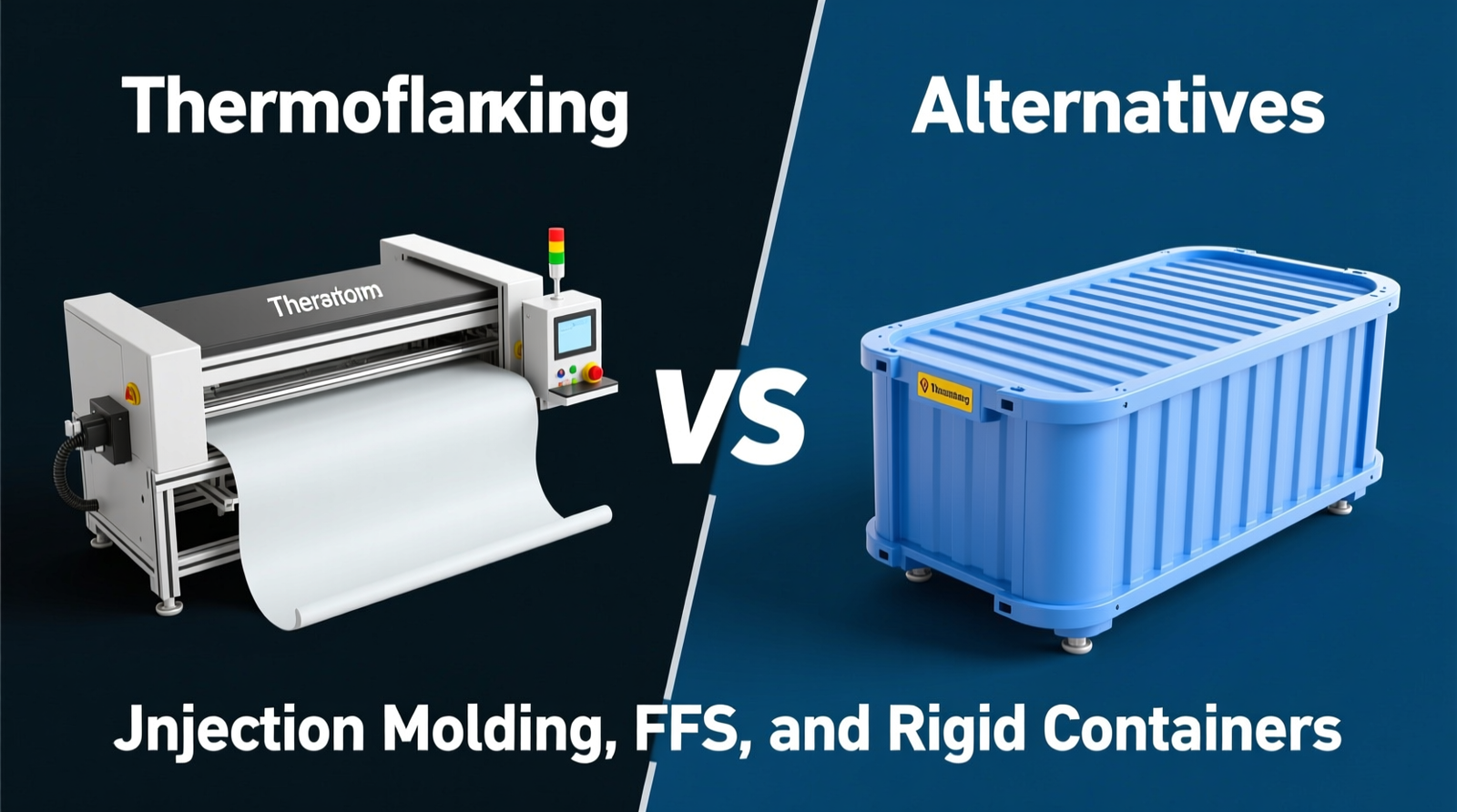
Before selecting a thermoforming system, it’s worth comparing it to common alternatives:
- Thermoforming: Lower tooling cost, quick design iteration, efficient lightweight trays; sensitive to sheet handling and heating uniformity.
- Injection molding: Excellent repeatability and complex features; higher tooling cost and longer lead time—often best for long-life, high-value parts.
- Form-Fill-Seal (FFS): Often strong for flexible packaging at very high speeds; less suited to rigid tray formats and certain presentation requirements.
- Pre-made rigid containers: Simple to deploy but can raise per-unit packaging cost and limit design flexibility; transport cube can be less efficient.
For many food and medical applications, a food tray thermoforming machine or blister line becomes attractive when the business case depends on lightweighting, shelf presentation, and integrated sealing quality control.
TL;DR: Thermoforming is usually the “sweet spot” when you need rigid or semi-rigid packs with faster tooling iteration than injection molding and more structure than flexible FFS.
Market Forces Driving Thermoforming Innovation
Innovation is being driven by a blend of regulation, retail expectations, and factory economics:
- Sustainability mandates: Recycled content and recyclability targets are pushing adoption of rPET and mono-material structures. For EU context, see the European Commission overview of packaging and packaging waste policy: https://environment.ec.europa.eu/topics/waste-and-recycling/packaging-waste_en.
- Food safety and traceability: Tighter process control, documented settings, and repeatable seals are more closely audited.
- Labor constraints: Plants invest in automation to stabilize throughput and reduce dependence on manual stacking/packing.
- SKU proliferation: More product variants increase the value of quick-change tooling and recipe-driven changeovers.
These forces translate into concrete expectations: shorter changeovers, more stable heating profiles, and data visibility for performance management. Many plants now track OEE (Overall Equipment Effectiveness)—a metric combining availability, performance, and quality—to understand true line capacity.
TL;DR: Regulations, labor, and SKU complexity are pushing thermoforming machine manufacturers toward faster changeovers, better process control, and measurable performance (OEE, scrap, uptime).
How Modern Thermoforming Machine Manufacturers Are Responding (Engineering-Level Features)
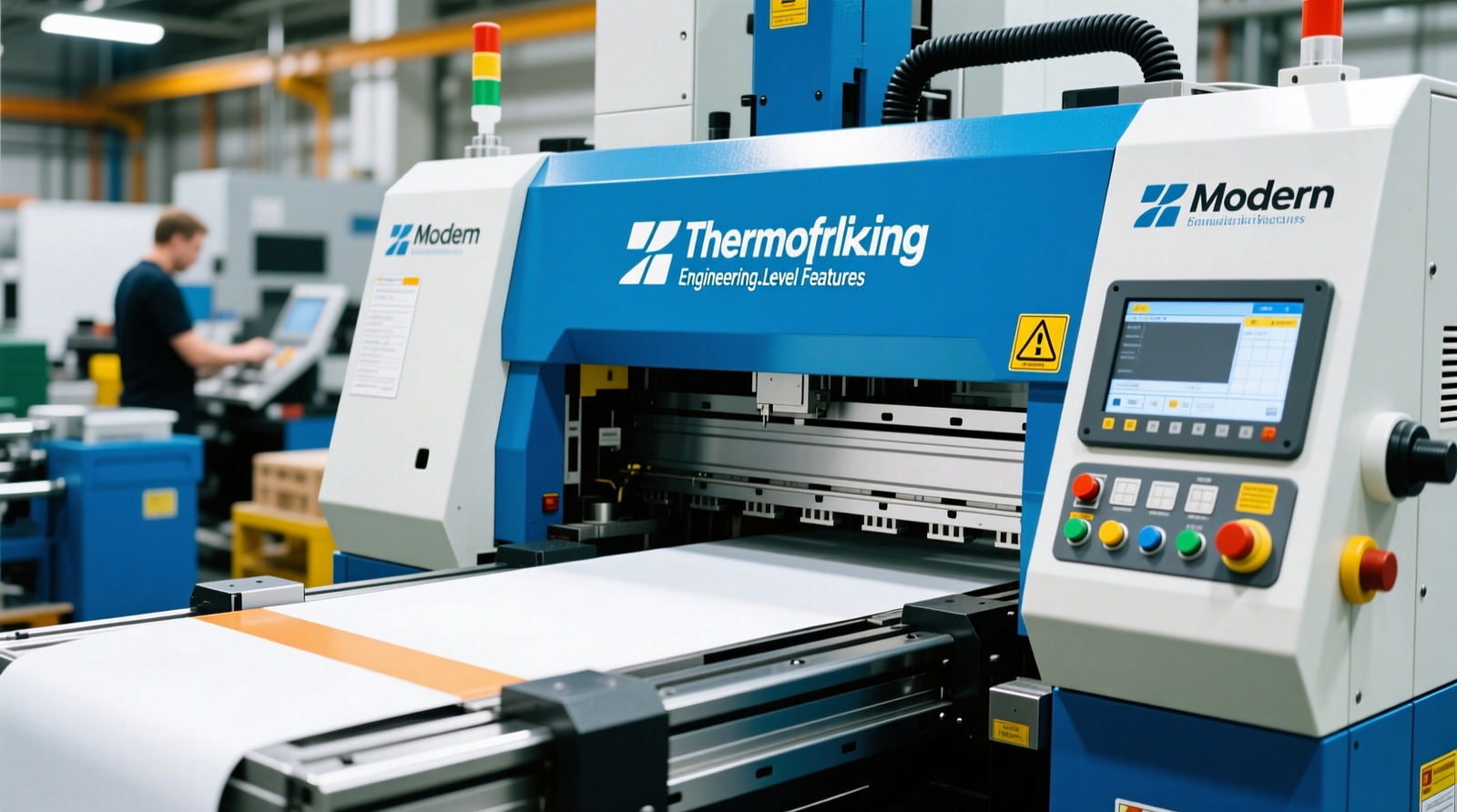
Thermoforming performance is often limited by a few repeatable failure modes: web sag (sheet drooping before forming), uneven heating (causing thin corners or weak seals), trimming variability, and tool temperature instability. Advanced machines address these with a combination of mechanical control and process intelligence.
Heating and web handling: controlling the sheet before it becomes a defect
- Multi-zone IR heating control: Independent heater zones help tune temperature profiles for deep draws or thin-gauge forming where temperature windows are narrow.
- Anti-sag strategies: Better web support, optimized heating recipes, and shorter exposure time reduce sag—especially important with thinner gauges or lower-viscosity materials.
- Closed-loop feed control: Servo indexing and precise film advance reduce pitch errors that show up as mis-trim or seal misalignment.
Vacuum forming vs. pressure forming (and why it matters)
Vacuum forming uses negative pressure to pull the heated sheet into the mold; pressure forming adds positive air pressure to push material into details, improving definition and corner fill. In packaging, pressure forming can reduce thinning in critical corners and improve cosmetic appearance—useful for premium trays or detailed cavities.
Trimming strategy: trim-in-place vs. post-trim
Trim-in-place trims the part while still registered in the forming station, which can improve dimensional repeatability and reduce handling. Post-trim trims downstream and can be easier to maintain for some formats but may introduce registration sensitivity. The best choice depends on cavity layout, cycle targets, and how the line integrates with stacking and inspection.
Tool temperature management: faster cycles without warpage
Tool cooling (water channels, controlled flow, and stable temperature regulation) is a common limiter of cycle speed and part stability. Better cooling design reduces warpage, improves demolding consistency, and can help maintain stable seal surfaces.
Integration: “automatic thermoforming line integration” as a plant requirement
Packaging lines increasingly require synchronized upstream/downstream equipment—extrusion sheet supply, dosing/filling, lidding, coding, checkweighing, and case packing—plus data exchange with MES (Manufacturing Execution System) or ERP (Enterprise Resource Planning) systems. This is where vendor experience in integration can matter more than nominal machine speed.
TL;DR: Modern thermoforming machines win by controlling heat, web handling, trim strategy, and tool cooling—because those are the root causes of scrap, downtime, and unstable seals.
MAP and Vacuum Sealing Integration for Food Trays (What to Specify)
Many food tray thermoforming systems combine forming with sealing under vacuum or MAP (Modified Atmosphere Packaging), where the air in the pack is replaced with a controlled gas mix to slow spoilage. Typical MAP mixes vary by product (often involving CO2 and N2, sometimes O2 for red meat color stability), so buyers should treat “MAP-ready” as a specification exercise, not a checkbox.
What to verify during trials:
- Seal integrity across worst-case tray geometry (corners, flange variation, thin-gauge areas)
- Gas residuals and repeatability (requires correct sealing time/temperature/pressure control)
- Film compatibility (anti-fog, peelable seals, barrier films) and changeover complexity
For background on MAP principles and food preservation, see the UK’s Campden BRI overview: https://www.campdenbri.co.uk/topics/packaging/modified-atmosphere-packaging.php.
TL;DR: MAP/vacuum integration can extend shelf life—but only if sealing control, gas management, and film compatibility are validated on your real product and tray geometry.
Thermoforming Applications Across Key Industries
Food Packaging
Thermoforming is widely used for meat, dairy, bakery, ready meals, salads, and frozen products. Key value drivers are repeatable seals, high throughput, and tight integration with downstream handling.
- Vacuum or MAP sealing for shelf-life management
- Tray formats optimized for stacking and logistics cube
- Inline coding/labeling options for traceability
TL;DR: Food tray thermoforming is about stable seals, throughput, and integration—not just forming speed.
Medical and Pharmaceutical Packaging
For medical blister packaging equipment and sterile tray applications, process documentation and validation capability matter as much as mechanical performance. GMP (Good Manufacturing Practice) expectations often require documented parameters, controlled change management, and traceable maintenance. In medical device contexts, companies commonly align with quality management systems such as ISO 13485 (medical devices QMS). Reference: https://www.iso.org/standard/59752.html.
- Controlled sealing windows to reduce leak risk
- Material clarity options (e.g., PETG—glycol-modified PET) for visual inspection
- Support for validation documentation (FAT/SAT protocols, calibration records)
TL;DR: In medical packaging, the “machine” is also a documentation and validation system—plan for GMP/ISO-aligned evidence, not only output rate.
Consumer Goods and Electronics
Thermoformed clamshells, inserts, and trays protect products and can improve shelf presentation. Pressure forming is often used when sharper detail and higher-definition surfaces are required.
TL;DR: For consumer goods, thermoforming balances protection and presentation, with pressure forming helping when visual detail matters.
Industrial and Transport Packaging
Returnable dunnage trays for components often prioritize toughness, stackability, and repeatable cavity geometry for automation.
TL;DR: Industrial thermoforming is driven by durability and handling efficiency, especially for reusable logistics loops.
Mini Case Example: Reducing Scrap on rPET Thin-Gauge Trays
Problem: A food packer running thin-gauge rPET (recycled PET) trays reported frequent corner thinning and occasional flange distortion, causing higher scrap and intermittent seal failures during MAP sealing.
Solution implemented on an inline thermoforming system:
- Rebalanced multi-zone IR heating recipe to reduce hot spots driving uneven draw
- Improved web handling setpoints (index accuracy and tension stability) to minimize registration drift into the trim/seal area
- Stabilized tool cooling temperatures to reduce warpage and flange variation
Measured result (typical outcome from this type of optimization): Scrap rate reduction and more consistent seal performance are usually the first measurable wins; in this project, the team targeted a sustained scrap reduction and fewer seal-related holds by focusing on the three root causes—heating uniformity, web control, and tool temperature stability.
TL;DR: On thin-gauge rPET, the fastest improvement path is usually heating uniformity + web handling stability + tool cooling control—because those directly drive thinning, warpage, and seal variation.
Global Deployment and What It Signals to Buyers
Shanghai Zhanshi Mechanical Equipment Co., Ltd. supplies thermoforming systems across multiple regions. For buyers, international deployment is most meaningful when it comes with:
- Documented commissioning practices (FAT/SAT, spare parts lists, training plans)
- Remote diagnostics processes aligned with plant IT policies
- Support for region-specific expectations (e.g., CE marking in Europe)
Note on compliance terms: CE marking is a European conformity marking for certain products sold in the European Economic Area. For official guidance, see the European Commission page: https://single-market-economy.ec.europa.eu/single-market/ce-marking_en.
TL;DR: Global installations matter most when they translate into repeatable commissioning, compliance readiness (like CE), and dependable remote/service processes.
How to Choose the Right Thermoforming Machine Manufacturer (Procurement Framework + Checklist)
Selecting among thermoforming machine manufacturers is easiest when you treat it like a process qualification project, not a catalog purchase. Use a structured procurement framework:
Step-by-step procurement framework
- Define product and pack specifications: cavity count, tray depth, flange width, seal type (peel vs weld), target throughput, and allowed scrap.
- Validate materials early: confirm sheet type (e.g., rPET/PP/PLA), thickness range, shrink behavior, and acceptable forming window.
- Decide forming method: vacuum forming vs. pressure forming based on detail level, thinning risk, and cosmetic needs.
- Plan integration requirements: filling, lidding, coding, inspection, checkweighing, and automatic thermoforming line integration with MES/ERP.
- Run trials with acceptance criteria: measure thickness distribution, seal integrity, cycle stability, trim quality, and changeover time using your real films and tooling.
- Execute FAT/SAT: FAT (Factory Acceptance Test) verifies performance at the supplier site; SAT (Site Acceptance Test) confirms it under real plant conditions.
- Lock in spares, training, and maintenance: critical spares list, preventive maintenance schedule, operator/maintenance training, and response-time commitments.
Technical questions buyers should ask vendors
- Changeover: What is the typical tool changeover time (mold + trim tool + recipe) for my format?
- Energy: What is energy consumption per cycle or per 1,000 packs under my expected heater settings?
- Uptime: What uptime/OEE assumptions are used, and what failure modes dominate in similar installations?
- Vacuum/pressure capability: What vacuum level and pressure forming limits are supported, and how are they controlled?
- Trim approach: Do you recommend trim-in-place or post-trim for my geometry—and why?
- Material tolerance: How does the system handle rPET variability (IV shifts, sheet thickness variation)?
- Integration: What protocols/interfaces are available for ERP/MES connectivity and line synchronization?
- Validation documentation: Can you provide FAT/SAT templates, calibration procedures, and change-control records for regulated sectors?
TL;DR: Choose thermoforming machine manufacturers by qualifying the process (materials, forming method, integration, FAT/SAT) and demanding measurable answers on changeovers, energy, uptime, and validation support.
Future Direction: Where Thermoforming Systems Are Heading
Thermoforming systems are evolving in ways that reflect real factory constraints:
- More automation where labor is most variable: robotic or automatic stacking, loading, and case packing
- Better control for difficult materials: improved recipes and sensing to handle rPET variability and thin-gauge forming sensitivity
- Data-driven maintenance: condition monitoring to reduce unplanned stops (heater degradation, vacuum leaks, web tracking drift)
- Alternative materials exploration: paper/fiber-based forming is growing, but often requires new tooling and heat management approaches
For plants, the payoff is usually less about a headline cycle rate and more about stable quality at speed—especially when running multiple SKUs per shift.
TL;DR: The next gains in thermoforming come from automation, tougher material capability (especially rPET), and maintenance intelligence that protects uptime.
Company Information
Company Name: Shanghai Zhanshi Mechanical Equipment Co., Ltd.
Contact Name: Lewis
Contact Phone: +86 13916846091
Address: No. 26 Kangyuan Road, Zhujiajiao Industrial Zone, Qingpu District, Shanghai, China
Email: Daisy@smktek.com
Website: Shanghai Zhanshi Mechanical Equipment Co., Ltd. – dedicated to the R&D and manufacturing of plastic thermoforming machines, plastic extrusion machines, and plastic high frequency welding machines.
TL;DR: Use the contact details above for quotations, material trials, and integration discussions (tooling + forming + sealing + downstream automation).
FAQ

Q: What technical metrics should I measure during a thermoforming trial run?
A: Measure thickness distribution (especially corners), scrap rate by defect type, seal integrity (leak rate or burst/peel results), cycle stability over time, and changeover time (mold + trim + recipe). Ask the vendor to document heater zone settings, forming parameters, and tool temperatures so you can reproduce results during SAT (Site Acceptance Test).
Q: What are the main drivers of total cost of ownership (TCO) for an inline thermoforming line?
A: The biggest TCO drivers are scrap rate, uptime/OEE (Overall Equipment Effectiveness), energy use in heating, tooling/trim maintenance cost, and labor for stacking/packing. To compare vendors, request an estimate of kWh per 1,000 packs at your target cycle, typical wear parts list (heaters, chains, seals, knives), and recommended preventive maintenance intervals.
Q: What payback period is typical when upgrading from semi-automatic to fully automatic thermoforming?
A: Payback often comes from labor reduction, fewer quality holds, and lower scrap—so it depends on wages, shift pattern, and current defect levels. A practical approach is to calculate savings from (1) reduced headcount at stacking/packing, (2) scrap reduction percentage, and (3) higher sellable output from improved uptime, then validate those assumptions during FAT/SAT with documented run data.
Q: What are common failure modes in thermoforming machines, and how do modern designs reduce them?
A: Common issues include heater failures or drifting heat output, web tracking/indexing problems that cause mis-trim, vacuum leaks that reduce forming definition, and seal inconsistency from unstable tool temperatures. Modern systems mitigate these with multi-zone heater control, servo indexing, monitored vacuum circuits, better tool cooling regulation, and alarms/trending that support predictive maintenance. Request a recommended spare parts list and a fault history report template.
Q: For my application, should I choose vacuum forming or pressure forming?
A: Vacuum forming is often sufficient for many food trays and simpler geometries, especially where cost and speed are prioritized. Pressure forming is typically chosen when you need sharper detail, improved corner definition, or better cosmetic appearance (common in premium trays and some consumer goods packs). Ask your vendor to run side-by-side samples and compare corner thickness and visual definition under identical material and cycle conditions.