Introduction: Huilong Extrusion Coating and Lamination Machinery at PlastIndia 2026
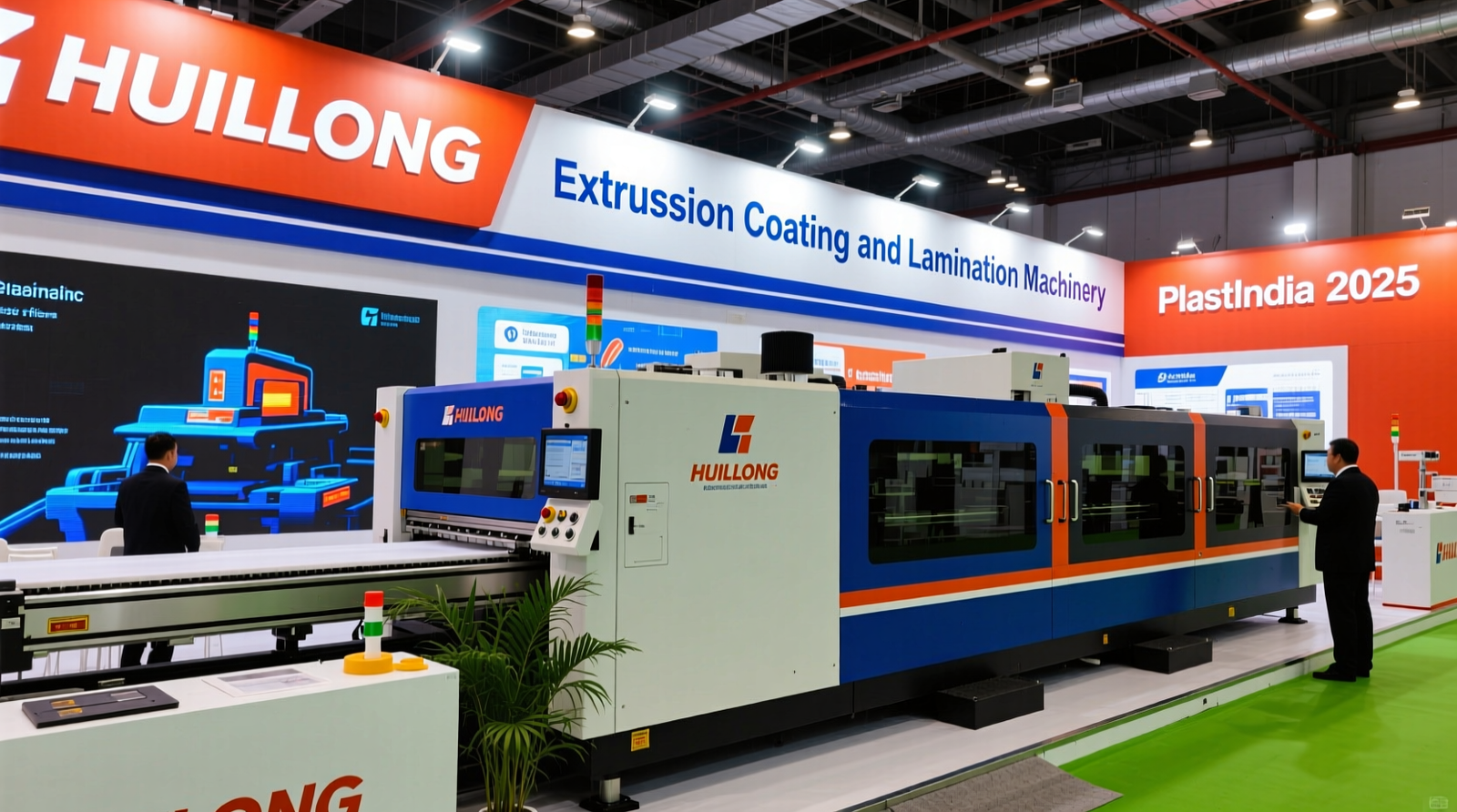
Abhay Sheth Technologies, the India representative of Huilong Plastics Machinery, will present extrusion coating and extrusion lamination (a solvent-free bonding process using a molten polymer “curtain”) equipment at PlastIndia 2026 in New Delhi. The showcase centers on single-head co-extrusion (two or more polymer layers extruded together) coating/lamination lines and a new tandem extrusion coating and lamination platform for high-barrier flexible packaging.
Typical industrial specifications for modern extrusion coating lines in this class commonly include web widths of roughly 1,000–2,500 mm and line speeds in the range of 150–400 m/min depending on structure, polymer, and substrate handling. Coating weights typically fall around 10–60 g/m² for polyethylene (PE) extrusion coatings, with higher coat weights used for specific heat-seal, barrier, or tie-layer (adhesion-promoting resin) needs.
Target applications include snack food packaging, extrusion coating line for aseptic carton packaging, and tandem extrusion lamination for pharma, where converters need repeatable bond strength, low odor, and consistent barrier performance.
TL;DR: Abhay Sheth Technologies will show single-head co-extrusion and tandem extrusion lamination lines aimed at high-barrier, solvent-free packaging, with typical industrial ranges of ~1,000–2,500 mm webs, 150–400 m/min speeds, and ~10–60 g/m² coating weights.
Advanced Extrusion Coating and Solvent-Free Extrusion Lamination Solutions (Applications & Structures)
At PlastIndia 2026, the highlighted systems are positioned for converters producing:
- Snack food and confectionery laminates (moisture/oxygen management, improved seal integrity)
- High-barrier laminates (often foil-based or metallized structures)
- Laminated tubes (lami-tubes) for oral care and pharmaceuticals (printability + barrier + squeeze performance)
- Aseptic liquid carton webs (multilayer paperboard laminates engineered for long shelf life)
To add technical clarity, here are example multilayer structures and what each layer does:
- Aseptic carton (illustrative): Paperboard / LDPE / Al foil / tie-layer / LDPE
- Paperboard: stiffness, machinability, print surface
- LDPE (low-density polyethylene): moisture barrier + heat-seal + “primer” for bonding
- Al foil: light/oxygen barrier (high barrier)
- Tie-layer resin (e.g., anhydride-grafted PE): adhesion between foil and PE
- LDPE inner layer: product-side seal layer and liquid barrier
- Pharma sachet (illustrative): PET / Al foil / LDPE
- PET (polyethylene terephthalate): stiffness, heat resistance, printability
- Al foil: near-total moisture/oxygen barrier (dose protection)
- LDPE: sealing and chemical resistance
- Retortable or high-performance variants (illustrative): PET / Al foil / PP where PP (polypropylene) can improve high-temperature performance depending on end-use.
Because extrusion lamination is inherently solvent-free, it can reduce reliance on solvent-based adhesives (and their associated drying energy and solvent management). For context on VOC (volatile organic compound) emissions and solvent concerns, see the U.S. EPA overview on VOC basics: https://www.epa.gov/indoor-air-quality-iaq/volatile-organic-compounds-impact-indoor-air-quality.
TL;DR: The lines target snack, pharma, lami-tube, and aseptic carton webs; typical structures include paperboard/LDPE/Al foil/tie/LDPE for cartons and PET/Al/LDPE for pharma, delivering barrier and seal performance with solvent-free lamination.
Key Technical Features: MBL T-Die, Chaotic Mixing, and Polymer Processing
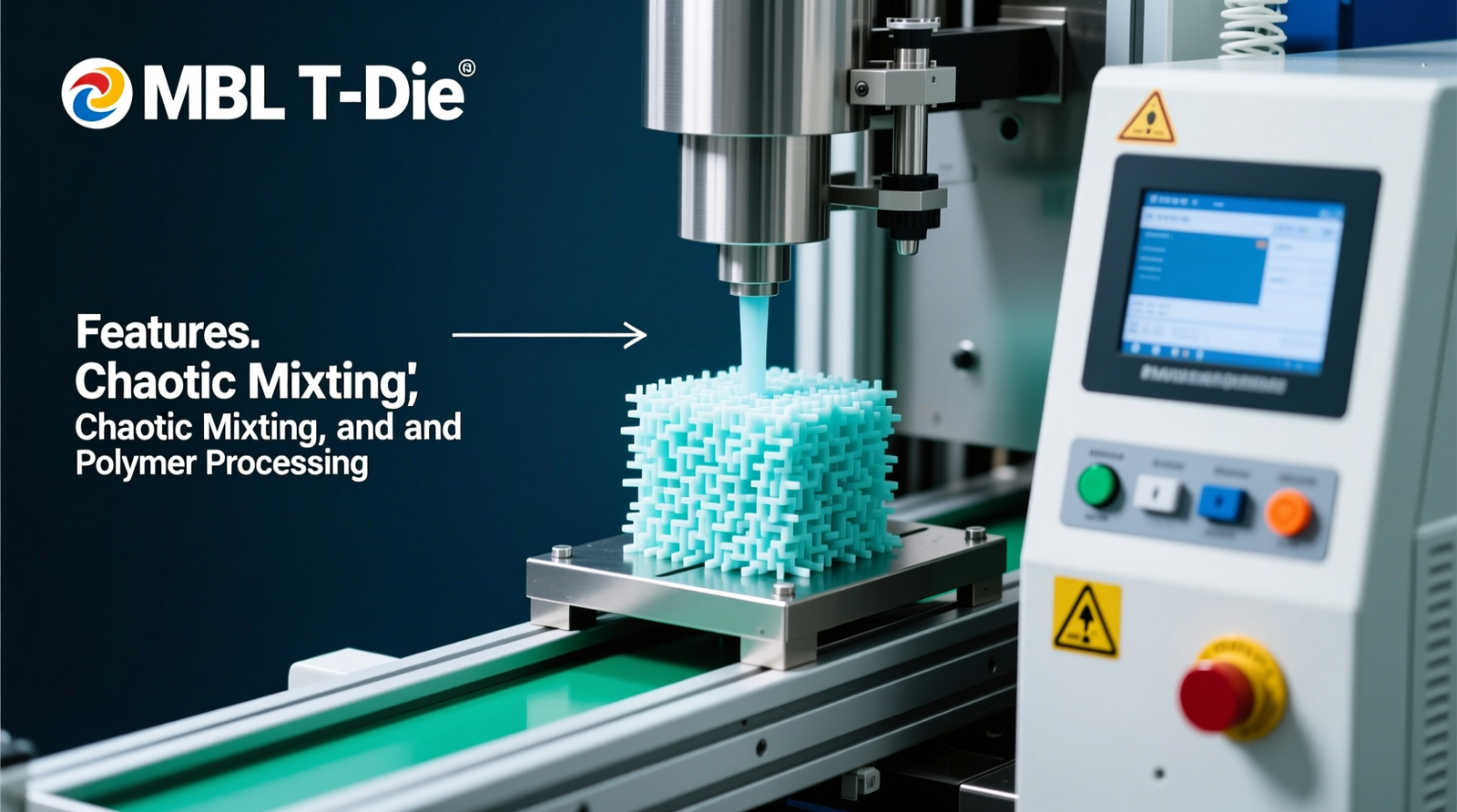
Huilong reports more than 40 patents related to extrusion coating and lamination. From a converter’s perspective, the “why it matters” is how specific die and extrusion technologies translate into measurable quality and waste improvements.
Oscillating MBL T-die (what it solves)
A T-die is the flat die that forms a wide polymer melt curtain across the web. Oscillating die technology moves the die (or the melt distribution) laterally in a controlled pattern to average out flow non-uniformities.
- Reduced gauge variation: oscillation helps “smear” persistent thick/thin bands across the web, improving cross-direction (CD) uniformity.
- Lower edge beading: better flow distribution and control can reduce thick edges, which can otherwise increase trim waste.
- Neck-in control: “neck-in” (web narrowing of the molten curtain as it stretches to the substrate) is influenced by polymer rheology, die lip design, air gap, and temperature. Stable melt delivery and die design help reduce variability, improving usable web width and reducing edge trim.
In practical operating terms, reducing edge trim by even 5–15 mm per side on wide webs can add up to meaningful resin and substrate savings over high-throughput production.
Barrier screws and chaotic mixing extruders (why dispersion improves)
A barrier screw is a screw design that separates solid bed and melt pool more effectively, improving melting stability and output consistency—especially important for thin coat weights and high line speeds. A chaotic mixer (static or dynamic mixing concept) promotes repeated splitting and recombining of melt streams, which improves:
- Temperature uniformity (fewer hot spots that can cause gels or degradation)
- Additive dispersion (e.g., antiblock, slip, pigments) and tie-layer uniformity
- Co-ex layer stability (more consistent layer thickness distribution in co-extrusion)
Common polymers and tie-layer chemistry used on these lines
Depending on application, extrusion coating and lamination lines typically process:
- LDPE and LLDPE (linear low-density polyethylene): general-purpose coating, seal layers, toughness
- EVA (ethylene-vinyl acetate) and EMA (ethylene-methyl acrylate): improved hot tack, sealing window, adhesion to some substrates
- Tie-layer resins: often maleic-anhydride-grafted polyolefins to bond to aluminum foil, PET, PA (polyamide), or metallized films
Screw design and temperature profiles are typically tuned to resin melt index (MI), thermal sensitivity, and target output to balance stable pressure, low gels, and consistent coat weight—especially important for high-speed solvent-free extrusion lamination solutions.
TL;DR: Oscillating T-dies help reduce gauge variation, edge beading, and neck-in variability; barrier screws and chaotic mixing improve melt stability and dispersion; typical resins include LDPE/LLDPE, EVA/EMA, and anhydride-grafted tie layers.
Process Control and Automation Options (Quality, Waste, and Uptime)
For decision-makers, “performance” usually means stable quality at speed with low scrap and high OEE (Overall Equipment Effectiveness—availability × performance × quality). Modern extrusion coating/lamination lines commonly offer automation packages such as:
- Automatic gauge control (AGC): closed-loop control using coat-weight measurement (often beta or infrared depending on substrate) to reduce coat-weight variation.
- Gravimetric dosing: weight-based feeders that stabilize throughput and co-ex layer ratios versus volumetric feeding—useful for expensive tie layers or EVA/EMA blends.
- Line synchronization: coordinated drives for unwind, coating station, nip, chill roll, and rewind to maintain stable tension and reduce wrinkles/telegraphing.
- Recipe management: structured parameter sets for repeat jobs, reducing operator dependence and shortening changeovers.
- Remote diagnostics: VPN-enabled troubleshooting (with customer permission) to reduce time-to-repair on control and drive issues.
In well-controlled operations, converters often target 2–5% total waste (start-up + trim + defects) and >85–90% uptime on mature, stable SKUs. Actual results depend heavily on substrate quality, resin handling (drying/contamination control), maintenance discipline, and operator training.
TL;DR: Automation such as AGC, gravimetric dosing, and synchronized drives supports consistent coat weight, fewer defects, and high OEE; well-run lines often target ~2–5% waste and >85–90% uptime on stable products.
Reliability, Safety, and Warranty (Standards-Driven Buying Criteria)
Abhay Sheth Technologies highlights a three-year warranty on key components such as the screw and T-die system—important when converting high-value structures (foil, specialty papers, pharma-grade films) where downtime and off-spec material can be costly.
On safety, modern converting lines typically incorporate guarding, interlocks, emergency stops, and lockout/tagout-ready (LOTO) provisions. Buyers often benchmark against globally recognized machinery safety concepts (risk assessment, guarding, functional safety). For general context on machinery safety principles, see the International Labour Organization (ILO) overview on machine safety and safeguarding concepts: https://www.ilo.org/global/topics/safety-and-health-at-work/resources-library/publications/WCMS_101488/lang–en/index.htm.
On compliance for packaging end-uses:
- Food-contact packaging typically requires that resins and additives meet applicable regulations (jurisdiction-dependent). A widely referenced framework is the U.S. FDA food-contact materials program: https://www.fda.gov/food/packaging-food-contact-substances-fcs.
- Emissions/VOC management: solvent-free extrusion lamination can simplify VOC control compared with solvent-based adhesive lamination, supporting EHS (Environment, Health, and Safety) goals and local emissions norms.
TL;DR: A 3-year warranty can reduce risk for high-value packaging production; safety features (guarding/interlocks/E-stops) support safer operation; solvent-free extrusion lamination can ease VOC management, while food-contact compliance depends on using compliant materials.
New Tandem Extrusion Coating and Lamination Machinery for High-Barrier Packaging
Huilong’s tandem platform is designed to run either:
- As a tandem line (two coating/lamination stations in series) for demanding high-barrier or pharma structures, or
- As two independent single-head co-extrusion lines when tandem demand is low.
This matters economically because converters rarely run one SKU all year. Dual-mode operation can improve utilization when job mix swings between, for example, extrusion coating line for aseptic carton packaging runs and shorter tandem extrusion lamination for pharma orders.
Indicative ROI/payback logic (qualitative but decision-useful):
- If a converter can keep both stations loaded (either in tandem or split mode) for more shifts per month, the line can deliver a faster break-even versus a single-purpose tandem-only asset.
- Plants with frequent changeovers often gain additional ROI from reduced changeover time (recipe-driven setup + stable die/extruder behavior) and lower scrap rates during ramp-up.
- For many converters, a practical payback target for major converting assets is commonly in the 2–4 year range; dual-mode utilization can help move real-world performance toward that target when the order book is mixed.
TL;DR: The tandem platform can run complex structures in tandem or split into two lines, which can improve utilization and payback—especially for mixed job portfolios across aseptic, pharma, and general flexible packaging.
Comparison: Extrusion Lamination vs Adhesive Lamination and Typical Competing Extrusion Lines
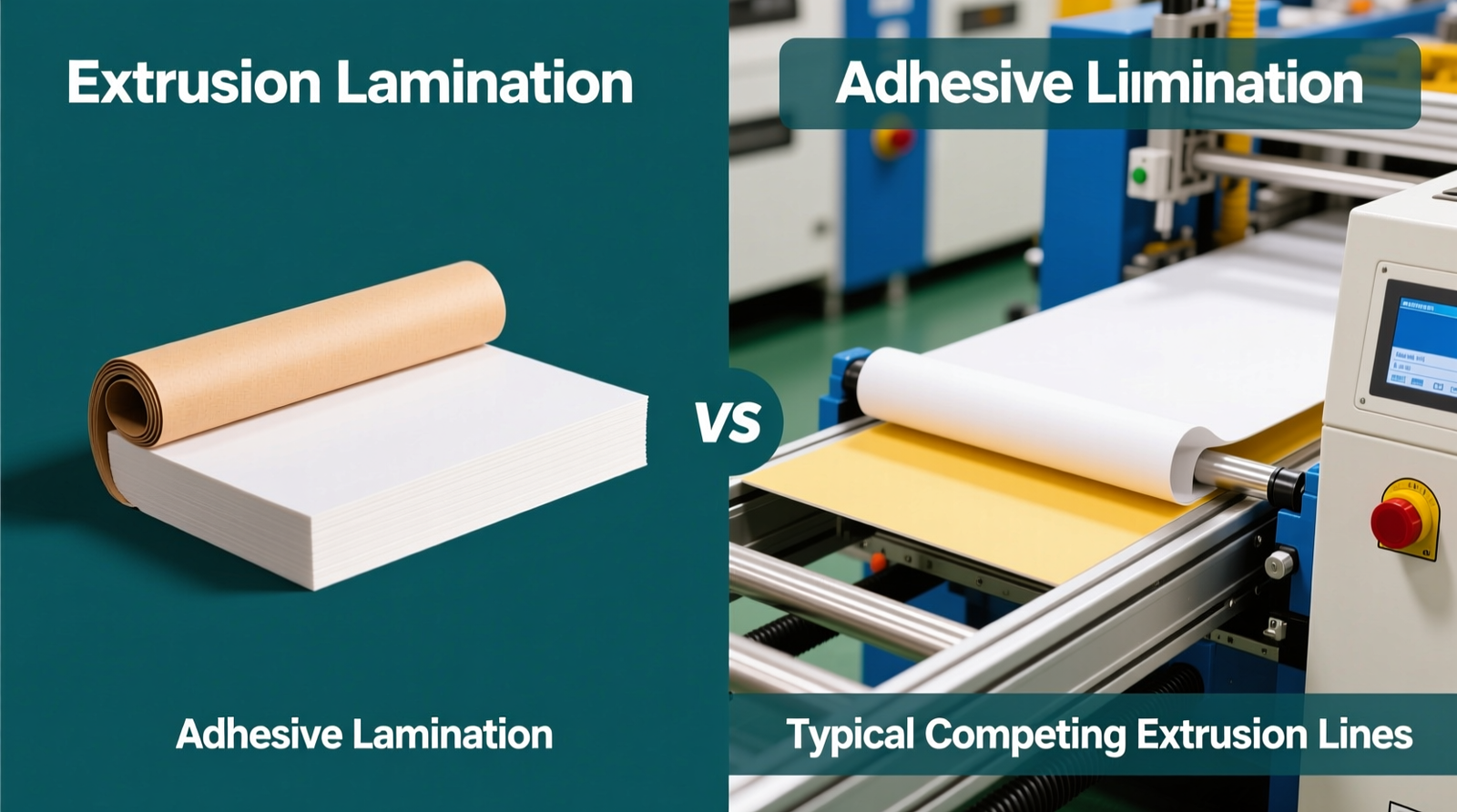
Converters often compare extrusion coating/lamination lines against (1) adhesive lamination and (2) other extrusion line suppliers. A realistic comparison looks like this:
- Adhesive lamination (solvent-based or solventless polyurethane)
- Strengths: broad substrate compatibility, lower melt-temperature exposure to substrates, good for certain high-performance structures.
- Trade-offs: solvent-based systems require solvent handling and drying energy; solventless still requires precise mix ratio control and often curing time (inventory/lead time impact). Potential for odor/migration concerns if not controlled.
- Extrusion lamination (solvent-free)
- Strengths: no solvent drying section; often lower VOC burden; fast bonding in-line; can reduce work-in-progress tied up in curing (structure-dependent). Good fit for high-output commodity and many barrier structures.
- Trade-offs: higher thermal load; neck-in/edge bead control becomes critical; demands robust die/extruder stability and good substrate handling.
- Competing extrusion lines (general market reality)
- Cost vs performance: lower-capex builds may sacrifice automation (AGC/gravimetric), die stability, or long-term parts support—often showing up as higher coat-weight variability or higher scrap.
- Maintenance impact: die lip wear management, screen changer discipline, and screw/barrel life strongly affect uptime; designs that simplify access and support predictable maintenance intervals tend to win on OEE over time.
Where Huilong’s patented die/screw/mixing features aim to compete is on coat-weight consistency, edge/neck-in stability, and repeatability—which are exactly the variables that drive trim waste, defect rates, and customer complaints in high-barrier packaging.
TL;DR: Adhesive lamination offers broad compatibility but can add solvent/cure complexity; extrusion lamination is solvent-free and fast but needs strong melt/die control. Competing lines differ mainly in automation, stability, and maintenance design—key drivers of OEE and scrap.
Customer Scenarios (Anonymized): OEE, Waste, and Defect Reduction
Scenario 1: Aseptic carton converter—trim and pinhole complaints
A converter running paper/foil/PE structures faced recurring edge trim losses and intermittent barrier defects that showed up as shelf-life complaints. After stabilizing die distribution and tightening coat-weight control (via improved melt stability + process recipes), the converter reported:
- Lower edge trim (less edge beading-related waste)
- Fewer barrier-related defects during long runs (better process repeatability)
- More stable ramp-up after changeovers, reducing start-up scrap
Scenario 2: Pharma laminate producer—tandem utilization problem
A mid-size pharma-focused converter had a demand pattern with short, urgent jobs and frequent SKU changes. A dual-mode tandem configuration helped by running tandem for foil-based pharma structures during peak periods, then splitting into two independent lines for shorter coating jobs. The operational impact was primarily:
- Higher asset utilization across variable job mix
- Reduced scheduling bottlenecks (less waiting for a single “tandem-only” resource)
- Improved OEE driven by fewer idle hours and better planning flexibility
Note: Actual OEE and scrap outcomes depend on substrate quality, resin handling, operator training, and maintenance practices, but these are the typical problem/solution patterns converters evaluate.
TL;DR: In real converter use-cases, better melt/die stability can cut trim and defects for aseptic structures, while dual-mode tandem configurations can improve utilization and OEE for pharma job mixes.
Market Trends: Recyclability, Mono-Material Packaging, and EPR Readiness
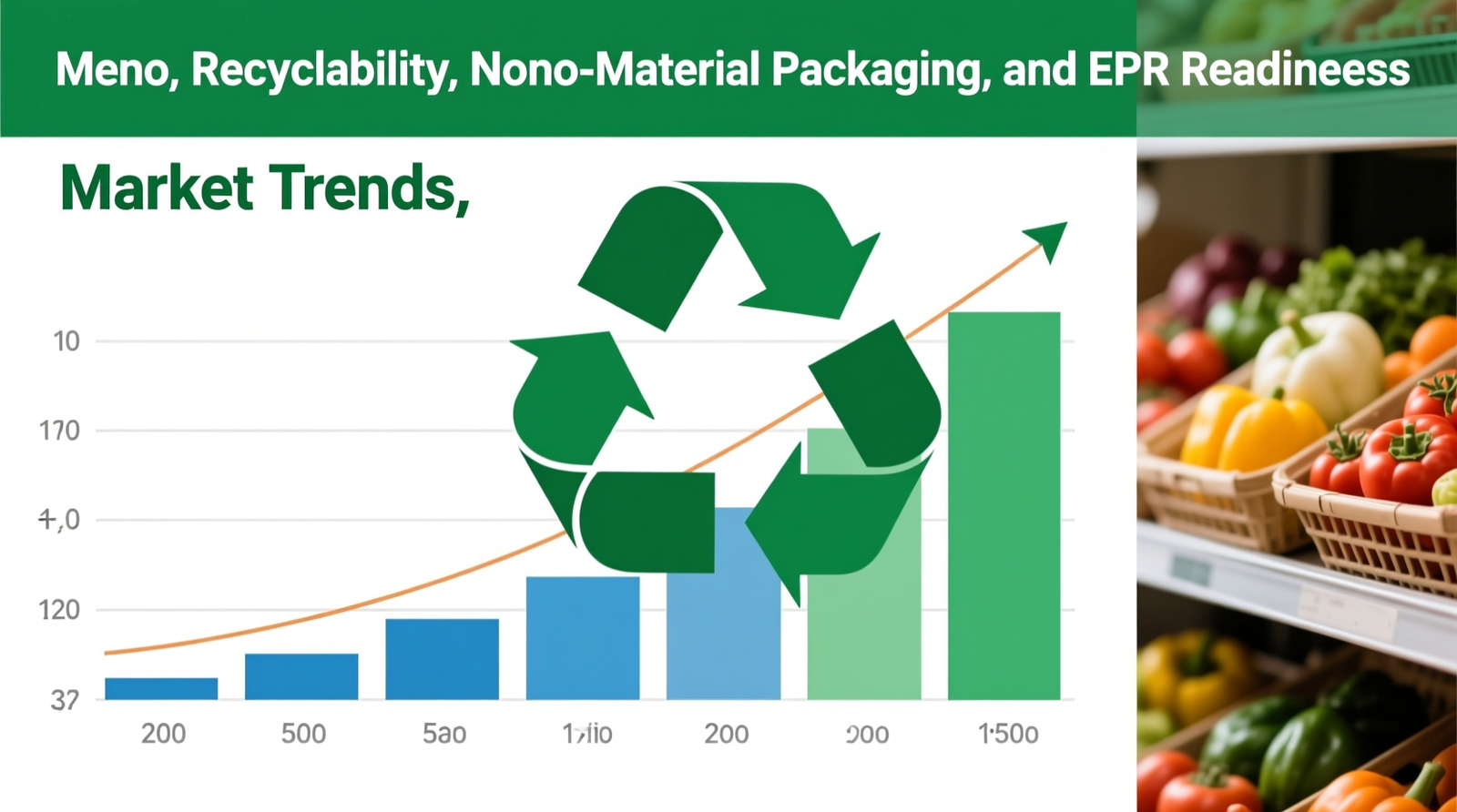
Flexible packaging is under pressure to improve circularity. Three practical trends are influencing investment in extrusion coating and lamination equipment:
- Mono-material structures: brand owners increasingly explore PE-based or PP-based laminates that can be recycled more easily than mixed-material composites, depending on local recycling streams. Extrusion coating can support all-polyolefin structures using tailored tie layers and sealants.
- Downgauging: thinner layers without losing performance requires better coat-weight control and stable extrusion—automation and die design become more valuable as thickness targets tighten.
- EPR (Extended Producer Responsibility) pressure
EPR (Extended Producer Responsibility) policies generally push brands and packaging suppliers toward better recyclability, traceability, and recovery outcomes. Equipment that reduces scrap, supports downgauging, and enables recyclable structures can help converters align with customer sustainability scorecards. For background on EPR concepts, see the OECD overview: https://www.oecd.org/environment/waste/extended-producer-responsibility.htm.
Extrusion lamination is also often positioned as a way to reduce solvent management complexity and VOC controls compared with solvent-based adhesive lamination—an increasingly relevant point as EHS expectations tighten.
TL;DR: The market is moving toward mono-materials, downgauging, and EPR-driven sustainability metrics; stable extrusion and precise coat-weight control help enable recyclable designs and reduce scrap and VOC-related burdens.
Technical Support, Service Deliverables, and Project Guidance (What Buyers Should Ask For)
Beyond the machine, converters evaluate commissioning speed, training quality, and service responsiveness. Abhay Sheth Technologies positions its support around application engineering and long-term operations. For industrial buyers, it is useful to confirm deliverables such as:
- Installation & commissioning plan: defined mechanical completion checks, heat-up protocols, trial schedule, and acceptance criteria (coat-weight uniformity, bond strength, scrap targets).
- Training formats: operator training at line-side during trials, plus maintenance training (die cleaning, screen changer routine, nip/roll care, safety checks).
- Remote diagnostics: structured troubleshooting workflow for drives, temperature control, and automation alarms to reduce downtime.
- Spare parts strategy: recommended spares list for uptime-critical items (heater bands, thermocouples, filters/screens, pneumatic parts), and local availability expectations.
Many plants set service KPIs such as a 24–72 hour window for first technical response (remote) and a defined escalation path for on-site support when needed; buyers should align these expectations in the purchase contract and FAT/SAT (Factory Acceptance Test/Site Acceptance Test) documentation.
TL;DR: Buyer value comes from defined commissioning, training, remote diagnostics, and a clear spare-parts plan—often with a 24–72 hour first-response target and documented FAT/SAT criteria.
PlastIndia 2026 Context (Event Reference)
PlastIndia is a major trade platform for polymer processing and converting technologies in India, bringing together equipment builders, raw material suppliers, and converters evaluating new capacity and upgrades.
TL;DR: PlastIndia 2026 is the trade context where converters can evaluate extrusion coating/lamination technology, automation, and support models in one place.
Conclusion: What Prospective Buyers Can Evaluate Next
For converters assessing solvent-free extrusion lamination solutions and coating lines, the most decision-relevant outcomes to validate are:
- Technical: coat-weight stability, neck-in/edge bead control, bond consistency, and repeatability on your substrates (paper/board, foil, PET, PE/PP films).
- Economic: utilization (especially for dual-mode tandem lines), scrap rate targets, energy and solvent-management impacts, and downtime risk (warranty + service model).
- Sustainability: support for downgauging, recyclable/mono-material roadmaps, and reduced VOC complexity versus solvent-based systems.
Next step: Prepare a shortlist of your top 3–5 structures (including an extrusion coating line for aseptic carton packaging or tandem extrusion lamination for pharma job), then request a performance discussion around target coat weights (g/m²), line speed (m/min), trim waste assumptions, and automation scope (AGC/gravimetric/recipes) before finalizing the configuration.
TL;DR: Validate quality stability, utilization-driven ROI, and recyclability/VOC advantages; bring your real structures and targets to the supplier to confirm speeds, coat weights, waste, and automation scope.
Publisher’s Note

This article is published for readers of Packaging South Asia, a B2B platform covering packaging, converting, and printing technology in India and South Asia.
TL;DR: Publisher context: this coverage appears for Packaging South Asia’s industry audience.
FAQ
Q: What line speeds, web widths, and coating weights are typical for extrusion coating and lamination lines used in flexible packaging?
A: Typical industrial ranges are often around 1,000–2,500 mm web width, 150–400 m/min line speed (structure-dependent), and roughly 10–60 g/m² coating weight for common PE coatings. Actual capability depends on polymer type, substrate handling, and automation level (e.g., automatic gauge control).
Q: What is a common multilayer structure for an extrusion coating line for aseptic carton packaging, and why does it use aluminum foil?
A: A common illustrative structure is paperboard/LDPE/Al foil/tie-layer/LDPE. The aluminum foil provides high oxygen and light barrier that supports long shelf life; LDPE provides moisture barrier and heat sealing; the tie layer promotes adhesion between foil and polyolefin layers.
Q: When does tandem extrusion lamination for pharma make sense compared with a single coating station?
A: Tandem setups make sense when you frequently run high-barrier pharma laminates that benefit from sequential layers/laminations, or when you need throughput for complex structures. Dual-mode tandem lines can also improve ROI by running as two separate lines when pharma tandem demand is low.
Q: How do oscillating T-dies and chaotic mixing extruders reduce defects in extrusion lamination?
A: Oscillating T-dies help average out cross-web flow non-uniformities, reducing gauge bands and edge beading that can drive trim waste. Chaotic mixing improves melt temperature and additive dispersion, supporting uniform layers in co-extrusion and reducing gel/variation-related defects.
Q: What are typical installation, commissioning, and training timelines for an extrusion coating and lamination line, and what maintenance training is essential?
A: Timelines vary by scope, site readiness, and utilities, but commissioning commonly involves staged checks (mechanical, electrical, heat-up, trial runs) followed by acceptance testing on target structures. Essential training includes die cleaning and lip protection practices, screen changer routines, nip/roll maintenance, tension control basics, and safety procedures (LOTO, guarding/interlocks). Buyers should confirm the supplier’s on-site support plan and remote diagnostics process before purchase.