Introduction

Packaging engineers, converters, and brand owners are increasingly evaluating repulpable barrier coatings and fiber-based heat seal solutions to replace plastic laminates without sacrificing line efficiency or shelf-life protection. This article explains how functional paper coatings work, what performance ranges to expect (seal windows, coat weights, WVTR/OTR), how to qualify them on press and on the packing line, and how they can support PPWR-compliant packaging roadmaps.
Where relevant, it also references key EU and US food-contact frameworks and design-for-recycling guidance used by mills and recyclability labs.
- Key Takeaways: Typical coat weights are often 3–12 g/m² (dry) depending on barrier target and paper porosity.
- Key Takeaways: Heat-seal coatings commonly run with seal jaws around 90–140°C (application-dependent) and can support high-speed form/fill/seal when paper stiffness and moisture are controlled.
- Key Takeaways: Qualification should include repulpability, barrier testing (WVTR/OTR), and seal tests (e.g., ASTM F88) plus print/adhesion checks.
TL;DR: Functional paper coatings can enable mono-material paper packaging with measurable barrier and sealing performance—if you specify coat weight targets, validate on your exact paper grade, and qualify with recognized test methods.
Driving the Transition to Mono-Material Paper Packaging (and Where It Makes Sense)
Plastic laminates became the default for pouches and sachets because they deliver wide sealing windows, stable barriers, and robust machinability. Paper, by contrast, is porous, moisture-sensitive, and prone to fiber picking—so it typically needs a functional layer to reach comparable converting and filling performance.
Modern paper coating systems focus on creating mono-material paper packaging structures (paper + repulpable coating) rather than paper/plastic composites. In practice, “mono-material” here means the package is designed to be processed in standard paper recycling operations with high fiber yield, assuming the coating is compatible with pulping and screening conditions.
Common fit-for-use applications include dry foods (powders, grains, snacks), certain bakery and confectionery items, and non-food packaging (hardware, small parts). Common boundary conditions include long-term high-humidity storage, high-fat contact at elevated temperatures, or retort/ovenable requirements—these often need additional layers or different substrate choices.
TL;DR: Paper coatings are most compelling where you want recyclable fiber-based packaging and your product doesn’t require retort-level barrier or high-temperature grease resistance without added structure.
Chemistries Behind Functional Paper Coatings (High-Level)
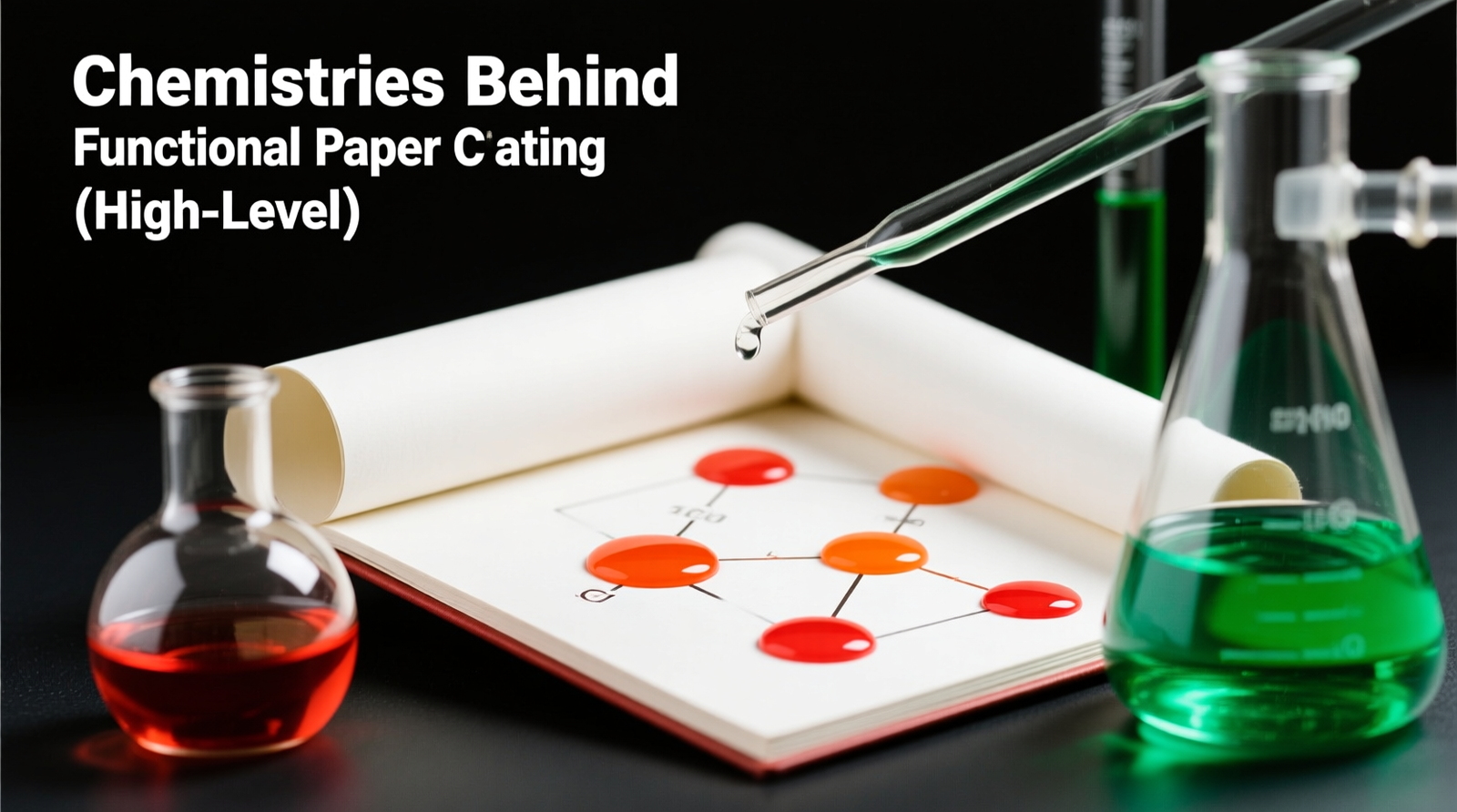
Most commercial functional paper coatings for packaging are water-based systems tailored for runnability and end-of-life. At a high level, common chemistries include:
- Water-based acrylics (acrylic dispersions): often used for heat-seal performance, toughness, and balanced barrier properties.
- PVOH (polyvinyl alcohol): frequently used to improve oxygen barrier in dry conditions; performance can drop at high relative humidity unless modified or protected.
- Bio-based components (e.g., polysaccharide derivatives or bio-attributed binders): sometimes used to improve renewable content, though performance is formulation-specific.
Coatings may also include wax dispersions, mineral pigments, crosslinkers, or slip additives to tune coefficient of friction (COF), blocking resistance, and converting behavior. The “right” chemistry is usually selected based on barrier target (water vapor vs. grease vs. oxygen), sealing method (heat vs. cold seal), and paper surface (sized vs. unsized, calendered vs. uncalendered).
TL;DR: Acrylics and PVOH are common building blocks; the formulation is tuned for sealing, barrier, and repulpability, with humidity sensitivity being a key design constraint for oxygen-barrier systems.
Heat Seal Coatings for Paper: Typical Performance Ranges and Practical Notes
Heat seal coatings create a sealable layer directly on paper so converters can build fiber-based heat seal solutions without adding a plastic film. In industrial trials, a practical starting point is to target a stable seal window and low blocking at ambient storage.
Typical operating ranges (application-dependent):
- Coating weight: often 3–8 g/m² (dry) for sealability on suitably closed paper surfaces; higher weights may be needed on very porous grades.
- Seal temperature (jaw): commonly 90–140°C, depending on dwell time, pressure, and paper moisture; some systems seal lower, but must be validated on your machine.
- Line speed: many paper FFS (form/fill/seal) lines run in the 60–200 m/min range depending on pack format; coatings must be tuned to avoid sticking, wrinkling, and dusting.
Quality targets to define early include seal strength (e.g., peel vs. fiber tear), hot-tack behavior (seal integrity while still warm), and seal-through contamination tolerance (for powdery products). For seal strength testing, many teams use ASTM F88/F88M (seal strength of flexible barrier materials) as a baseline method, adapted for paper structures.
TL;DR: Expect seal-coat weights in the single-digit g/m² range and seal jaws around 90–140°C in many cases, but the final seal window must be proven on your exact paper grade and line conditions.
Water-Based Barrier Coatings: What “Barrier” Can Mean (WVTR/OTR and Grease)
Barrier needs vary widely, so it helps to specify the exact failure mode: water vapor transmission, liquid water holdout, grease staining, or oxygen ingress. For coated papers, barrier performance depends on coat weight, formulation, base paper porosity, and converting damage (cracking at folds, pinholes from dust, etc.).
Typical ranges you may see in projects (illustrative; verify with supplier data on your substrate):
- WVTR (water vapor transmission rate): barrier-coated papers can move from “paper-like” to materially improved WVTR at optimized coat weights; performance is strongly humidity- and temperature-dependent. WVTR is commonly measured per ASTM F1249.
- OTR (oxygen transmission rate): oxygen barrier can be significantly improved with PVOH-type layers in dry conditions, but may degrade at higher relative humidity. OTR is often evaluated per ASTM D3985.
- Grease resistance: commonly screened with TAPPI or ISO-based methods (and product-specific stain panels), because “no visible staining” can be as important as numeric values for brand owners.
Application boundaries to call out: many repulpable systems are not designed for retort, ovenable packs, or high-fat/high-temperature contact without extra design measures. Also, long-term exposure to high humidity can reduce oxygen barrier for hydrophilic layers (e.g., PVOH-rich systems) unless protected by a humidity-shielding topcoat.
TL;DR: Barrier coatings can materially improve WVTR/OTR and grease holdout, but humidity and converting damage are common limiters—specify which barrier matters and test under your real storage conditions.
Regulatory and Food-Contact Positioning (EU + US)
For food packaging, regulatory credibility depends on referencing the correct frameworks and maintaining documentation (composition, declarations, and migration testing as needed).
- EU: The baseline is Framework Regulation (EC) No 1935/2004 on materials intended to come into contact with food. Depending on coating constituents and national requirements, additional measures may apply. (Note: Commission Regulation (EU) No 10/2011 is specific to plastics; coated paper solutions typically rely on the framework regulation plus applicable national measures and supplier compliance statements.)
- US: Food-contact status is typically aligned to the U.S. FDA regulatory framework for indirect food additives (e.g., relevant 21 CFR listings), supported by supplier documentation.
For recyclability and “design for recycling,” many companies benchmark against European paper value-chain guidance such as 4evergreen (fiber-based packaging circularity) and CEPI (Confederation of European Paper Industries).
TL;DR: Use EC 1935/2004 as the EU foundation, avoid misapplying EU 10/2011 (plastics-only), and align recyclability claims with recognized paper-industry guidance (4evergreen/CEPI) plus documented test evidence.
How Functional Paper Coatings Support PPWR-Compliant Packaging (Specific, Not Generic)
The EU’s Packaging and Packaging Waste Regulation (PPWR) emphasizes that packaging placed on the market must meet recyclability performance criteria and encourages material choices that improve recycling outcomes. In practice, repulpable coated papers can support PPWR-aligned strategies by:
- Designing for paper recycling (fiber recovery and screenability), which can increase the likelihood the structure is classified as recyclable in paper streams when verified by recognized methods.
- Reducing plastic content versus conventional paper/plastic laminates for certain applications, simplifying end-of-life routing.
- Improving on-pack performance (seal integrity + adequate barrier) so downgauging or elimination of a plastic web doesn’t increase food waste or reject rates.
Because PPWR implementation details are evolving, industrial teams should connect coating selection to measurable acceptance criteria (repulpability test outcome, fiber yield, rejects, and barrier/line KPIs) rather than relying on broad “recyclable” language.
TL;DR: PPWR readiness is strengthened by measurable design-for-recycling evidence (fiber recovery/screening) plus performance KPIs that prove paper can replace a plastic layer without raising scrap or product waste.
Equipment Compatibility: Application Methods, Drying, and Common Process Adjustments
Functional paper coatings are typically designed to run on common converting equipment, but success depends on matching rheology, drying capacity, and surface prep to the base paper.
Common application methods include:
- Flexo (flexographic coating units): good for thin, controlled lays; watch foaming and anilox selection.
- Gravure: capable of consistent film build at high speeds; cylinder selection affects coat weight uniformity.
- Rod/Meyer bar: often used for trials and pilot lines; useful for rapid coat-weight screening.
- Curtain coating: efficient for uniform coverage and higher coat weights where available.
Drying and curing: water-based systems generally need sufficient hot-air drying and airflow to avoid residual moisture (which can cause blocking, odor, or poor seal). A typical starting point is staged drying (lower temperature early to prevent skinning + higher later to drive off water), then verify residual moisture and rewind temperature. Some systems may use low-level crosslinking; if so, dwell time and post-dry aging can affect final properties.
Common adjustments when moving from plastic to coated paper include web tension tuning, nip pressure optimization to reduce cracking, dust management, and seal jaw surface/coating selection to reduce picking and sticking.
TL;DR: Flexo/gravure/rod/curtain coating are all common; drying capacity and web handling (dust, tension, cracking) are usually the make-or-break factors when scaling coated paper on high-speed lines.
Qualification Roadmap for Converters (Recommended Tests and Validation Steps)

A structured qualification reduces surprises during scale-up. A typical validation flow looks like this:
- Define the use case: product type (dry/fatty), storage humidity/temperature, shelf-life target, and sealing format.
- Select base paper: porosity/roughness drives coat weight and barrier outcome; include at least two candidate papers to avoid supply constraints.
- Lab screening:
- Coat weight verification (dry g/m²) and coat uniformity.
- Cobb test for water absorptiveness (commonly per ISO 535).
- Seal strength per ASTM F88/F88M and seal window mapping (temp/pressure/dwell).
- Barrier tests: WVTR (e.g., ASTM F1249) and OTR (e.g., ASTM D3985) where relevant.
- Ink adhesion / rub if printed: cross-hatch/tape screening and wet rub suited to your ink system.
- Repulpability / recyclability assessment: align with paper-industry evaluation approaches used in your region and document fiber yield/rejects; many companies reference 4evergreen guidance as a practical framework (4evergreen).
- Pilot run: confirm drying limits, blocking risk, winding quality, and conversion defects (cracking, pinholing).
- Packaging line trial: measure pack integrity, leak rate, jaw contamination, cleaning intervals, and overall equipment effectiveness (OEE).
TL;DR: Treat coated paper like a system (paper + coating + print + sealing): validate coat weight, barrier, seal strength, and repulpability, then confirm runnability and OEE on the actual packing line.
Comparison: Coated Paper Structures vs. Traditional Plastic Laminates
| Attribute | Repulpable coated paper (mono-material paper packaging) | Traditional plastic laminate (e.g., OPP/PE, PET/PE) |
|---|---|---|
| Heat-seal window robustness | Medium (paper variability matters) | High |
| Moisture barrier (WVTR) | Medium (can be improved with higher coat weight/topcoats) | High |
| Oxygen barrier (OTR) | Medium in dry conditions; can drop in high humidity | Medium–High depending on structure (EVOH, etc.) |
| Grease/fat resistance | Medium (depends strongly on chemistry and temperature) | High |
| Recyclability in paper stream | High potential if repulpability is proven (fiber recovery + screenability) | Low (not paper-recyclable; may be recyclable in plastic stream depending on structure/region) |
| Complexity (materials, sorting, end-of-life routing) | Low–Medium | Medium–High |
| Total cost impact | Case-dependent (possible savings from delamination steps; possible costs from higher coat weight/drying) | Often optimized and predictable, but may face EPR/fees and recycling constraints |
TL;DR: Plastic laminates still lead on universal barrier/seal robustness, while repulpable coated paper can win on paper-stream recyclability and simpler end-of-life—if your product’s barrier needs are within the achievable range.
Short Case Examples: What Changes in Real Conversions

Case example 1 (dry food sachet pilot): A converter replaced a paper/PE laminate with a coated-paper structure using a water-based heat-seal layer plus a light barrier topcoat. The project goal was to route packs into paper recycling where available. After line trials, the team reported (a) stable sealing after optimizing jaw temperature and dwell, (b) reduced scrap after adding inline coat-weight control, and (c) improved fiber recovery in internal repulpability screening versus the previous laminate (which could not be paper-recycled). Key KPI improvements tracked were lower reject rate after process stabilization and higher “paper-stream compatibility” in documented tests.
Case example 2 (non-food small parts packaging): A manufacturer moved from a thin plastic pouch to a paper-based pack with a heat-seal coating to reduce plastic use and improve warehouse handling (less static, better pack stiffness). After qualification, the line ran at comparable speed with minor tension and anti-block adjustments; maintenance teams reported fewer issues with film static and improved pack stackability. Primary KPIs were material mix simplification and packing-line uptime after tuning.
Note: Exact numerical outcomes (e.g., “>90% fiber recovery,” WVTR/OTR values, or cost deltas) should be confirmed per substrate, coat weight, and test standard used; converters typically capture these in a formal trial report.
TL;DR: Successful transitions usually come from tuning seal settings, controlling coat weight, and verifying repulpability—then measuring scrap/OEE and recyclability evidence versus the incumbent laminate.
Improved Process Control with UV Tracer Technology
UV tracer coatings incorporate a fluorescent marker so converters can inspect coverage and coat weight uniformity using UV-enabled web inspection. This is useful when a few g/m² swing can move seal strength, blocking tendency, or barrier performance.
In practice, UV tracer inspection can help teams detect streaks, coating voids, and edge build-up early—reducing roll-to-roll variability and preventing downstream seal defects. It also supports traceability documentation when customers require evidence of controlled application.
TL;DR: UV tracer systems are a practical way to verify coating presence and uniformity inline—helping stabilize sealing and barrier performance at production speeds.
Conclusion

Functional paper coatings—especially repulpable barrier coatings and heat-seal layers—are enabling a broader set of paper packaging formats that aim to balance performance with paper-stream end-of-life. The strongest industrial results come from specifying measurable targets (coat weight, seal window, WVTR/OTR where needed), selecting the right paper grade, and running a disciplined qualification program that includes repulpability and packing-line OEE.
For regulatory confidence, teams should ground claims in established EU/US food-contact frameworks and align design-for-recycling evidence with recognized paper-industry guidance such as 4evergreen and CEPI.
TL;DR: Coated paper can replace plastic laminates in selected applications—but it must be engineered as a system and validated with recognized test methods to ensure performance, compliance, and recyclability outcomes.
FAQ
Q: What are repulpable barrier coatings, and how are they different from extrusion coatings?
A: Repulpable barrier coatings are typically water-based functional layers designed to disperse or separate adequately during paper pulping so fibers can be recovered with acceptable reject levels. Extrusion coatings (often polyethylene) create strong barriers but can reduce paper-stream recyclability unless specifically engineered and proven through repulpability screening and mill-relevant testing.
Q: What coat weight (g/m²) is typical for paper heat-seal and barrier performance?
A: Many projects start around 3–8 g/m² (dry) for heat-seal layers and roughly 5–12 g/m² (dry) for barrier layers, depending on paper porosity and barrier targets. Lower-porosity papers can often achieve targets at lower coat weights; very porous papers may require higher laydown or pre-coating to avoid “sink-in.”
Q: Which test methods should converters use to qualify fiber-based heat seal solutions?
A: Common methods include ASTM F88/F88M for seal strength, ASTM F1249 for WVTR (moisture barrier), ASTM D3985 for OTR (oxygen barrier), and ISO 535 (Cobb) for water absorptiveness. Many teams also add print adhesion/rub tests and a repulpability assessment aligned with their regional paper-industry guidance.
Q: Are these coatings compatible with flexo, gravure, and digital or offset printing?
A: Flexo and gravure application are common for coatings, while print compatibility depends on surface energy, porosity, and the ink system (water-based, solvent-based, UV). For digital or offset printing, you’ll typically need an adhesion/rub validation on the coated surface and may require a primer or topcoat to prevent ink mottle or poor anchor. Plan a print trial that includes rub, tape, and blocking checks after drying and aging.
Q: How do paper coatings affect packing line efficiency and maintenance?
A: They can improve or reduce efficiency depending on dusting, blocking, seal jaw contamination, and seal window robustness. Many lines need minor adjustments (web tension, jaw temperature/dwell, anti-stick jaw coverings, and improved dust extraction). A practical approach is to track OEE, cleaning intervals, and seal defect rate during a staged trial; many suppliers can support trials with on-site or regional technical service within typical project lead times of a few weeks, depending on location and trial scheduling.
Q: What are common limitations for mono-material paper packaging with functional coatings?
A: Typical limitations include retort/sterilization, ovenable packs, and long-term high-humidity storage for oxygen-sensitive products (unless additional humidity-protective layers are used). High-fat contact at elevated temperatures can also challenge some grease-barrier chemistries. The best practice is to validate with product simulants and real storage testing, not just lab screening.